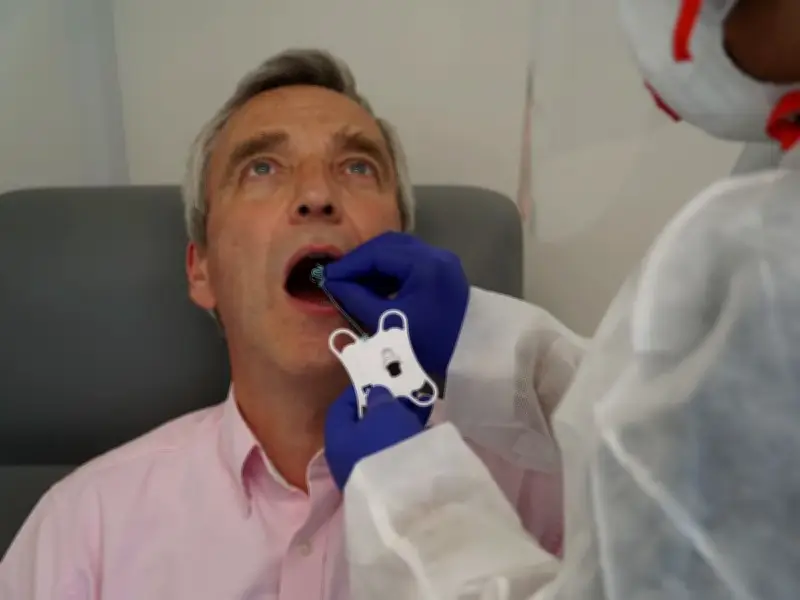
Thousands of patients in England could be offered a new seven-minute test to detect a condition that increases the risk of developing oesophageal cancer, under draft guidance from the National Institute for Health and Care Excellence (Nice).
Two capsule sponge tests, Cytosponge and EndoSign, have been recommended for use on the health service. The technology is designed to identify Barrett's oesophagus, a condition in which stomach acid damages the lining of the food pipe, and abnormal changes to cells can sometimes lead to cancer.
The test involves swallowing a small capsule attached to a string. Once inside the stomach, the capsule dissolves to release a sponge, which is then pulled back up to collect cells from the lining of the oesophagus for laboratory analysis.
How the test works and where it can be carried out
Already trialled in pilot schemes, the tests can be carried out at GP surgeries, pharmacies and community diagnostic centres without the need for sedation. Nice said its committee found patients prefer the sponge on a string test to endoscopy, which involves a thin tube with a camera at the end being passed through the throat.
More than 9,000 people are diagnosed with oesophageal cancer in the UK each year, with the disease often detected at a later stage when it is harder to treat. According to Nice, Barrett's oesophagus impacts around 1% to 2% of adults and is common among those who have long-term acid reflux. Most people do not go on to develop cancer, but the tests also offer a way for them to monitor their condition.
NHS leaders welcome the recommendation
Professor Jonathan Benger, chief executive of Nice, said: "Oesophageal cancer is very difficult to treat when it is diagnosed at a later stage, so identifying people sooner is really important." He added that for people with persistent acid reflux and other risk factors, there is an increased chance of developing Barrett's oesophagus, which can increase their risk of oesophageal cancer.
"Capsule sponge tests offer a quick and less invasive way to detect concerning changes associated with oesophageal cancer or Barrett's oesophagus, helping to identify people who should go on to have further tests and treatment," he said. "This new technology has the potential to make testing easier for patients, while helping the NHS focus valuable endoscopy capacity on those who need it most."
Professor Peter Johnson, national clinical director for cancer at NHS England, said: "The NHS is always looking for better ways to get to the bottom of people's symptoms, and thousands have already benefited from this incredibly efficient test through pilots we have been running, so it's fantastic it is now being considered for rollout across the country."
First recommendation under new healthtech programme
The recommendation is the first to be issued by Nice under the National HealthTech Access Programme, an initiative designed to identify cutting-edge technology and devices and assess whether they should be used routinely on the health service.
Thomas Slater, director of healthtech at Nice, said the recommendation "is an important milestone" and "a real example of what we want it to achieve for patients and the NHS". "Capsule sponge tests show how innovative health technologies can improve people's experience of care and help the NHS use its resources more effectively," he added. "This is just the beginning. We want the programme to support consistent adoption of high-impact technologies across the country, ensuring they deliver benefits for patients and value for taxpayers."