A Newport mum who was told a suspicious mark on her face was an ingrown hair has revealed how it turned out to be skin cancer, leaving her needing surgery and 20 stitches.
Emma Evans first noticed the mark in July last year. At first, she thought it looked like a small spot, but she soon noticed it had become hard, shiny and wasn’t going away. Within weeks, it then became scabby, with a red lump appearing underneath, and continued to scab and grow.
GP prescribed antibiotic cream
Concerned, Emma, a professional dog walker, made an appointment with her GP. She said the doctor believed the mark was an ingrown hair and prescribed antibiotic cream. But Emma said she immediately felt something was not right.
“I said, ‘I’m not convinced. I’m really not convinced,’” she said. “I know it’s not normal and it keeps scabbing. It’s itchy and I feel it’s getting bigger.”
“I didn’t trust his judgement, because I felt it was more sinister than that, but I felt a little bit of a pain in the neck for being ‘overdramatic’. Though now I know I should have pushed even further.”
The cream made no difference. Emma then visited a pharmacist, who she said suggested the mark could be a verruca and advised her to see her GP. But the lesion continued to grow.
Cancer diagnosis and surgery
Emma eventually contacted a dermatology consultant who had treated her previously and managed to secure a cancellation appointment at St Joseph’s Hospital. By the time she was seen in August, the mark had changed considerably. Her consultant suspected it could be squamous cell carcinoma, a type of skin cancer, and arranged for it to be tested.
Emma, who had previously been treated for basal cell carcinomas, said the news was “devastating”. Her father passed away from cancer, and she said the appearance of the lesion reminded her of the skin problems he had experienced before he became very poorly.
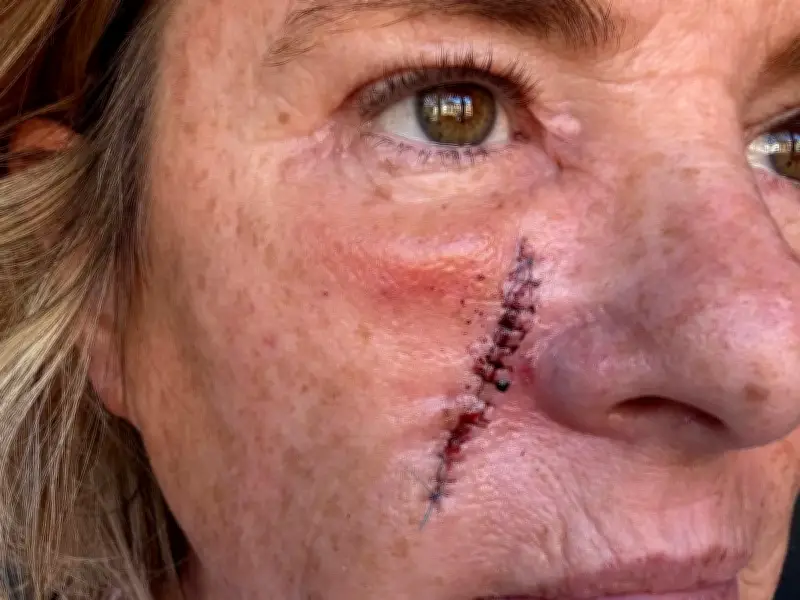
The lesion was removed in September during a procedure under local anaesthetic. Emma was left with a large wound on her face which required 20 stitches. She believes the delay in identifying the lesion meant the surgery she needed was more extensive than it might otherwise have been.
“I’m just glad I had the means to go privately, and I also had the gut instinct to do it,” she said. “It was really hard, especially with it being on my face.”
Follow-up care and recovery
Further blood tests and scans were carried out to check whether the cancer had spread to her lymph nodes. Emma said the results were clear, and she is now thankfully fit and well. She said she later had to pay privately for these additional blood tests and scan after her GP practice declined to take over her follow-up care because she had received treatment at a private hospital.
Emma said she received an apology from the GP practice over what she believes were missed warning signs of her skin cancer. She believes years of sun exposure may have contributed to the damage to her skin. She grew up in a seaside community in Cornwall and spent much of her childhood outdoors.
She said sun protection was not taken as seriously when she was growing up. “I was brought up on a sunny island in Cornwall where we played all day out in the sun,” she said. “I had no idea that childhood sun damage could come back and bite you 40 odd years later.”
Emma now works outdoors and takes extensive precautions to protect her skin. She uses SPF 50, wears a hat and protects areas including her lips and ears, regardless of the weather. “It’s a non-negotiable for me to leave without an SPF, even if it’s pouring down with rain and blowing a gale,” she said. “I don’t lie out sunbathing all day. I always wear a hat.”
Her scar has healed well and she is now considering having regular full-body skin checks so that changes which can be difficult to spot, including on the back or shoulders, can be monitored.
Emma hopes sharing her experience will encourage other people to take changes to their skin seriously and speak up if they are worried. “Never feel you’re insignificant or you’re wasting someone’s time,” she said. “Ultimately, just being double safe could save your life or could save you from surgery.”