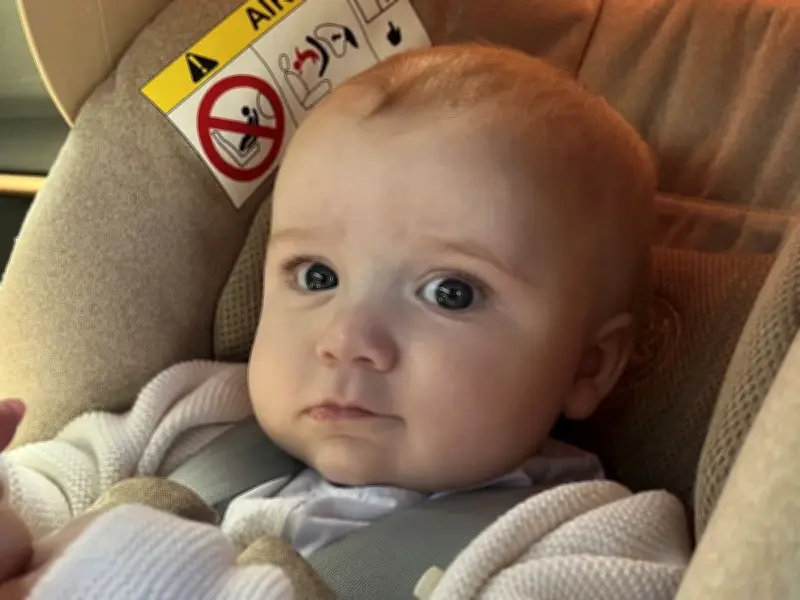
A mother who noticed her baby's eye wasn't focusing properly discovered he had a rare form of eye cancer she had never heard of. Olivia Hannaford, 30, from Liverpool, first thought her son Oliver's eye was "just off" and that he might need glasses, but she rushed him to hospital after spotting an unusual white "glow" in his eye while breastfeeding.
Glow spotted during breastfeeding
Olivia, a former beautician, contacted her health visitor after seeing the glow on July 10, 2025. She initially believed it was due to his young age and his eyes still "adjusting," and that at worst he might need "glasses to correct the slight turn in his eye."
But she decided to take Oliver to hospital after sending pictures of the irregularity to her mum and partner, Thomas Furnival, 29. She said: "He was lying propped up facing upwards towards me in bed. He looked to his right towards the window when I saw the glow in his eye."

"I honestly thought I was going crazy. I tried taking as many pictures and videos as I could, screenshotting them. It was so hard trying to capture it in photos of a baby who had just turned five months old," she added.
Diagnosis and treatment
Olivia called Alder Hey Hospital, where a specialist asked her to send the photos. She received an immediate call back and was asked to bring Oliver in that same day. During a sight test, the ophthalmologist asked Olivia to cover Oliver's right eye, and he followed all the lights and cards perfectly. But when she covered his left eye, he became distressed, shaking his head and trying to move her hand.
Doctors suspected retinoblastoma, a rare eye cancer, and Oliver was transferred to Birmingham Women's and Children's Hospital, where the diagnosis was confirmed. Olivia said: "The doctor came in and asked us to explain what we had been noticing with Oliver's eye. After we had finished explaining, the doctor said, 'I'm so sorry to be the one to tell you this, but your son has suspected retinoblastoma.'"
She added: "Tom and I probably just stared, confused. She followed with, 'he has a cancerous tumour in his eye.' The word cancer - how do you even wrap your head around it, especially for a baby? We were both crying hysterically. Straight away I honestly thought our son was going to die."
Recovery and awareness
A week after the diagnosis, Oliver started four rounds of intra-arterial chemotherapy alongside ongoing laser treatment. More than a year on, Oliver, now one, has completed his final round of chemotherapy. He will undergo one final laser treatment before having an examination under anaesthetic to see how the tumour has responded.
Olivia said Oliver is "thriving" and added: "We can honestly say a year on from his diagnosis, life is as perfect as we'd planned from the second we found out we were pregnant. Oliver really is the funniest baby, he's obsessed with flowers at the minute and smelling them, with the funniest little scrunch face when doing so. He loves shouting for his dad from the second he opens his eyes until he goes to sleep. Oliver really is just a happy little 18-month-old, living his life exactly how he should be. Nothing holds him back."
The Childhood Eye Cancer Trust (CHECT) is urging parents and healthcare professionals to be aware of the most common possible symptoms of eye cancer – a white glow in the eye, which may appear in a flash photo or in certain lighting, and a squint. Richard added: "Oliver's story shows the importance of retinoblastoma awareness among health professionals. We are grateful that Oliver's diagnosis was confirmed and that he was able to receive treatment."
"If you're worried that your child may have retinoblastoma, please take them to a GP or optician as soon as possible. You can also contact the Childhood Eye Cancer Trust support team at support@chect.org.uk – they can provide information to take to your appointment." The Child Cancer Smart campaign advises health professionals to refer to the local on-call paediatrician if a child has had three persistent symptoms, has visited their health professional three times or had unexplained symptoms for three weeks.