
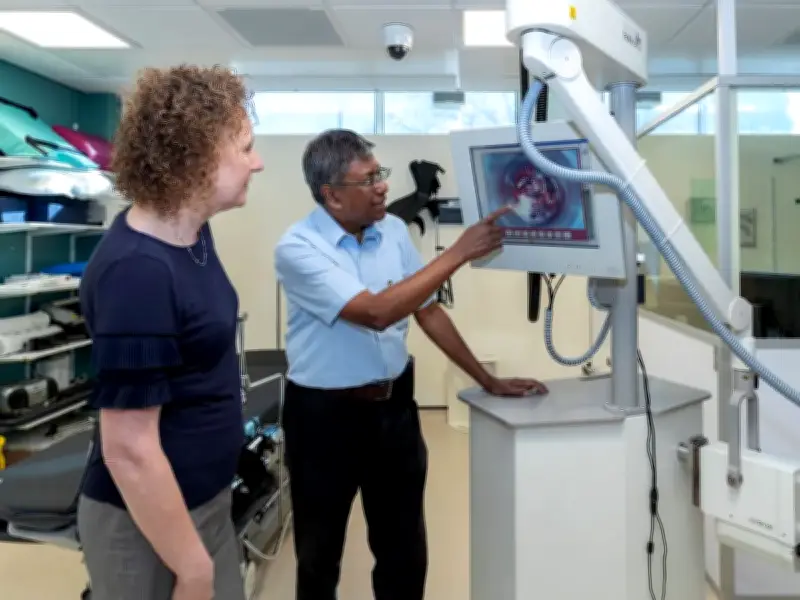
Professor Arthur Sun Myint, 78, has helped save the lives of thousands at the Wirral's Clatterbridge Cancer Centre after being inspired by a patient years earlier. Thanks to his ingenuity, he has managed to change the lives of thousands living with bowel cancer across Merseyside.
While he had been working in oncology at the NHS for years helping to treat those living with cancer, it was one particular patient's reluctance that persuaded him to consider a different way of doing things.
The patient who inspired a new approach
He told the ECHO: "When I started my career, I was interested in treating rectal cancer because I had a patient who had rectal cancer with liver metastases [cancer that has spread to the liver from somewhere else in the body] which could be operated on.
"And the liver surgeon insisted that he should have an abdominoperineal excision [a major operation to remove the rectum] to remove everything to make sure that there's no residual tumour left in the rectum. But that would mean a permanent stoma, and the patient refused that."
Understanding why patients might be reluctant to undergo life-changing surgery to fit a stoma, Professor Myint decided that he wanted to change the status-quo in the industry and provide an alternative treatment. He said: "I was determined to help patients like this patient to try and cure them without the need for major surgery and a stoma being fitted."
Introducing Papillon therapy
After becoming a consultant at Clatterbridge in 1989, he began investigating alternative ways of treating bowel cancer and eventually came across the Papillon therapy which was first developed in the 60s by Professor Jean Papillon, a French radiation oncologist in Lyon, France.
Papillon therapy is a non-surgical type of radiation treatment for people suffering with bowel cancer. A probe is used to deliver a high amount of radiation directly to the tumour and the cancer is removed while importantly managing to preserve the rectum meaning that there is no need for major surgery or a stoma.
Thousands treated and cured
Since Professor Myint introduced Papillon therapy to the Clatterbridge Centre in 1993, over 3,000 patients have been treated using the therapy with an estimated 80% having been cured from bowel cancer at the hospital using the therapy.
Looking back over the impact that his decision to roll-out Papillon therapy has had over the years, he said that he'll always remember the patient that first inspired him. He said: "That is the lasting memory in my mind, and I was determined to help patients like this first patient to try and avoid major surgery and a stoma if we can cure them without needing them. That was my inspiration."
Life beyond the clinic
Away from his time helping to treat patients at the Clatterbridge Centre, he's dad to his daughter, Win and son, Thura and husband to Cecilia. He explained that over the years he has taken refuge away from the stresses and strains of the job by spending time with them and indulging in one of his favourite hobbies.
He said: "I'm an artist, I've done a lot of portraits for Royal College of Radiologists. I've recently just done a portrait of Professor Bill Heald, who's a doyen of surgery for rectal cancer. I went to Lisbon to present his portrait, and he was delighted. So, that's my hobby in the spare time.
When I don't do oil painting, I will do sketches, and then I'll do some watercolors. I've now started using pastels, that's a much quicker way of getting a painting done."




