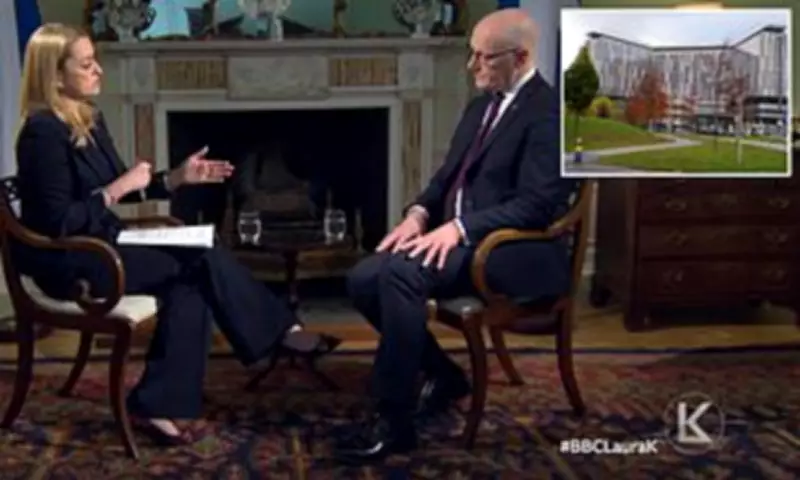
First Minister John Swinney has become entangled in a fresh controversy with the families of victims from the infection scandal at Glasgow's flagship Queen Elizabeth University Hospital (QEUH). The dispute centres on his assertion that he offered a personal apology during a recent video call, a claim that has been directly contradicted by those involved.
Conflicting Accounts Emerge After High-Profile Interview
During a prominent BBC television interview broadcast on Sunday, John Swinney told presenter Laura Kuenssberg that he had apologised to families during discussions about the QEUH on Thursday. In the same interview, he denied that the Scottish Government had failed to act on what he described as 'red flags' regarding the hospital's issues.
However, several family members who participated in the video call have since insisted that neither Swinney nor Health Secretary Neil Gray offered any form of apology during the conversation. This has created a significant rift between the government and those affected by the hospital scandal.

Swinney's Statements Under Scrutiny
In his interview with Laura Kuenssberg, Swinney stated: 'I expressed my regret for the experiences of families, and in some cases for the loss of children who had been cared for in the Queen Elizabeth University Hospital.' He added: 'I said to the families that fundamentally I believe the hospital is a safe hospital, on the basis of all of the data that I have available to me.'
When pressed specifically on whether he had apologised to families who lost loved ones, Swinney responded unequivocally: 'Of course I did, yes.' He defended the Scottish Government's response to concerns about the hospital, pointing to the establishment of a public inquiry as evidence of their serious approach.
Families Issue Strong Rebuttal
Following Swinney's television appearance, the families of both deceased and surviving patients issued a collective statement challenging his version of events. They declared: 'While the families welcomed the opportunity to speak directly with the government's leadership, the absence of an apology has been noted as a significant oversight in the pursuit of meaningful reconciliation and justice.'
The statement continued with a direct contradiction: 'This morning the First Minister said to Laura Kuenssberg that he offered the families an apology during this meeting. We can confirm that this simply never happened.' The families emphasised their ongoing commitment to seeking full accountability and ensuring systemic improvements within the healthcare service.
Political Reactions and Further Developments
Scottish Labour deputy leader Jackie Baillie offered a sharp critique of Swinney's position, stating: 'Once again John Swinney refused to take responsibility for his government's shameful record on the QEUH. The SNP ignored warning after warning and backed up the Health Board as they lied to families and bullied whistleblowers.'
Baillie characterised the situation as 'the worst scandal in the history of devolution' and called for transparency regarding whether the hospital was opened before it was safe and whether it remains safe now.
Swinney's Clarification Attempt
In response to the families' statements, Swinney attempted to clarify his position, saying: 'I expressed my sincere sorrow and regret during the long, and at times emotional, call with families. It was primarily an opportunity for them to tell me their experiences and for me to listen but I also tried to communicate to them how sorry I was about their experiences.'
He acknowledged a communication failure, stating: 'I have obviously not communicated that effectively so I want to be crystal clear today: I am deeply sorry for the issues they have experienced at the QEUH and all that families have gone through.' Swinney described the families' pain, trauma and suffering as 'unimaginable' and framed Thursday's conversation as the beginning of a wider discussion to help families obtain the answers they deserve.

The controversy continues to unfold against the backdrop of an ongoing public inquiry into the hospital's original construction and development, as well as the issues that have emerged subsequently. The discrepancy between the First Minister's account and that of the affected families has created significant tension in what remains one of Scotland's most serious healthcare controversies.