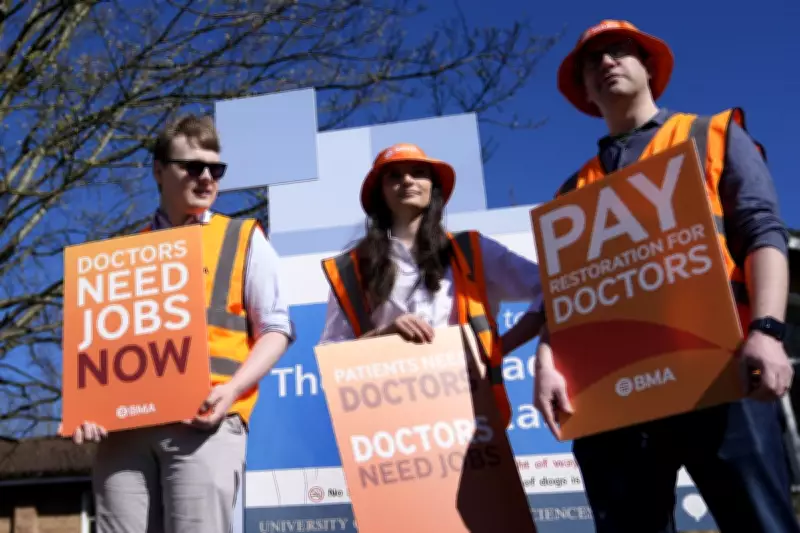
Resident doctors in England will go on strike for four days in June, the British Medical Association (BMA) has confirmed. The walkout is scheduled to begin at 7am on Monday, June 15, and conclude at 6.59am on Friday, June 19. The announcement follows the union's initial discussions with newly appointed Health Secretary James Murray on Wednesday.
The BMA has warned that further strikes could be announced for July if no progress is made in negotiations. Health leaders have expressed concern that the industrial action could lead to thousands of appointments and operations being cancelled or rescheduled.
Mr Murray, who replaced Wes Streeting earlier this month, said he had hoped to establish a productive relationship with the BMA, but described the union's demands for additional pay increases as unrealistic, unaffordable, and unsustainable. He stated: "I was clear with the BMA that after a 33.4% pay rise for resident doctors over the last four years – the highest anywhere across the public sector – the BMA's demands for further substantial pay increases this year are unrealistic, unaffordable, and unsustainable."

Dr Jack Fletcher, chairman of the BMA's resident doctors committee, said the union had hoped a change in leadership at the Department of Health and Social Care would lead to a different approach. "Sadly, we have run up against the same unwillingness to move we encountered under Mr Streeting," he said. "We were prepared to give Mr Murray time to settle into his role before completing the work his predecessor left unfinished – to both make a fair and meaningful pay offer and make concrete commitments to end the jobs bottleneck throttling the careers of our colleagues."
Dr Fletcher described the BMA's demands as straightforward, calling for a credible offer comprising concrete new jobs and real progress towards pay restoration. He added that the union is ready and willing to negotiate but felt it had no choice but to call further strikes.
The last round of action by resident doctors, which lasted for six days over the Easter holiday, marked the 15th strike since 2023. The cumulative cost of the walkouts is estimated to have surpassed £3 billion.
Matthew Hopkins, interim acute and ambulance network director at The NHS Alliance, condemned the decision as "rash and wholly irresponsible," warning that it would leave patients paying the price. He said the latest strike, the 16th stoppage in three years, risks undermining progress made in reducing waiting lists and improving productivity.
Mr Streeting had previously struck a deal to end strikes by resident doctors in 2024, but industrial action resumed in 2025. Before the April strike, he had offered a 4.9% increase in average basic pay from 2026 to 2027, which he claimed would leave resident doctors 35.2% better off than four years ago. His proposal also included 1,000 extra training places, but that offer was withdrawn due to increasing strike costs.
Resident doctor members of the BMA have a mandate for industrial action until August. The union is also balloting consultants and specialist, associate specialist and specialty (SAS) doctors, with voting set to close on July 6.