Measles Outbreak Spreads Across 50 UK Council Areas, Low Vaccination Rates Blamed
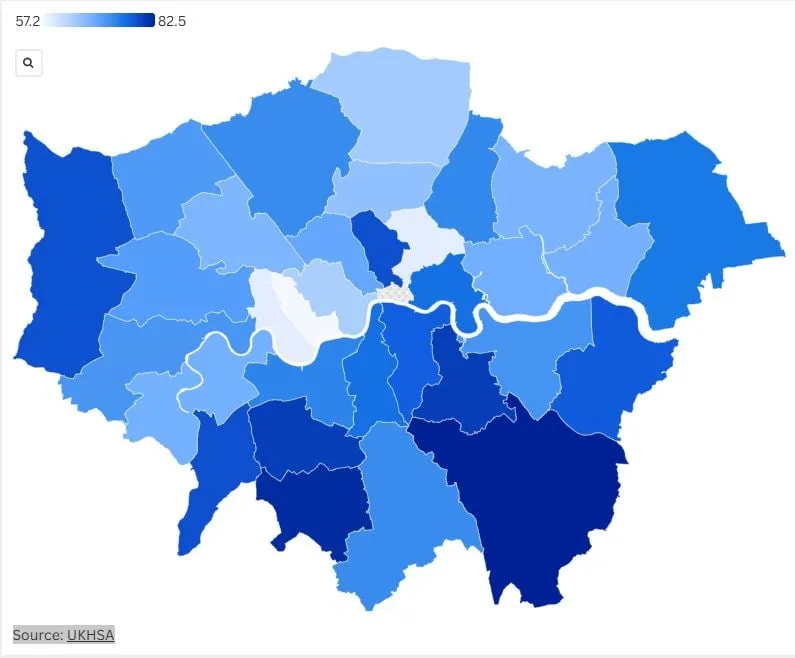
The UK Health Security Agency has confirmed that measles infections have now been identified through laboratory testing in every single region of England. This Victorian-era disease, which had been previously eliminated in the United Kingdom, has made a concerning resurgence across fifty separate council areas. A newly published map highlights the specific low vaccine-rate locations where the illness is spreading most rapidly.
Epicentre in Enfield with Alarming Vaccination Statistics
Enfield in London has emerged as the epicentre of the current measles outbreak, recording eighty confirmed cases so far this year. This total includes thirty-five new infections since the last update in February. Enfield also possesses one of the nation's lowest vaccination rates, with approximately one in three children lacking protection from the MMR vaccine. The latest data reveals that only 64.3% of children in Enfield had received both necessary MMR jabs for full protection by their fifth birthday.
The target vaccine coverage rate established by health authorities is 95%. Although the UKHSA has verified that fifty distinct council areas have reported at least one confirmed infection, the agency only publishes detailed case numbers for areas with a minimum of ten cases. So far, three council areas have met this threshold, all characterised by worryingly low vaccine coverage rates.
Additional Hotspots in Birmingham and Haringey
Apart from Enfield, Birmingham has reported forty-three measles cases so far, including nineteen since February. In the London borough of Haringey, which neighbours Enfield, fifteen cases have been confirmed. In Birmingham, 75.5% of five-year-olds have received both MMR jabs, while in Haringey, just 65.0% of under-fives are fully protected against the disease.
This outbreak follows the World Health Organization's decision to strip the United Kingdom of its measles elimination status in January. This action was taken due to the sustained circulation of the disease for more than a year. The UK was first declared measles-free in 2017 but lost that status two years later, only to regain it temporarily in 2021, largely thanks to social distancing measures during the pandemic.
Historical Context and Recent Case Trends
Measles outbreaks began re-emerging in 2023 and intensified throughout 2024. In England alone, there were 2,911 laboratory-confirmed cases of measles in 2024, marking the highest number since 2012. Based on this data, both the WHO and the UK Health Security Agency concluded that the virus had re-established endemic transmission within the country, resulting in the loss of its elimination status.
The most recent figures indicate that measles cases have declined since the 2024 peak, but they remain at elevated levels. Last year, there were 957 laboratory-confirmed cases of measles. As of March 9 this year, there have already been 235 reported cases. The majority of these infections have occurred in unvaccinated children under the age of ten.
Public Health Warnings and Symptom Awareness
Dr Yimmy Chow, UK Health Security Agency’s London Region Deputy Director, issued a stark warning: "We continue to see measles cases in north London, and while children remain unvaccinated, the risk of further spread is very real. Measles is a serious disease that can cause pneumonia, meningitis, blindness, seizures and, tragically, death."
Key symptoms of measles include a high fever, coughing, sneezing, red and sore watery eyes, and a distinctive rash that usually appears after the initial symptoms. Measles has probably existed since the 6th century and was first identified in the UK during the 17th century. It became closely associated with the Victorian era when rapid urbanisation and overcrowded cities created a fertile breeding ground for the illness.
In the 21st century, measles typically starts to improve after about a week. However, it can lead to serious complications if it spreads to other parts of the body, such as the lungs or brain. Babies and individuals with weakened immune systems face a higher risk from measles infections.
Vaccination Rates and Herd Immunity Concerns
The UKHSA has attributed the resurgence of measles directly to falling vaccination rates, after uptake of the MMR jab slumped to its lowest level in a decade. As of last summer, 91.8% of five-year-olds in England had received one dose of the MMR jab, and 83.7% were protected by both doses. In many areas, including Enfield, Birmingham, and Haringey, vaccine uptake is significantly lower.
The World Health Organization states that a vaccine coverage rate of 95% is necessary to achieve "herd immunity," which prevents highly transmissible diseases like measles from circulating within communities. From this year, the MMR jab has been replaced by the MMRV vaccine, which offers the same protection as MMR but also provides coverage against chickenpox.
Health authorities are urging parents to ensure their children are fully vaccinated. Dr Chow emphasised: "Two doses of the MMR vaccine provide vital protection. If your child has missed any vaccinations, or you are unsure whether they are up to date, please contact your GP surgery as soon as possible — it is never too late to catch up."