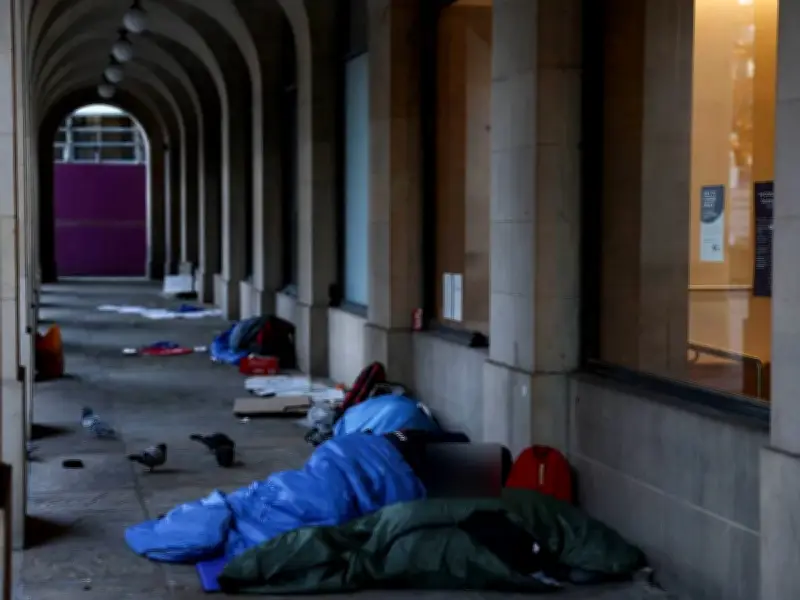
Rough sleeping across Greater Manchester has reached one of its highest levels in six years, according to new government data released as former mayor Andy Burnham pledged to make homelessness a national priority.
The figures show there were 444 rough sleepers across the ten boroughs in June 2026, up from 402 in June 2025 – a rise of 42 people, or 10.4 per cent. It is the highest figure for June and the fourth highest monthly total since October 2020.
Burnham's national drive
The data lands as Mr Burnham – who made ending rough sleeping his first pledge on entering Downing Street in July – pushes ahead with a national drive to get every rough sleeper off the streets by Christmas, backed by a £442 million funding package.

The biggest driver of the rise in Greater Manchester was Manchester city itself, where the number of rough sleepers in June jumped from 149 last summer to 195 – an increase of 46 people. Tameside saw the second sharpest rise, climbing from 21 to 33, while Trafford rose from 6 to 10 and Bury edged up from 29 to 31. Not all boroughs saw increases: Salford, Oldham, Rochdale and Bolton recorded slightly lower numbers.
Funding and pressure
The overall rise adds pressure on Mr Burnham's promise to deliver a "route off the streets" to every rough sleeper in England by Christmas. Emergency accommodation and wraparound support will be rolled out across England this winter, with areas of greatest need receiving the largest share of the £442 million pot. Greater Manchester is set to receive just under £17 million as part of a £37 million package for the North West.
Mr Burnham has acknowledged that Government funding "may not fully be enough" and issued a "rallying call" to charities, faith organisations and community groups to get behind his "moral mission". He said: "We did it in the pandemic. We can do it again. But it needs all of us."
Record under scrutiny
Mr Burnham's record on rough sleeping in Greater Manchester has come under scrutiny since he moved into Downing Street. When he was elected mayor in 2017 there were 268 rough sleepers across the city region. That figure fell to a low of 90 in 2021 following the success of pandemic-era emergency housing schemes, but the latest official snapshot shows numbers have risen again.
Mr Burnham attributed the rise in part to national policy failures – including cuts to local housing allowance and Home Office decisions – as well as Greater Manchester's reputation for offering more generous support than other areas, which he says attracted rough sleepers from further afield. He said: "I became a bit frustrated if I'm honest. I knew I couldn't achieve the mission without everywhere doing the same thing."
Asked whether he was confident of meeting his Christmas target, he told the Manchester Evening News: "I may not succeed. Let me just put my hands up and say that. I'd rather try, because that's who I am." He added that the national effort was intended to be permanent rather than a seasonal fix: "It's not just, we have a drive for Christmas and then it goes away."
Reactions and national trend
Housing Secretary Angela Rayner backed Mr Burnham's approach, while acknowledging the difficulty of tackling rough sleeping in isolation. "The lesson from Greater Manchester is it's really difficult to do in isolation," she said. "We saw the figures go down, but obviously then we drew in people from other areas into Greater Manchester who knew that there was an offer there."
Homelessness charity St Mungo's described the Prime Minister's announcement as "a pivotal moment" for thousands of people sleeping rough. Chief executive Emma Haddad said: "A roof over somebody's head provides immediate safety, but lasting recovery requires intensive, person-centred, joined-up support."
Nationally, the number of rough sleepers has been on an upward trend since October 2020 and reached a peak of over 9,500 in July 2025. In June this year there were 8,748 rough sleepers in England.
Deputy council leader councillor Tracey Rawlins said: "We are clear that even one person sleeping rough is one too many. However, the number of people sleeping rough – while varying slightly from month to month – is actually quite stable in Manchester at a time when it is increasing dramatically in other parts of the country.

"Last August there were 166 different people recorded sleeping rough at some point during the month. This August it was 171. This does not mean that there are that many people sleeping rough on any given night. Our most recently nightly headcount recorded under 50 people doing so. But there are people who as part of a transient lifestyle drift in and out of rough sleeping and at other times might stay with friends, or even have their own accommodation.
"They each have their own individual stories and support needs and there's a huge amount work going on both to help prevent people from becoming homeless and to help anyone who ends up on the streets to get off them and ultimately into settled accommodation. We are also tackling structural issues, for example by overseeing record building of affordable housing in recent years, and through cost-of-living support."