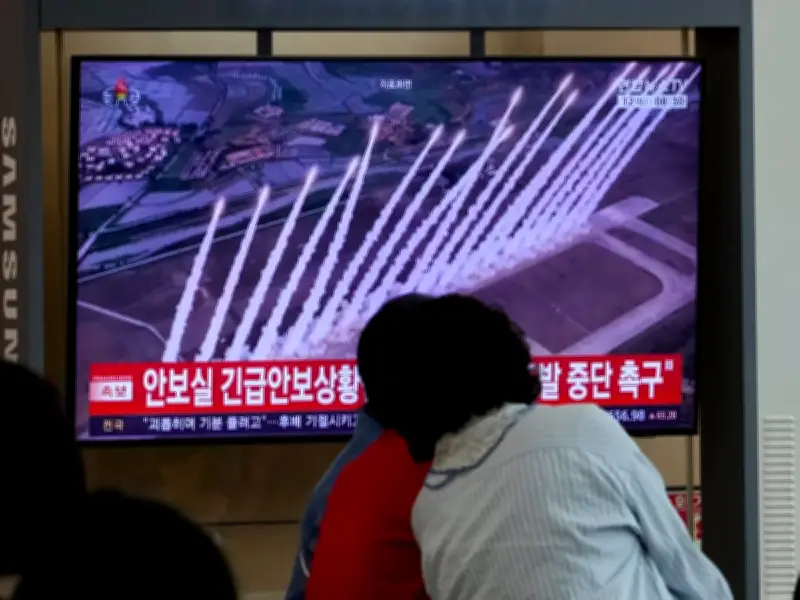
North Korea has carried out a joint live-fire exercise involving missiles, artillery and drones which it insisted showed "huge destructive power." The test included launching various types of weapons at the same time, probably designed to develop the capability to overwhelm South Korean and American air defences.
Continued testing despite US overtures
Analysts say North Korea isn't reducing its testing programme despite U.S. President Donald Trump recently scaling back a military drill with South Korea in an apparent bid to restart diplomacy with leader Kim Jong Un.
The North's official Korean Central News Agency said Saturday's exercise was intended to practise the operations of an integrated weapons control system. South Korea's military previously said it detected short-range ballistic missile launches from North Korea's eastern coastal Wonsan region on Saturday morning.

Official statements on the drill
Following his observation of the firing drill, North Korean Marshal Pak Jong Chon said the exercise would "improve the level of specialisation to bring down the enemy's armed forces organisationally and structurally once an order is issued."
He added that the weapons systems deployed demonstrated "the huge destructive power of concentrated fire," according to KCNA. It's exceptionally challenging to independently confirm North Korean assertions regarding its weapons trials.
Missile ranges and regional context
South Korea's Joint Chiefs of Staff reported that multiple missiles launched on Saturday each travelled approximately 250 kilometres (155 miles) towards North Korea's eastern waters. The flight ranges indicate that the weaponry is intended to target locations within South Korea, including US military installations.
The firing exercise, which marked North Korea's first public ballistic missile launches in roughly three weeks, occurred one day after the United States, South Korea and Japan concluded a trilateral military drill that North Korea regards as a provocation.
In August, Trump instructed the Pentagon to "substantially reduce" a major bilateral military exercise with South Korea, referencing what he described as a positive relationship with Kim. However, North Korea rejected Trump's gesture, stating that shortening the drill didn't alter its "provocative, aggressive nature." The Ulchi Freedom Shield exercise ultimately concluded six days ahead of its original timetable.
Kim's bargaining position
Emboldened by his advancing nuclear stockpile and strengthened relationships with Russia and China, experts believe Kim likely considers he possesses greater bargaining power in potential diplomacy with the US than when he initially encountered Trump in 2018-2019.
Kim stated earlier this year that he might resume negotiations if the US abandons its "hostile policy" towards his nation and acknowledges what he terms the North's standing as a nuclear power.