
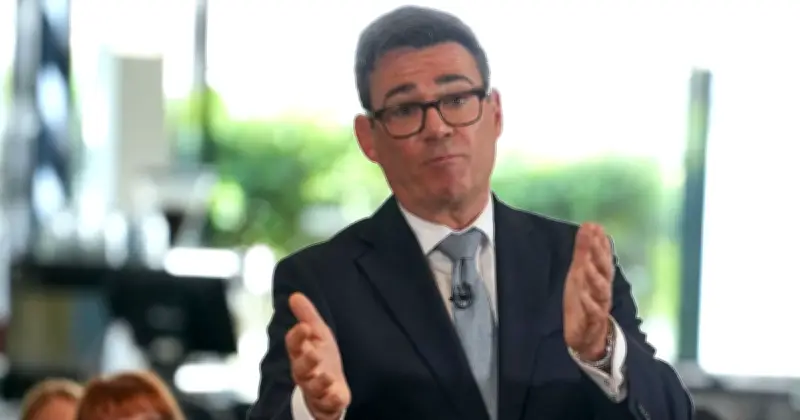
Andy Burnham has pledged to introduce "quite radical" changes to social care if he becomes Prime Minister, drawing a comparison between the UK's system and American healthcare, where "the most vulnerable pay with everything."
Speaking on the How to Fail with Elizabeth Day podcast, Mr Burnham expressed confidence that improvements are possible, saying, "So I don't get overwhelmed by it, is the point I'm coming to, because it can't be worse than that, can it? Surely we can make it better than that."
Radical Proposals and Public Acceptance
Mr Burnham acknowledged that some of his proposals might be radical, but he believes the British public will be receptive once they see the details. He stated, "If we can get beyond that, and we can just put the proposals in front of people, some of them might be quite radical. I think the British public will let us know which one they can accept and they're actually often quite radical in what they want."
The Prime Minister has been warned that he will be judged on whether he delivers on his "grand social care promises." Campaigners have insisted that the crisis "needs solving now" following his recent pledge to reform the system.
Silver Voices Raises Concerns
However, the Silver Voices campaign group has raised concerns about the details of Mr Burnham's plans to establish a National Care Service. Director Dennis Reed, writing in the Daily Express, criticized the lack of specifics, stating: "Burnham failed to commit to a free social care service based on the same principles as the NHS, so that support for dementia is the same as that for cancer, he did not define what he meant by a National Care Service, and he failed to give assurances that no older person under his system would have to sell the family home to pay for care. He gave no indications about how it all would be paid for."
Mr Reed added: "The social care crisis needs solving now. 30,000 older people in England died last year waiting for the social care which could have extended their lives, everyone a loved grandparent or relative. Andy Burnham will be judged on whether he delivers on his grand social care promises."
Political Direction Questioned
Mr Reed claimed that the Prime Minister's approach lacks "political direction" because the review into social care is being led by Baroness Louise Casey, a civil servant, rather than a politician. He also criticized the failure to invite all parties in Parliament to cross-party talks, with only the Tories and the Lib Dems asked to participate.
In a major speech last week, Mr Burnham outlined plans to create a National Care Service, calling it a "major dereliction of public duty" that successive governments had failed to address. He admitted that tax hikes could be necessary to fund the changes, warning of "difficult, difficult decisions." He also announced that Baroness Casey's review would report next year.
Mr Burnham, whose father has Alzheimer's, promised to reform social care to help "my dad and the millions like him." He said: "This is huge for me. I know this will require me to put what political capital I have on the table and it could wear down that political capital in some ways. But I'm prepared to do it. I'm prepared to do it because this has gone on too long. The risks of failing to act are too great."
Public Opinion Divided
Recent YouGov polling showed that the public is divided by age on how to pay for reforms. Some 61% of pensioners supported increasing income tax to fund the overhaul, but this dropped to 40% among 18-24-year-olds. Meanwhile, almost half of 18-24-year-olds supported raising inheritance tax to pay for long-term care, but this fell to 39% among over 65s.
Separate polling by More in Common found that 70% of the public want social care to be funded by tax, compared to 21% who said it should be paid for by individuals. Mr Burnham previously proposed a so-called "death tax" to pay for social care reform as health secretary in 2009. The Department of Health and Social Care has been contacted for comment.




