
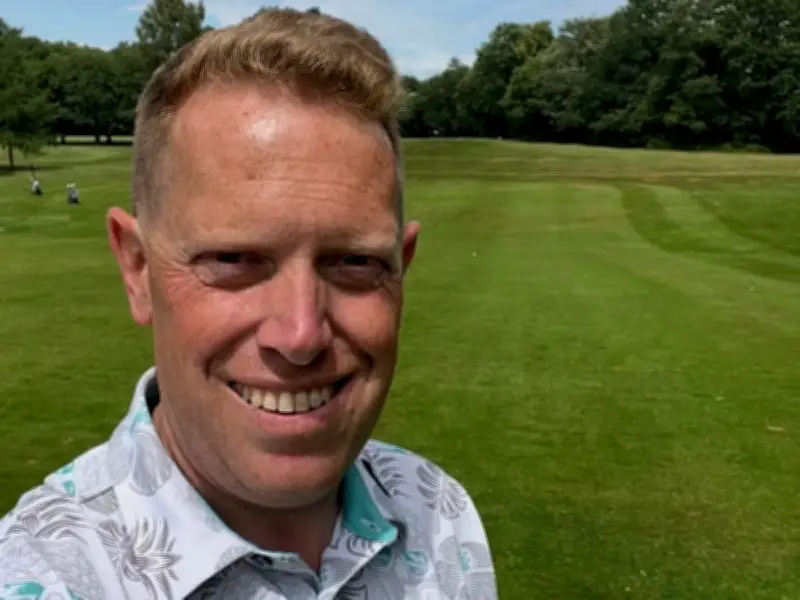
A primary school teacher from Bebington who suffered a stroke at the age of 47 walked out of hospital the following day thanks to new technology. Martyn Olver was sitting at home watching his son play a video game when, "like the flick of a switch," he began to experience stroke symptoms.
The dad felt a sudden, intense pain in his head, quickly followed by his right eye becoming unbearably sore, urging him to reach for some painkillers. By the time numbness started spreading through his arm and leg, he had recognised something could be seriously wrong and asked his dad to call 999. The paramedics arrived within 10 minutes, and by that time Martyn could "barely" stand.
New triage system saves precious time
What Martyn, from Bebington, didn't know was that from the moment the 999 call was made, a new remote triage system was already working to save precious time. Wirral University Teaching Hospital (WUTH) has joined a Cheshire and Merseyside-wide trial with North West Ambulance Service (NWAS) and is currently running a pre-hospital triage service for suspected stroke patients, a significant development in stroke care that has been providing 24-hour support since January 2026.
Pre-hospital triage allows remote consultations between ambulance crew, ambulance control rooms and stroke specialists at the hospital. Stroke specialists can understand the symptoms, preview the patient's medical history, and if appropriate pre-book scans while the patient is still in transit. This ensures the patient can be taken straight to the scanning department on arrival at hospital, so they can receive faster access to emergency treatment.
Rapid treatment at Arrowe Park
The result has dramatically shortened the critical window between a patient arriving at hospital, being scanned and receiving the blood clot-busting treatment that can prevent permanent brain damage. When Martyn arrived at Wirral's Arrowe Park Hospital he was met by the stroke team, taken straight to the CT scanner and immediately given a clot-dissolving injection.
Martyn said: "From my dad's phone call to me being sat on the stroke ward receiving treatment, it took less than two and a half hours. I could not fault the care I received. Every single person was top drawer, from the ambulance crew to the staff in A&E, CT department and on the ward where a nurse called Chris sat with me through the night. Chris was fantastic, checking my stats every 15 minutes and putting me at my ease at a very frightening time. I honestly can't thank everyone enough."
Within moments of receiving the injection, Martyn began to regain movement in his arm. The following day, he was walking unaided and was discharged from hospital. Just three months later he was back in the classroom teaching full time.
Future enhancements and FAST reminder
The trust is also looking to enhance its stroke service further by introducing full digital communication, enabling specialists to assess patients in real time through video devices carried by ambulance crews while they are still on the way to hospital. This technology could allow even faster and more accurate assessments to be made before arrival at hospital. It is now receiving a growing number of pre-hospital triage calls.
Rapid intervention is key to successful treatment, and people are encouraged to remember the FAST acronym and call 999 immediately if symptoms appear. Stroke Consultant Dr Ruth Davies said: "There is a phrase 'time is brain' which perfectly explains the need to get treatment started fast. During a stroke, nearly two million brain cells are lost for every minute that passes without treatment, so every second counts. A stroke is a medical emergency. We urge the public to spot the warning symptoms of a stroke and call 999 immediately. Quick medical treatment could mean the difference between life and death and can prevent severe long-term disability."
FAST stands for 'Face, Arms, Speech, Time', helping people recognise the most common signs of a stroke and reminding them that time is critical when seeking help. Martyn added: "When my pain started, I could have easily left it, thinking I've got a really bad headache, and I'll wait for the painkillers to kick in. If I had, I might be in a very different situation now. So even if you're slightly unsure about your symptoms, get in touch with somebody to ask for help."
Janelle Holmes, Chief Executive of Wirral University Teaching Hospital, said: "With around 700 stroke patients treated at WUTH each year, innovation such as this is having a significant impact on patient outcomes. I am incredibly proud of our staff and the way they continue to work alongside our partners at North West Ambulance Service to deliver faster access to specialist care and the best possible outcomes for patients." John Collins, Consultant Paramedic for NWAS Cheshire and Merseyside added, "Stroke really is one of those time critical emergencies, and anything we can do to shorten the time from 999 call to that clot-busting injection being given is crucial to recovery. We've been using pre-hospital video triage for Stroke patients at Whiston Hospital for a number of years and seen some fantastic results. Now, more patients will benefit from the innovation across Wirral."




