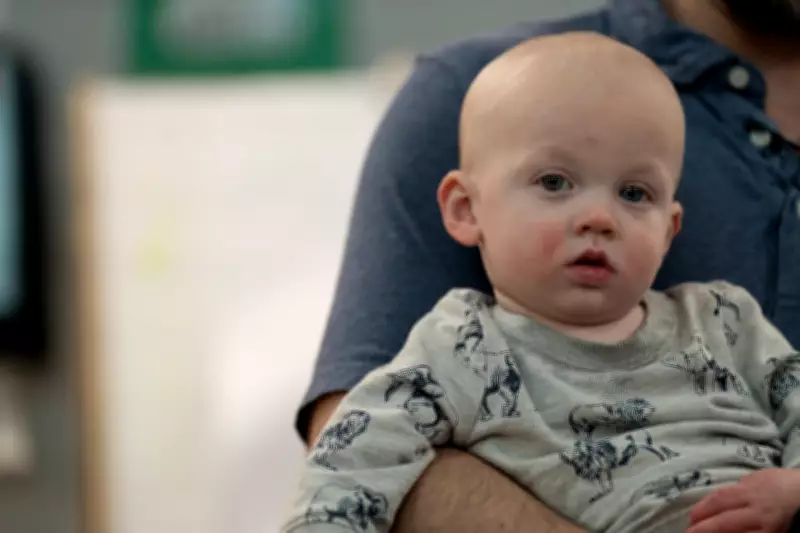
Infants Under MMR Age Face Grave Risk in Record Measles Outbreaks
Babies who are too young to receive the measles, mumps, and rubella (MMR) vaccine have become alarmingly vulnerable during major measles outbreaks, such as the extensive surge currently gripping South Carolina. This outbreak represents the largest the United States has witnessed in over thirty-five years, surpassing previous incidents in Texas and other states.
Families Confront Measles Threat in Daily Life
The Otwell family experienced this threat directly. With their baby Arthur not yet eligible for the standard MMR vaccination and another child due in June, routine activities like grocery shopping at a local Costco—identified by health officials as a site of potential exposure—became sources of anxiety. "A lot of people just don't get it; they think it's just a cold. It's not," stated John Otwell, highlighting widespread public misunderstanding about the severity of measles.
By Arthur's nine-month checkup, the South Carolina outbreak had intensified dramatically, leading state authorities to permit early MMR vaccination at nine months instead of the typical twelve to fifteen months. However, their newborn will remain unprotected until at least six months of age, a scenario that terrifies parents of infants in any region where measles is circulating.

Why Unvaccinated Babies Are So Vulnerable
Measles can devastate the fragile systems of unvaccinated infants, causing severe symptoms such as refusal to eat or drink, pneumonia, dangerous brain swelling, and in tragic cases, death. These youngest children rely entirely on herd immunity for protection, which requires at least ninety-five percent of a community to be vaccinated to prevent outbreaks effectively.
Unfortunately, declining vaccination rates have significantly weakened this communal shield across South Carolina and the nation. In Spartanburg County, the epicenter of the outbreak, fewer than ninety percent of students have received all mandatory vaccines. "Babies become sitting ducks," explained Dr. Deborah Greenhouse, a pediatrician based in Columbia. "The burden is on all of us to protect all of us."
Political Shifts Endanger Public Health Safeguards
Increasingly, certain policymakers and officials are framing vaccination as a matter of individual freedom and parental rights rather than a critical public health imperative designed to safeguard entire populations. At the federal level, Health Secretary Robert F. Kennedy Jr., a long-time opponent of vaccines, has pursued substantial reforms to vaccine policy alongside significant cuts to public health funding.
Although a temporary federal court ruling has slowed his initiatives, numerous bills have been introduced in various state legislatures, including South Carolina, which threaten to further reduce vaccination rates. South Carolina's measles outbreak, involving approximately one thousand cases, has shown some signs of slowing, but measles continues to spread across multiple states.
The United States has recorded seventeen outbreaks this year and forty-eight last year, placing the nation on the brink of losing its hard-earned status as a country that has eliminated measles.
Doctors Scramble to Protect the Youngest Patients
Pediatricians like Dr. Jessica Early, who never anticipated confronting measles in her career, now fear for their patients and their own children. In response, she and other medical professionals have begun administering the approved infant MMR dose as early as six months old and are offering the second MMR dose ahead of the standard schedule for older children.
Frustratingly, the exact number of South Carolina infants who have contracted measles or required hospitalization remains unknown. State officials have disclosed that two hundred and fifty-three of the nine hundred and ninety-seven cases involved children aged four and younger but have declined to provide more detailed breakdowns citing confidentiality.
Similarly, hospitals are not mandated to report measles-related admissions, leaving a significant gap in data. Across the state, doctors fielded numerous anxious inquiries from parents questioning whether it was safe to bring infants to medical waiting rooms or daycare facilities.

Daycare Centers Grapple with Outbreak Fallout
Thomas Compton, regional director of Miss Tammy's Little Learning Center, a childcare network operating within the outbreak region, reported that eighteen parents withdrew their children from his facilities despite no confirmed cases. Some families forfeited deposits just days before enrollment, forcing the company to lay off a teacher.
Although licensed daycares in South Carolina must require vaccinations under state law, families can easily obtain religious exemptions. Approximately one-fifth of the three hundred children at Miss Tammy's facilities have such waivers. During the measles surge, Compton noted that state officials provided minimal guidance, leaving staff to intensively clean surfaces, monitor local cases via social media, and seek information online.
"A lot of parents were really stressed out," Compton recalled. "Anytime that we had a little sickness going on or something, they were like, 'Do you think it's the measles?'"
State Legislation Threatens to Undermine Infant Vaccination
Last year, an Associated Press investigation revealed that Trump administration officials had directed activists to promote anti-science legislation in statehouses nationwide. As of late October, around three hundred and fifty anti-vaccine bills had been introduced across the country, including at least eight in South Carolina.
This year, a state bill proposes prohibiting required vaccines for children under two years old. "In other words, it would get rid of those requirements in the daycares," pediatrician Greenhouse stated. "And for people like me, that is a gut punch that is terrifying."
During a subcommittee discussion, Republican State Senator Carlisle Kennedy argued that his bill aims to protect parental rights, sharing that his own child, born with non-functioning kidneys, received vaccines on a personalized schedule coordinated with doctors. Opponents emphasized that herd immunity is precisely what protects vulnerable children in such situations. The Senate subcommittee advanced the legislation, and Greenhouse fears it may gain further momentum.
"In the climate that we are currently living in, I think any bill potentially could have legs," she warned. "It is our job to do our absolute best to make sure that those legs don't go anywhere."
Vaccine Skepticism Grows Amid Legislative Confusion
Regardless of whether the bill becomes law, doctors assert that such legislation fuels vaccine skepticism and public confusion. While the American Academy of Pediatrics continues to recommend the standard vaccination schedule, some parents express uncertainty, mistakenly believing that government guidelines now call for fewer vaccines.
"They don't actually know who they can trust," Greenhouse observed. Dr. Martha Edwards, president of the South Carolina chapter of the American Academy of Pediatrics, noted that the state, like others, has simplified the process for obtaining nonmedical vaccine exemptions. In the outbreak's epicenter, religious exemptions have more than doubled since 2020, with four percent of school-age students statewide holding such exemptions for the 2025-26 academic year.
"Parental choice is a big buzzword in a lot of the Southern states," Edwards remarked. However, she stressed that the choice not to vaccinate directly impacts other parents' rights to keep their children safe from preventable diseases.
National Protection Fades as Measles Spreads Widely
Medical experts anticipate the situation will deteriorate further. During the first three months of 2026, the United States recorded one thousand six hundred and seventy-one measles cases, constituting seventy-three percent of the total from 2025, which was already the worst year for the virus in over three decades. In November, international health officials will determine whether measles should still be considered eliminated in the U.S.
National MMR vaccination rates have declined to ninety-two point five percent among kindergarteners for the 2024-25 school year, down from ninety-five point two percent in 2019-20. These figures mask much lower rates in specific communities; at one Spartanburg County school, only twenty-one percent of children had received all required vaccines.
Doctors fear it is merely a matter of time before various vaccine-preventable diseases begin threatening lives on a scale not seen for a century. "The whole concept of immunization is one of the best things that has ever happened to medicine," Greenhouse reflected. "To see that we are actually going backwards is just confounding."
Helen Kaiser, a resident in the outbreak area, chose to vaccinate her twin two-year-old boys early to protect both her family and the broader community. "I would never forgive myself," she expressed, "if I knew that my son had gotten another baby very sick and it was something I could have prevented."