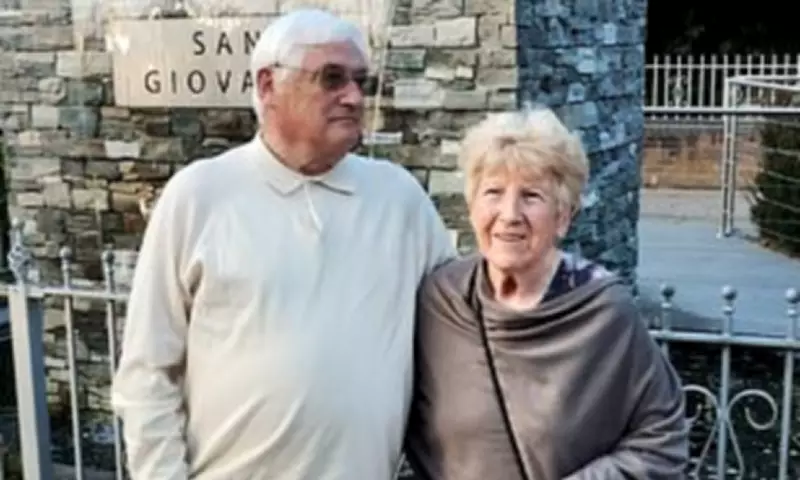
When John Teeling lost his job as a designer in his early 60s and became short-tempered around his loved ones, his wife Mary put it down to depression. Her husband was suffering mood swings after nearly nine months out of work, which were exacerbated by the death of his father.
Mary encouraged her husband to seek medical help, which eventually saw him referred to a psychologist. But by the time his appointment arrived, the health professional determined John had 'worked through it'. 'She said we didn't need to worry,' John, now 78, from Coventry, recalls. But far from overcoming his illness, John's symptoms were just the beginning.
Despite having a 'peg to hang [his symptoms] on', Mary noticed her husband's memory beginning to falter over the next months. 'It was never great,' she jokes. 'But I just noticed there was a slight decline.'

Mary, now 81, and John had married in their early 20s after meeting through Mary's sister. She recalls being apprehensive about dating him at first because of their three-year age gap. 'I felt a lot older than him at the time,' she says. John also notes the awkwardness of being friends with her sister. Nonetheless, 'love found a way,' says John. The pair went on to marry and have two children - Simone, 51 and Aaron, 50. While Simone lives in a village just 10 miles from her parents, Aaron moved to Australia.
After a lifetime together, Mary knew her husband's behaviour better than anyone else - so she was able to spot his memory issues early on. Concerned about her husband's cognitive decline, she sought advice from her GP who told her to read the paper with John in the evening, and then ask him a question about the day's news before they went to bed. 'I'd say, 'what did you think of that article'? or 'did you read that'?' but the method was hardly foolproof. '[The GP] just said no, she couldn't see that there was anything wrong with his memory whatsoever.'
For years, Mary's concerns were dismissed - until they could no longer be ignored. One night, Mary woke up in the early hours of the morning to go to the toilet. But when she walked into the bathroom, John had collapsed on the floor. Recalling the terror of finding her husband unconscious, she says: 'I thought he had gone, really. I couldn't find a pulse, so I phoned for the ambulance.'
John was taken to hospital where he was fast-tracked for a brain scan - the results of which astonished medics. Mary says: '[The doctors] were surprised he was actually working', pointing to damage in John's frontal lobe - the part of the brain which controls decision making, movement and language.
After seeing the damage to John's brain, doctors referred him to a memory clinic. 'I took tests, about three or four, and had another scan,' he recalls. 'And then they told me I had Alzheimer's. Flat, just like that.'
After receiving the devastating news that he had early-onset Alzheimer's at the age of 64, John was assured a dementia nurse would visit his home to discuss his diagnosis and care. But the couple waited eight agonising weeks for this visit to materialise. 'I was diagnosed at the end of March and [the nurse] came in June. She was lovely and everything - but it's just the gap in between... Your mind immediately goes to the worst. All that's out there [about Alzheimer's] is people dribbling. It's a terrifying diagnosis without having further information.'
John's long wait for information and support illustrates a wider picture of how dementia patients are left in the dark and without support following diagnosis, which has been highlighted this week in a shocking report. John says his family only had each other to lean on while they waited. Simone was able to be with her parents, while Aaron video-called them from Australia. 'I can't really tell you how awful it is,' John says. 'It's like the ground opens up and you're swallowed by it. We thought, what are we going to do? Will we move out of here, find a bungalow? We were planning straight away for the future. For the end.'
Thankfully, John and his friends found the humour in the diagnosis. He and Mary decided to be open with loved ones about his Alzheimer's. 'One of my friends just laughed at me and said, 'you've always been like this'!' he jokes.

Despite his positive attitude, John explains he and Mary have been forced to seek out resources and information from Alzheimer's Society after his nurse referred them to the charity. He claims there was little NHS help available to him. After making contact with the charity, John began visiting a dementia support hub in Coventry. He has also joined a 'singing for the brain' group, which encourages people with dementia to engage with music in order to help with their cognition.
In time, John and Mary found a rhythm in living with John's diagnosis. But in early 2021, the couple were thrown another challenge. By then in his 70s, John was eligible for PSA tests on the NHS. In the UK, men aged 50 or over can ask for a PSA test - which checks for prostate conditions - from their doctor even if they don't have symptoms of a condition. It was one of these monitoring tests that raised a red flag with John's doctor, who sent him for further tests. Within weeks, John was told he had prostate cancer.
It was more difficult news for John, whose Alzheimer's diagnosis already meant his needs were ever changing. However, compared to an eight-week wait for a nurse visit for that diagnosis, he was able to speak to a nurse immediately about cancer. 'The nurse and the specialist explained it all there and then,' he says. 'It was so different to when I was told about Alzheimer's.'
The two experiences are not even comparable, John says, but he has long campaigned for better support for people with dementia from the minute they are diagnosed. He says he has called upon University Hospitals Coventry and Warwickshire NHS Trust to consider having people on-hand at clinics when people receive the diagnosis, who can talk them through what will happen and what help is available to them. 'Even a volunteer, someone who has Alzheimer's, would help,' he says.
Every step of the way, John had significantly more contact with the NHS regarding his cancer diagnosis compared to Alzheimer's. Shortly after he was told he had prostate cancer, he was enrolled in a six-week radiotherapy course, before moving on to hormone therapy. Thankfully, the intense treatment paid off and John went into remission last year. Now being monitored over his prostate, John has regular contact with the NHS - but his Alzheimer's diagnosis is never discussed.
John's story comes after a landmark report revealed a shocking lack of support for people diagnosed with dementia. The Unlocking the Door report, published by Alzheimer's Society in association with the Daily Mail's Defeating Dementia campaign, revealed that one in five dementia patients say they received no support after being diagnosed - with families saying they were 'released into the wild' after receiving such a bombshell.
Michelle Dyson, chief executive of the Alzheimer's Society, said the comparison with cancer care should shame the nation. 'Dementia care in the UK is stuck in a system of delay, denial and neglect,' says Ms Dyson. 'In the digital age of instant answers, people are still waiting far too long for a diagnosis of the country's biggest killer. That would never be tolerated in cancer care, yet for dementia it has become routine. At every stage, people are missed. Symptoms are missed, diagnosis is delayed, and support often comes too late to be that lifeline so desperately needed by people with dementia and their loved ones.'
A spokesperson for UHCW NHS Trust said: 'We thank Mr Teeling for sharing his experience and are pleased that he felt well supported following his prostate cancer diagnosis. Across the NHS, cancer pathways are supported by clear national standards for faster diagnosis and treatment, which include early access to specialist nursing support. The current national target is two weeks. This has led to significant improvements in how quickly patients are assessed and supported following a suspected cancer diagnosis. We recognise that demand for dementia services has increased considerably in recent years, both locally and nationally, and that this can impact the speed at which follow-up support is provided after diagnosis. We are sorry to hear that Mr Teeling found this period difficult and acknowledge how important timely information and reassurance are for patients and their families. We are continuing to review and strengthen our dementia services, working with partners to improve access, reduce waits and enhance the support available at the point of diagnosis. This includes exploring new approaches with community and voluntary organisations, as well as incorporating the valuable perspectives of people with lived experience. We remain committed to improving services so that everyone diagnosed with dementia receives timely, compassionate and consistent support.'