
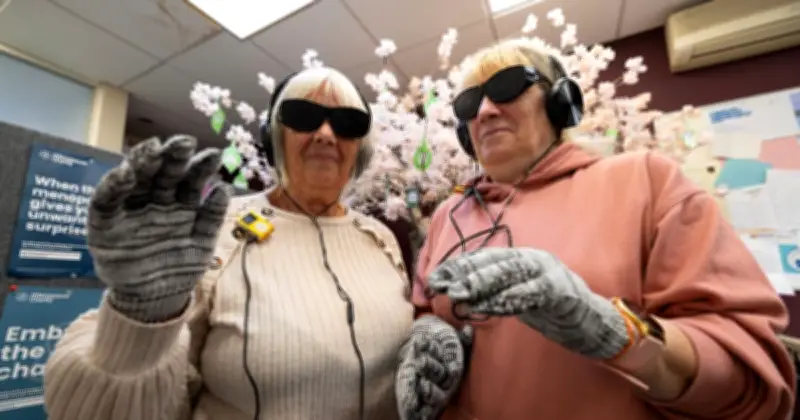
Care workers and members of the public are being trained to better support people with dementia by experiencing how it affects their lives. The Sunday Express joined a session where participants donned gloves, sunglasses that create tunnel vision, headphones, and shoe inserts that make walking uncomfortable.
As a constant stream of chatter played through the headphones, we were ushered into a dark room lit only by a multicoloured disco ball, with loud music blaring. For around three minutes, our group was asked to complete tasks such as opening a pill box or writing a note to a loved one. It was intensely frustrating – my hands were clumsy and my thinking slow as my brain was overwhelmed by the assault on my senses.
Designed by care branch owners
The experience was designed by Home Instead Dartford, which provides care in elderly people's homes in south east London. Ram Chandra Thapa, who owns the branch with his wife Christina Uppenkamp, said the aim is to help participants understand what someone with dementia may be feeling when struggling to complete seemingly easy tasks.
He added: “We need to understand what the other person might be going through and show them the power of empathy. Listen to them, let them express themselves, and understand that maybe they will take a little longer to complete a task.” Tunnel vision felt particularly frustrating. Folding clothes became significantly more difficult when I had to move my entire head to see what I was holding.
This part of the experience could help people understand why a simple action such as walking across a room to retrieve a pair of glasses can become difficult or even distressing for someone who cannot easily see the hazards in their way, Mr Thapa said.
A family's story
Also joining the group was local resident Ann Gillett, 65, whose husband of 40 years was diagnosed with dementia just two weeks earlier. David, 66, had undergone a memory test in preparation for an operation. It revealed he had vascular dementia. Ann has suspected her husband may have dementia after noticing changes in his behaviour around a year ago.
He started sleeping a lot, became reluctant to leave the house, talked about the past more frequently, and sometimes struggled to find the right words. The diagnosis was still a shock and Ann felt bombarded with information.
She said: “When she told me he had dementia I just broke down. David hasn't accepted it yet. “He used to take me to darts, we used to go shopping. I have to do online shopping now. He used to pay the bills but I've got to pay the bills now. “He's a happy-go-lucky person and this took that away from him. He used to be independent but it's so hard. Now and then I go in the shower and have a little cry.”
Rolled out to the community
Ann said the simulation experience was scary but helped her understand what David might be going through. She added: “I feel like I can go home and help him a bit.”
The experience was initially rolled out last year as part of the home care branch's training for staff. Around 60% of its personal care clients have dementia. Ms Uppenkamp said: “Then we realised we might as well do it for everybody, so we rolled it out in the community.” The goal is “to educate people” about dementia and encourage greater empathy, she added.
“We all know the theory and there is training and learning that you can do but unless you have stood in somebody's shoes, you will never know how it really feels. It's not just words on paper, you need to feel it to understand it. We've had tears in the office. We had a lady a few days ago whose family member had been diagnosed, and she started crying because suddenly it all made sense.”
Staff supporting people with dementia are taught to be patient, speak clearly but avoid patronising, reduce distractions, and offer support where necessary, but let people do things for themselves whenever possible. Mr Thapa added: “Every individual is different and that's what makes dementia so complicated. But if you understand them and what they might be going through, you can do better.”




