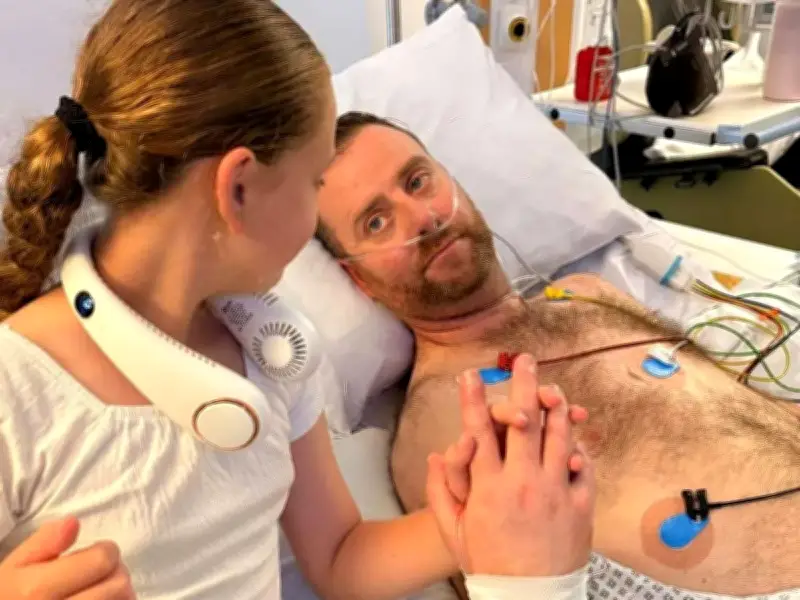
A father from North Wales nearly died after toothache developed into a deadly heart infection that left him fighting sepsis and suffering multiple strokes. Danny Ellis, 42, from Llanrwst, underwent two heart surgeries at Broadgreen Hospital in Liverpool after doctors found a hole in his heart valve.
Toothache leads to infection
In April, Ellis woke up in the middle of the night with excruciating toothache while on a week away. He took painkillers and planned to call a dentist on his return. His dentist prescribed antibiotics, which initially seemed to work, but the pain returned in May. An X-ray failed to identify the root cause, and a further course of antibiotics provided only short-term relief.
The infection is thought to have travelled from his tooth into his bloodstream before targeting his heart valve, causing a hole to form in the delicate tissue.
Hospital admission and diagnosis
In June, Ellis, who co-owns a SPAR shop in Betws-y-Coed, began feeling unwell with what appeared to be flu symptoms. His wife Ceri noticed red marks appearing across his arms, legs and body, thought to be Janeway lesions, a potential indicator of endocarditis. After he spent a day asleep on the sofa, she arranged a GP appointment for him on June 23.
Doctors suspected a possible heart attack and called an ambulance. He was rushed to Ysbyty Gwynedd in Bangor, where he was admitted for MRI and CT scans and X-rays. When he mentioned his dental troubles, doctors requested an echocardiogram, which revealed a hole in his mitral valve. They diagnosed endocarditis, an infection affecting the heart's inner lining, alongside life-threatening sepsis.
Too unwell to be transferred immediately to a specialist heart unit in Liverpool, he was placed on a round-the-clock antibiotic drip. He experienced violent bouts of shaking as medical staff fought to stabilise him.
Two heart operations
Once sufficiently stable, Ellis was transported by a critical care ambulance to Broadgreen Hospital, where another infection left his lungs filling with fluid. Surgeons attempted to repair his heart valve on July 6 but were forced to abandon the procedure when his blood failed to clot, rendering it too dangerous to proceed.
With specialist equipment brought in, surgeons made a second attempt on July 8, this time with success. However, Ellis then learnt he had suffered multiple strokes during his illness. He could barely walk, found it difficult to use his left side and worried his memory had been impaired.
He underwent rehabilitation back in Bangor and was eventually discharged on August 19. He is now recuperating at home but is still rebuilding his strength, with the effects of the strokes preventing him from doing everyday tasks including lifting his daughter Harriet Ann, nine.
Ellis said his determination to return home to his daughter kept him going throughout. He paid tribute to the nurses whose efforts helped save his life, adding that his dentist now uses his story as an example to patients so that they take infections seriously.