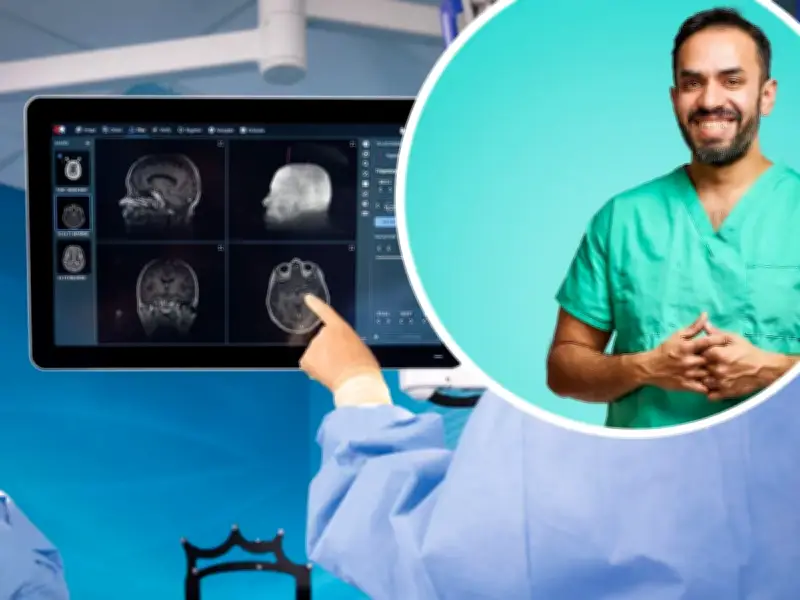
More than £6m in funding is set to help a Newcastle NHS facility become a "world leader" in pioneering technology that is giving hope to people with debilitating neurological conditions. Senior neurosurgeon Mr Akbar Hussain told ChronicleLive how the funding boost for the National Centre for Neurotechnology and Neurorestoration would mean NHS patients in the North East and beyond would "not be forgotten".
Funding and expansion plans
Mr Hussain, who is clinical director at the NCNN as well as being a leading consultant, co-founded the centre in 2025 with academic colleague Dr Luke Bashford. Both men have previously spoken about the astonishing possibilities provided by technology which can interpret, intercept or even alter the messages sent in our brains.
For people who may be diagnosed with conditions from Parkinson's to Motor Neurone Disease (MND), or who have suffered an injury to their brain or spine, this can be lifechanging. People who lose the ability to talk may be able to communicate using their thoughts, while those who have lost limbs might be able to control a prosthetic with their own brain.
£6.2m in funding this week announced by the ARIA (Advanced Research and Invention Agency) organisation means that more and more research pushing the boundaries of what is possible in this field - and simply research which helps to better understand the mysteries of our brains - will take place in the North East.
A national hub for research and treatment
The NCNN - a collaboration between the Newcastle Hospitals NHS Trust and Newcastle University - is to expand and become a national hub for research and treatment using this technology. Mr Hussain said this gave the UK as a whole a route to keep up with health-technology giants in countries such as the US and China.
He told ChronicleLive: "This funding will help us to look into new opportunities and develop our infrastructure and capacity to facilitate more research. And so hopefully, more of this [technology and treatments] will come here and become available for our patients."
"If you take computer power and the size of microchips as just one example, the acceleration we have seen in just the last ten years has been unbelievable. Even in the last five years, we have seen how something initially useful but imperfect can develop rapidly - look at ChatGPT."
"For us to keep up as a country we will need to be able to have this streamlined pathway - so we can bring as much of this technology through as we can and we can better understand the problems we face with the brain."
How the technology works
Previously, Mr Hussain and co-founder Dr Bashford told ChronicleLive how "brain-computer interfaces" (BCIs) could revolutionise treatment options for some patients - and how microchips implanted into the brain could see progress to restore mobility in those with spinal cord injuries or motor neurone disease, or help those unable to speak to communicate using their thoughts.
There are different ways in which this technology and better understanding of how our brains function can be applied. Neuromodulation means altering the activity of our nerves by delivering "targeted electrical impulses". This can involve interrupting or adjusting nerve signals which can cause pain or seizures and has already paid dividends for patients with some kinds of epilepsy.
Then neuroprosthetics are devices or systems which connect directly to our nervous system and can "replace, restore or enhance" lost function. This can, for example, see thoughts translated into actions. Mr Hussain added: "When it comes to neuroprosthetics, what we are trying to do is to make it easier for people to understand."
"If you can understand how the brain works, let's say how it regulates movement, you are then able to understand how to interact with the brain and how to have a device that's able to move through just thinking."
Impact on NHS patients
Looking to the future, Mr Hussain said that the innovation happening as we speak in Newcastle - and which can now be scaled up - had real-world implications for NHS patients here who may otherwise have few treatment options. He added: "One of the things I say to people is that we have made huge strides forward in all aspects of medical care - cancer care, hepatology, cardiac care, for example - and what this means is that people with neurological conditions are not forgotten."
"This will mean that NHS patients here in the North East will benefit from world-leading technology and are not going to be left behind. We will have the facilities to do the research, and develop technology and approaches that may not yet be available but will be in the future."
"In the past, perhaps we would have had to rely on research in the US or China, but with this funding and our work, we are hoping to really become world-leaders."