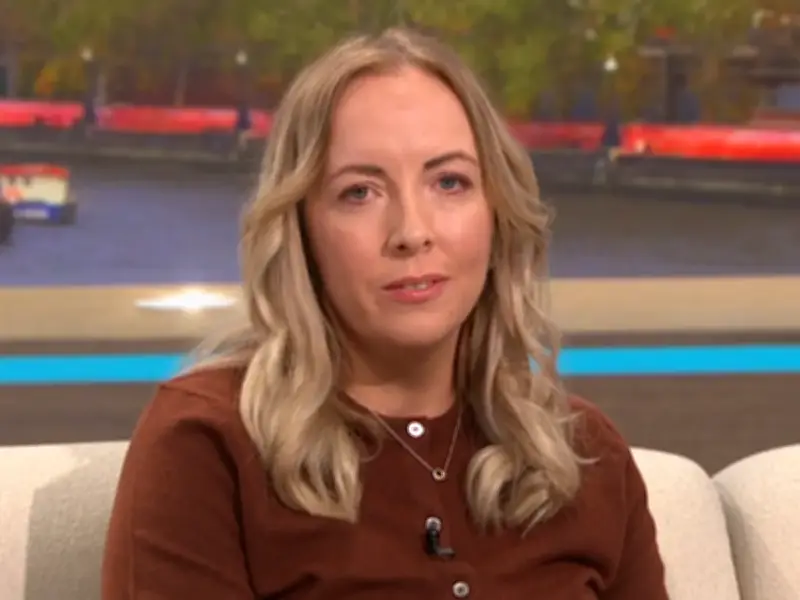
Michelle Beagan, a 42-year-old teacher from Northern Ireland, appeared on Tuesday's Good Morning Britain (October 13) to discuss her rare life-limiting condition, Friedreich's ataxia, and her campaign for access to a drug that could slow its progression.
Presenter Ed Balls explained that it took Michelle ten years to receive a diagnosis of the condition, which is a rare progressive genetic neurodegenerative movement disorder.
Early symptoms and delayed diagnosis
Speaking to Ed Balls and Susanna Reid, Michelle described when she first realised something was wrong: "When I was in my 20s, around 21, I started to notice that I was very wobbly. I had a real affiliation for wearing high shoes and suddenly realised I couldn't actually walk in them anymore."
She recalled a turning point: "I had a few stumbles. I went to a club, and hadn't actually drunk anything. Got stopped and got told I couldn't come in because I was 'too drunk'. That was the turning point, I thought, 'Right, I've got to get this checked'."
Living with the condition
Michelle, now 42, explained that while she has some slurring in her speech, it is not recognised by most people, though she notices it herself. She stressed the importance of her speech: "I'm still lucky enough to be working, I'm a teacher, so my speech is really important to me, being able to maintain that. I've often said that with this disease, I can almost cope with the fact that I may end up in a wheelchair and lose my mobility, but to lose my speech, I think I'd lose myself."
When asked about her prognosis, Michelle said that when she was first diagnosed, doctors told her she would have between five and ten years before needing a wheelchair. She added: "Thankfully, I've defied that, so I'm hoping that I can continue to do that with speech and everything else. That's why the drug is so important to get now."
Fight for drug access
Michelle is fighting for access to a drug that could slow her symptoms, but it currently costs £250,000 a year to fund. ITV viewers learned that the drug came onto the market around three years ago in different countries, with some cases showing symptoms being reversed.
Doctor Hilary shared that this is the first drug for Friedreich's ataxia that makes a difference. He explained that, as it is so expensive, it has to go before NICE, which then has to decide on cost-effectiveness. While it is approved for medical use, it has not been approved for NHS funding yet by NICE. Some countries in Europe can get the drug, including Ireland, but it is not available in Northern Ireland, where Michelle is from.
Sharing that around 1,000 to 2,000 people in the UK have this condition, Michelle added: "You're not looking at big numbers in terms of population, but that is almost what comes against us because NICE sees that as not economical, so it's not really a good spend for the number of people you're helping.
"In a lot of ways, that's almost like putting a value on your life and almost saying your life isn't worth this spend, which is very frustrating."
Good Morning Britain is available to watch weekdays on ITV from 6am.