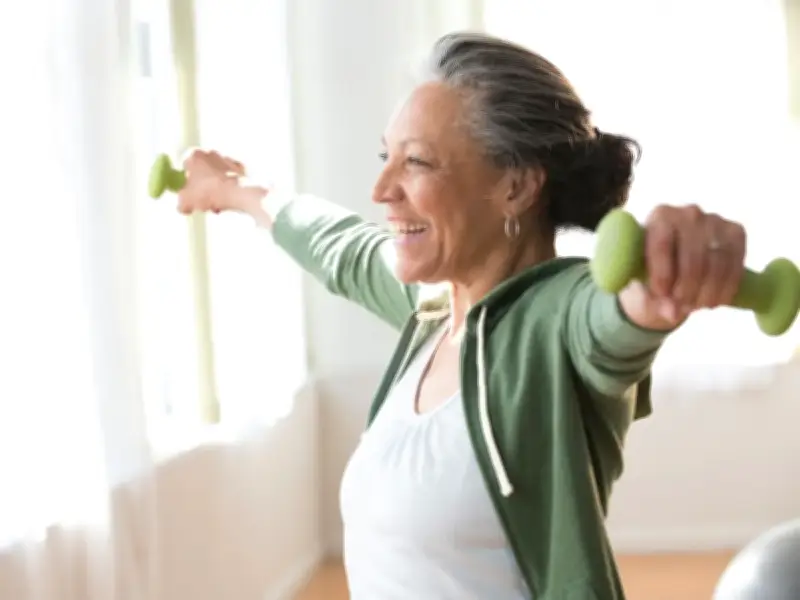
A 72-year-old woman has significantly improved her osteoporosis and chronic pain through a program of strength training exercises, according to a report by Women's Health. Four years ago, Pam was suffering from chronic back and shoulder pain and osteoporosis, a condition that weakens bones, making them fragile and more likely to break, as defined by the NHS.
After attending Balance and Body Restoration Physical Therapy and Massage in Dublin, California, she has become one of the facility's strongest clients. Wanting her "life back," Pam is now able to confidently perform a range of strength exercises in a single session, including deadlifts and kettlebell swings.
Bone Density Improvement
The most stark difference over the years has been her significant improvement in bone density. Her latest femoral neck T-score, which compares hip bone density with that of a healthy young person, showed progress from -2.7 in 2024 to -2.3 in 2026. Osteoporosis is defined as a score below -2.5.
This success hasn't happened overnight, as the 72-year-old has worked hard over the last two years to boost her bone density.
Clinic's Account of Pam's Journey
Sharing Pam's journey on Instagram, the clinic wrote: "More than the numbers though — Pam’s body feels GOOD. She has little to no pain day to day. She lives unrestricted. She carries her own groceries and suitcases. She has the energy to keep up with her grandkids. And to us, that matters MUCH more than what her T-score says."
Pam’s story is proof: it’s never too late, and you don’t need to have 'athletic experience' to become one of the strongest versions of yourself. You just need the right program and the discipline to show up consistently.
Exercises Used
Below are five of the strength training exercises that Pam has used over the years to help improve her condition. It's important to note that Pam's progress was made under direct clinical supervision for years, and this particular program was tailor made for her specific needs. Those hoping to see similar results should consult with a health professional before embarking on any routine.
Double Kettlebell Deadlift
The clinic explains that hip-hinge movements such as deadlifts can load the thigh bone and spine, making them beneficial for bone health. To carry out a double kettlebell deadlift, place two kettlebells on the floor between your feet and stand with your feet hip-width apart. Hinge at your hips while bending your knees slightly and grip a kettlebell in each hand with an overhand grip. Keep your back flat and chest lifted. Stand up straight by extending your hips and knees at the same time, squeezing your glutes at the top. Slowly lower the kettlebells back to the floor by hinging at your hips and bending your knees, keeping the spine neutral. Perform three sets of six reps.
Double Kettlebell Goblet Squat
Stand with your feet hip-width apart and toes turned slightly out. Hold a lighter kettlebell in each hand, with hands together and bells resting on forearms, elbows tucked close to the body. Keeping core tight and chest lifted, lower into a squat by pushing hips back and bending knees, keeping weight distributed between heels and midfoot. Lower until thighs are parallel to the floor and knees are in line with toes. Pause briefly, then drive through heels to stand. Perform three sets of six reps.
Kettlebell Swings
The clinic explained: "Weight plus acceleration leads to greater force, which generates stronger signals for bone growth." Stand with feet hip-width apart, holding a kettlebell in both hands between your legs. Slightly hinge hips and bend knees as you swing the kettlebell back between your legs, keeping it close to your body. Swing forward until it reaches around shoulder height, standing fully upright with knees extended and arms straight as the kettlebell floats momentarily. As it falls, hinge hips and allow it to swing back before repeating. Perform five sets of 10 reps.
High Plank
This exercise doesn't require kettlebells. Start on hands and knees, with hands directly beneath shoulders. Step feet back until body forms a straight line from head to toe. For more stability, widen stance; for more challenge, bring feet closer together. Brace core and squeeze quads and glutes so hips don't lift or dip. You can also drop to elbows for a harder exercise. Providing essential baseline stability, do three sets of 45 seconds each.
Farmer's Carries
This can be done with kettlebells or heavy jugs. Pick up the equipment from outside each ankle, drive through heels to stand tall. Pull shoulders down and back while maintaining a strong grip. Using small, controlled steps, walk forward while keeping torso upright. To change direction, set the kettlebells down, turn around, and pick them back up before continuing. Helping your spine and postural muscles, carry out this activity for three sets of around 15 to 20 seconds.