
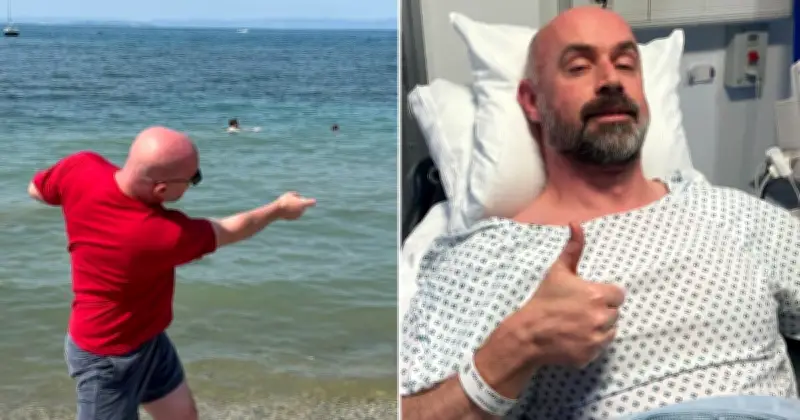
Andy Reynolds, a 48-year-old from Wigan, has turned stone skimming into a key part of his rehabilitation after a sudden stroke left his right arm weak. He is now preparing to compete at the World Stone Skimming Championships on Easdale Island in Scotland.
Stroke symptoms appeared during a work call
In June 2023, Andy was working from home and preparing for a Microsoft Teams meeting when his arm went limp. He recalls: “I sat on my bed and my arm just went completely limp. Out of the blue, no warning signs, no headache, no blackout. My arm just dropped.”
Initially suspecting nerve damage, he joined the call but soon realized he couldn't control his arm. A woman on the call noticed his odd behavior and urged him to phone someone. Following NHS 111 guidance, he completed simple tests, and when he opened his eyes after closing them, his arm had dropped. He says: “That was the first time I heard the word 'stroke' mentioned by anybody.”
Diagnosis and surgery
At his local hospital, doctors confirmed a major stroke and transferred him to Salford Royal Hospital. Tests revealed a dural arteriovenous fistula (DAVF), an abnormal blood vessel in his brain that was bleeding. He underwent a five-hour operation, which he described as “very traumatic, very confusing.”
He spent eight days in hospital, and his daughter Ellen, then 10, couldn't visit due to ward rules. After returning home, his partner Jill and her daughter Anna moved in to support him. He was advised to regularly stimulate his arm, and with Jill's help, he created a “bag of tricks” with items like a ball, clothes pegs, and resistance bands.
Discovering stone skimming
Andy started an Instagram account (@mythrowingarmstopped) to track his recovery. He came across a Liverpool University stone skimming society and decided to try it. He says: “I thought this was a great way for me to try and prove to myself what I can still do. It turns out I'm pretty good at it, even with the physical limitations I'm left with.”
On a good day, he can make a pebble hop around 70 meters. He explains the technique: “You throw it almost sideways, and you've got to get down as low as you can so that the stone is traveling horizontally along the surface of the water before it makes contact.”
Raising awareness and competing
Andy estimates he has around 50% of the control and less than 50% of the sensation in his right arm. He has faced stigma, with people thinking he was drunk due to uncoordinated walking. He took part in the London Landmarks Half Marathon for Different Strokes, a charity supporting stroke survivors of working age.
Austin Willett, chief executive of Different Strokes, said: “Andy’s story is a powerful reminder that stroke can happen to anyone, at any age, and that awareness can truly save lives. The quick thinking of his colleague in recognising the signs and acting fast made all the difference, and it underlines just how important it is that more people understand what to look for.”
Andy is passionate about spreading awareness that strokes can happen to younger people. He says: “Strokes are far more common in young people than you think. And the recovery journey is completely different for somebody who's a parent, has a full-time job, or has other dependents, like older parents they are caring for.”




