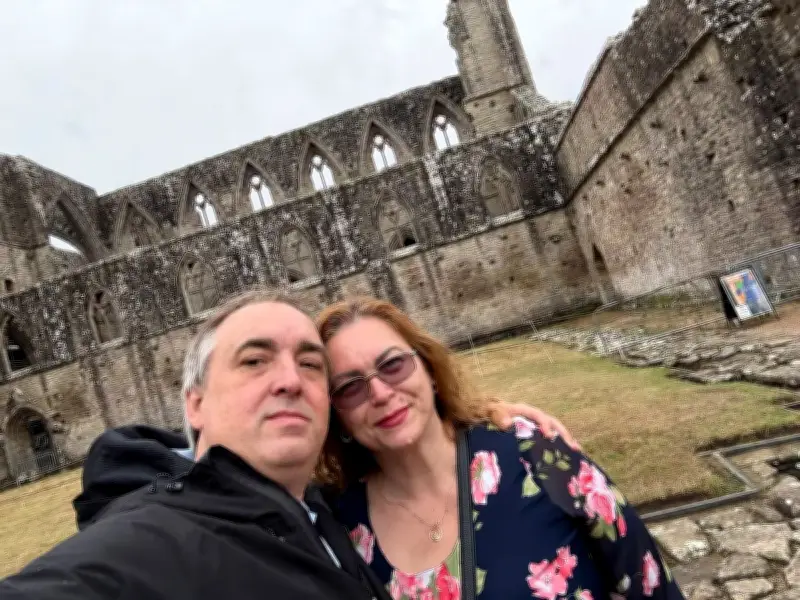
Geraint Hutchings, a 47-year-old from Ynysddu, spent years caring for both his parents, Jean and Ray, after they developed dementia at roughly the same time. One of the lowest points came when his father went missing for five hours after trying to catch a bus to visit his mother in hospital. Police searched for Ray before finding him lost and confused.
Geraint, an only child also raising three young children, has spoken about the emotional toll of caring for his parents as their health deteriorated and the years of frustration securing the support they needed. His mother died in November 2025, aged 79, while his 80-year-old father continues to live with the condition.
Juggling care, work and family
Geraint said the past five years had been emotionally exhausting. "I would come home and my partner at the time would ask me what would happen and I could not speak about it because I was so exhausted," he said.
The difficulties began when his mother was admitted to the Royal Gwent Hospital in Newport after falling out of bed and breaking her arm. During her admission, Geraint said concerns about her memory became apparent when she repeatedly gave hospital staff different addresses while they were trying to confirm her identity. She was later transferred to Ysbyty Ystrad Fawr, where she remained for several months. He recalled being frustrated that she could not be assessed by the memory clinic while she was an inpatient.
Geraint also described trouble after concerns that his parents were not taking their medication properly, eventually arranging lockboxes to help manage it. As their needs increased, he said he initially had to arrange and pay for care privately before support was put in place. "It was just constant," he said, describing the pressure of managing his parents' needs alongside work and family life.
Hospital visits and voice memos
At one point, his parents were in different hospitals, with visiting hours between 5pm and 7pm. Geraint would visit his mother at the Royal Gwent before travelling to see his father at Nevill Hall Hospital in Abergavenny. He said the journey and limited visiting hours made an already difficult period even harder. After raising concerns, his father was moved, and eventually both parents were at Ysbyty Ystrad Fawr.
Geraint recalled how devoted his parents were to one another, despite their illnesses. His mother had spent months in a communal area at the hospital rather than a private room. "My mum was lying there in bed whilst people are coming to visit people. They are sitting there and having conversations whilst my mum is lying in the bed next to them," he said.
To keep their conversations alive, Geraint would voice record his hospital visits. "I have got voice memos and it is just conversations of me, my mum and dad are having. Things like that I have got forever," he said. Despite the strain, he remembered moments when his mother could still talk, eat and joke with the family. "You could still have fun with her, we could still take the Mick out of my dad constantly, which is our favourite hobby," he said.
Stroke and ambulance delay
In August 2025, Jean suffered a stroke. Geraint recognised the signs, including one side of her face drooping, and called an ambulance. He described how it took around nine hours for an ambulance to arrive, and recalled receiving a call asking how serious her condition was. "By that time, they were lifting her in the back of the ambulance, she had a stroke again on the way to Ysbyty Ystrad Fawr," he said.
Geraint believes the delay affected his mother's dementia. Before the stroke, she could still interact with her family. Afterwards, she was unable to speak or eat and needed to be fed through a tube.
Paul Underwood, deputy director of operations at the Welsh Ambulance Service, said: "We are deeply sorry to hear about Mrs Hutching's experience. Following Mrs Hutching's initial 999 call, we carried out welfare calls to monitor her condition before an ambulance was dispatched."
"Our services continue to face significant pressures, reflecting wider challenges across the health and care system, including delays in transferring patients from hospitals, which can impact ambulance availability in local communities. Since this incident, we have changed the way 999 calls are prioritised to further improve patient care."
"New call categorisation arrangements are now in place to help ensure patients experiencing life-threatening emergencies receive help as quickly as possible, while all patients receive the most appropriate response for their needs. We would encourage a representative of Mrs Hutching's family to contact our Listening to People Team so that we can better understand their experience and carry out a full review of what happened."
Wider support and research
Geraint continues to be there for his father while living with the loss of his mother. A spokesperson for Aneurin Bevan University Health Board said: "We extend our sincere condolences to Mr Hutchings following the loss of his mother. We recognise the challenges families face when caring for a loved one with dementia and are sorry to hear about his experience."
"We are keen to understand the concerns he has raised and would encourage him to contact our Listening to People team, who can support him through the process and ensure his concerns are reviewed fully."
Geraint's experience is reflected by Carents, a national organisation offering support for adult children caring for their ageing parents. Carents' recent research, based on the experiences of more than 4,000 carents, found that 96% say they are often "always on alert", exhausted and isolated, while 80% feel expected to cope without help and 62% feel guilty asking for support.
Adam Dunlop, a spokesperson from Carents, said: "Geraint's experience will be familiar to thousands of families across Wales. The pressures of caring for a parent with dementia build over time, juggling appointments, medications, finances and other day-to-day tasks, often alongside work and family of your own. 'Overwhelming' is a word we hear again and again."
"Many people in Geraint's position don't see themselves as carers. They're simply a son or daughter doing 'what you do', so they rarely look for support for themselves, and can end up feeling isolated and alone. Through Carents, people caring for ageing parents can connect with others who get it, and find information and practical support at carents.co.uk."