

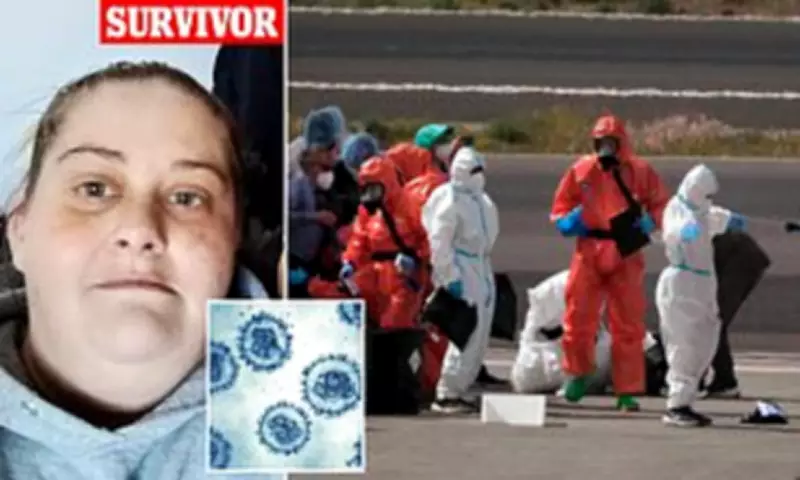
A survivor of a rat-borne virus has described how the potentially fatal illness left her in a coma, fighting for her life, and with debilitating long-term consequences. Jennifer Benewiat, 43, told the Daily Mail she experienced ICU psychosis and had to relearn how to walk and shower after contracting hantavirus nearly 16 years ago.
Benewiat, a mother of three from Kansas, fell ill in December 2010 over the Christmas period. After driving an hour home to Wichita from Hutchinson, she collapsed on her doorstep. This led to her hospitalisation, where doctors later warned she might die. She was placed on a ventilator for ten days, leaving her paralysed from the neck down. She has no memory of those days and had to be retaught 'all the things a normal person does in a day' during her recovery from the virus, which has a 40 percent fatality rate.
Benewiat told the Daily Mail she experienced 'a little bit of a trauma kind of response' upon hearing about the hantavirus outbreak on the MV Hondius cruise ship, which has left three dead and put America on alert as it monitors patients with potential symptoms. She still feels the effects of hantavirus in her daily life, despite overcoming the illness more than a decade ago. 'I have muscle weakness and numbness and tingling in my extremities,' she said.

Now able to do everything she did before, Benewiat admitted: 'I just can't do them as quickly as I used to do. Doing housework and stuff like that, I have to take breaks more often than I used to.' She described collapsing at her door: 'I was exhausted and had a fever, but I had work the next day, so I figured I would sleep it off and be fine in the morning.' However, she woke up hours later vomiting with a fever exceeding 103 degrees. Her sister rushed her to hospital, but tests 'found nothing.'
Benewiat was sent home with medication, only to feel worse the next day. Her mother then took her to the emergency room, where her oxygen levels dropped precipitously. 'They couldn't tell me what was going on because they didn't know,' she said. 'All they knew was that I wasn't breathing right and so they had to do something to help me breathe.' Her body was 'rejecting all of the treatment,' and she wasn't tested for hantavirus until a colleague recognised her symptoms from a previous outbreak. The test took ten days, during which she remained on a ventilator.
Doctors eventually confirmed hantavirus pulmonary syndrome, which stunned Benewiat. 'I'd never heard about it. When they told me what it was, I was like, 'What is that? How did I get that?'' Her parents decided to insert a tracheostomy tube, but just before the procedure, she began breathing on her own. She suffered from ICU psychosis, 'seeing things and hearing things.' Benewiat lost about 65 pounds and described her rehabilitation as 'very, very, very, very difficult.' It took her a month to walk with a walker and an additional month of intense therapy to relearn feeding and showering.
To this day, it remains unclear how she contracted hantavirus. The health department investigated her home and workplace but found nothing. Benewiat hypothesises she may have been infected at a Christmas tree farm two weeks prior. The current outbreak involves the Andes strain, which can be transmitted person-to-person, while Benewiat had the Sin Nombre virus from deer mice. Forty-one Americans across 16 states are now being monitored for symptoms, and ten people from the cruise ship have fallen ill, including three who died.






