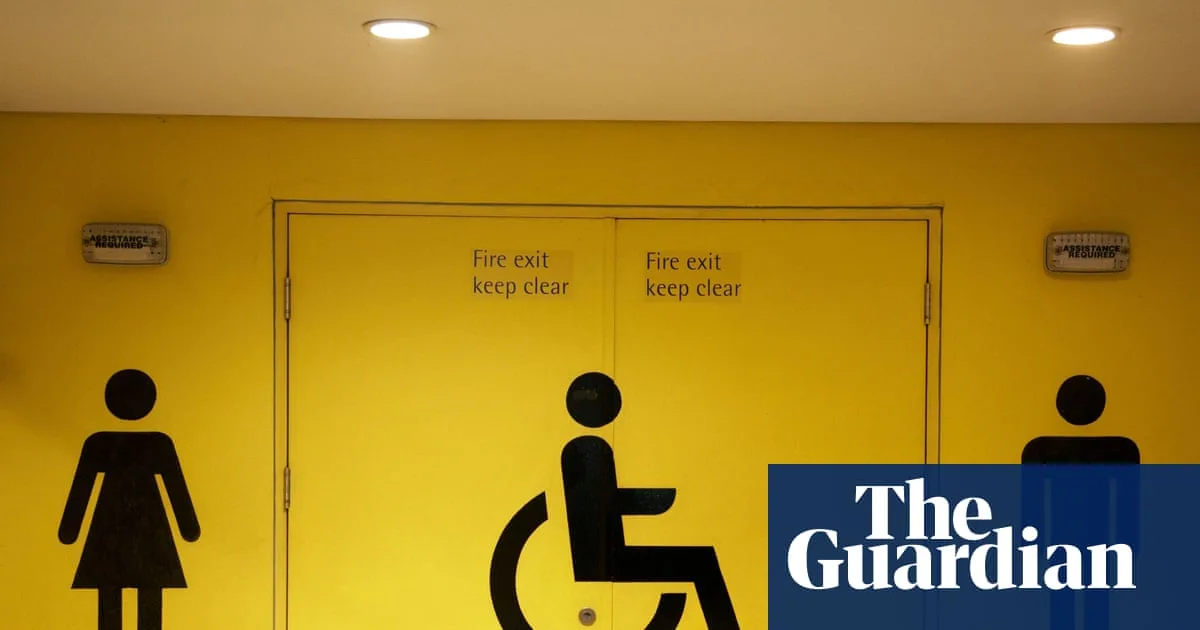
As Britain's rights watchdog says restaurants, shopping malls and leisure centres must make alternative arrangements for customers who do not wish to use single-sex toilets or changing rooms, James Moore issues a plea on behalf of fellow wheelchair users – please don't drag disabled loos into this.
Guidance on single-sex spaces
After successfully competing for a place in the Guinness Book of Records for hand-sitting, education secretary Bridget Phillipson – whose portfolio also includes equalities – has finally laid before Parliament the long-awaited guidance on single-sex spaces. And it's bad news for one protected group in particular… but not the one you might think. Having spent more than a year in her ministerial intray, the updated Equality & Human Rights Commission guidance – a 340-page Code of Practice on Services, Public Functions and Associations – has determined that single-sex spaces should be used on the basis of biological sex, not gender identity. You'd be forgiven for asking what took everyone so long?
It means that loos in shopping centres, changing rooms in department stores and shower facilities in municipal gyms should be either male- or female-only – which, before the culture wars of the past decade or so, they of course were. For many, this marks a return to common-sense. But it also raises a question over service provision for those who would prefer not to use the facility tallied to their natal sex – trans people, for instance, and those who identify as non-binary. Which is why another national debate is brewing, about how to provide 'third spaces', who can use them and who will pay for them.
Practical challenges for businesses
Businesses in the already hard-pressed hospitality sector have already warned that installing 'extra' facilities won't always be practical – financially or, when a premise's space is tight, practically. And, in a small country where it costs more to build a high-speed railway than it does others to send astronauts around the moon, a new law-abiding toilet facility is more than a rounding error in the end-of-year accounts. Last year, after the Supreme Court judgement, the Liberal Democrat-run Kingston Council revealed it had spent £13,000 of taxpayers' money converting the toilet block in one of its parks into gender-neutral stalls.
So, for all these reasons and more, I am braced for the inevitable. Wheelchair users like me are caught in what I call a no-them's-land – and experience tells me that, more often than not, disabled people, with our spacious accessible loos, will simply be made to share. Hey, presto! A ready-made solution at zero cost! Disabled toilets are already there, trans people can just use them! You don't mind, do you?
Well, I do, actually. Is it right that hard-won provisions for disabled people can be so blithely co-opted into a nebulous 'third space' for those who can't/won't use either the Gents or the Ladies? To put it more forcefully, why should my conveniences be inconvenienced? There aren't enough disabled loos as it is. I often find that they're of poor quality, poorly maintained, and sometimes made completely unusable by people who aren't disabled waltzing in and making a disgusting mess involving discarded toilet paper and… worse. But if this really is the direction of travel, we'll need a new symbol for door of the 'disabled/baby changing/trans/non-binary' loo. And who is going to risk cancellation by designing that?
Disabled people: the unwanted stepchild of equality
When it comes to equality, disabled people are often the unwanted stepchild. And 'our' facilities are not quite the panacea for our problems. Sometimes, they're used as a de facto store rooms, which can swiftly make an accessible toilet inaccessible, even potentially dangerous for blind or partially sighted users. It's often the case that the 'disabled' loo is a shared facility, with a baby-changing table – which is the worst of all worlds. I've had kids: changing can be a complicated, messy and time-consuming procedure. Male loo, female loo… disabled/transgender/non-binary loo (with a baby-changing facility, too).
I remember a family trip to Brighton – a city whose residents pride themselves on their progressiveness, and a constituency whose local politicians are world-beating virtue-signallers – that was distinctly uncomfortable for me because we simply couldn't find an accessible loo that was open and, thanks to a flow of day-tripping families, left in an usable condition. And that's before you get to the problem of people who feel that laziness is a disability. More often than not, it's blokes who think it's their right to 'nip in' to the disabled loo. I can tell they don't have a hidden disability, either, because when they emerge and see me waiting in my chair, they mumble 'Sorry…'.
By comparison, I was at the Old Vic the other night to see One Flew Over the Cuckoo's Nest, and the queues for the ladies snaked up the stairs. None of the female patrons so much as looked at the accessible loo that was right there, within conveniently easy reach. My sincere thanks to them for that, because – fun fact – some disabilities, including the ones I was left with after my pelvis was snapped in three by a cement truck, make queuing for the loo difficult, if not actively excruciating.
Leave disabled loos out of the 'third space' debate
So, to the lobby groups now considering their response to the ECHR guidance, steering a new cohort of people in the direction of the accessible loos is not a good answer to your questions. Making us wait our turn is going to impact a lot of disabled people. And, in case memories don't stretch back to 2010, disability is one of the nine protected characteristics safeguarded by the law in the Equality Act, as is biological sex. (Gender identity mostly isn't.) However this 'third space' debate pans out, let's leave disabled loos out of it.






