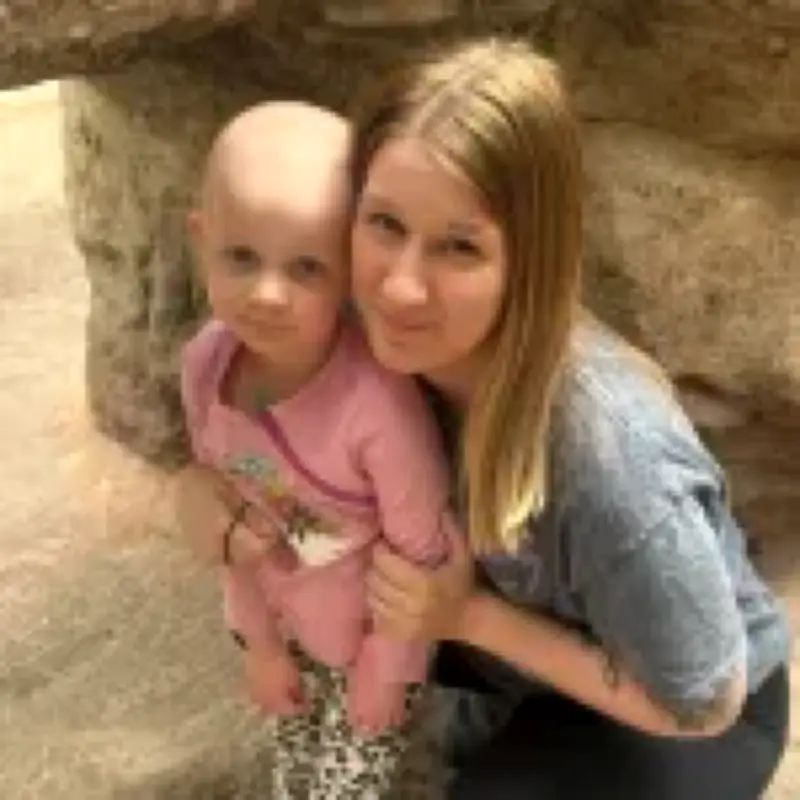
A three-year-old girl's rare eye cancer was discovered after her mother noticed a black reflection in her eye on a baby monitor. Miley Draime's left eye began to drift last year, and her parents initially assumed it was a lazy eye while waiting for an ophthalmologist appointment.
However, when her eye began to glow and later appeared black through the baby monitor, her mother, Kristen Draime, 29, realized it was far more serious, leading to over six months of surgery and treatment.
First signs of trouble
The ordeal began on November 8, 2025, when Kristen was bathing Miley and noticed an unusual white glow in the child's eye. After putting Miley to bed, she searched online and came across retinoblastoma, a rare form of eye cancer.
'When I went deep diving into retinoblastoma, I found an article in the trenches about a mum seeing her daughter's eye was black on the monitor, and it was a tumour,' Kristen said. She immediately checked the baby monitor and noticed that her left eye was completely black while her right reflected normally.
'Her left eye just went wild,' Kristen recalled. 'I could tell she couldn't see me. It was the most gut-wrenching feeling. After seeing "the glow" meant retinoblastoma and seeing her eye black on the monitor, I felt a deep instinct that it was retinoblastoma for sure.'
Diagnosis and surgery
The next morning, Kristen and her husband, Andrew Draime, 38, took Miley to a local paediatric emergency department. The family was then referred to ocular oncologist Arun Singh at Cleveland Clinic's Cole Eye Institute.
'They called him in on a Sunday,' the hospice social worker from Cleveland, Ohio, recalled. 'I knew it wasn't good because they're not going to call a specialist in on a weekend if it's not something serious.' After an ultrasound and thorough examination of Miley's eye under anaesthesia, Dr Singh delivered the news: the tumour had almost completely consumed Miley's eye, and it would need to be removed.
On November 21, 2025, Miley underwent surgery at Cleveland Clinic Children's to remove her left eye. Although the family had hoped surgery would be enough, a postoperative biopsy revealed chemotherapy would also be necessary because of the tumour's size and location. Miley began treatment just before Christmas 2025, and in June 2026, she rang the end-of-treatment Bravery Bell, surrounded by cheering family members and caregivers.
Recovery and life after
Miley now has a permanent prosthetic eye, replacing the temporary one she had been given after surgery. The small plastic disc is cosmetic, but it also helps the eye socket maintain its shape and can be removed for cleaning.
'You wouldn't know she'd had her eye removed,' the mum-of-two said. 'She does great navigating through life, and I can only occasionally tell she has one eye. It's mind-blowing how well she is doing. I will never stop being thankful that I get to keep my daughter in this world. She lost her eye, cancer is so unfair, it took that from her. But she gets to be here. She gets to live a normal life.'
Dr Singh explained: 'Retinoblastoma has the highest cure rate of any childhood cancer. Removing the eye is the most common treatment because leaving it intact risks letting the cancer spread to the brain or elsewhere in the body.' Retinoblastoma is a rare type of eye cancer that affects the retina and mostly affects children under three years of age. Symptoms include a white glow in the pupil, a squint, a change in iris colour, swelling around the eye, uncontrolled eye movements, vision problems, and pain in one or both eyes.