
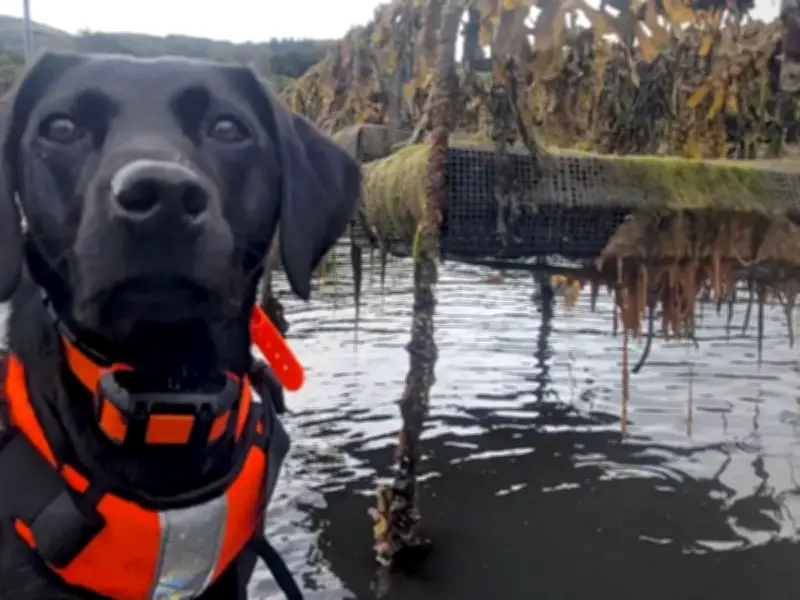
A working dog from the Scottish Highlands has been named animal of the year by a charity for hunting down an invasive marine creature called the carpet sea squirt. The organism, nicknamed “sea vomit”, is particularly harmful to coastal wildlife and economies.
A trailblazing sniffer dog
Black Labrador Sgiath works at low tide with her owner, Dr Texa Sim, and has found hundreds of colonies of the sea squirt. If left uncontrolled, the creature can smother and kill native species. Sgiath (pronounced Skee-ah) is thought to be the UK’s first sea squirt-hunting dog.
Dr Sim, a marine ecologist from Glencoe, has had Sgiath since she was a puppy. The dog was first trained as a mountain rescue dog, but proved so skilled that her owner wondered if those abilities could help with her own work. Dr Sim trained Sgiath to recognise the scent of the carpet sea squirt, and the dog now joins her on beaches to sniff out the creatures.
Sgiath, Gaelic for “shield”, is a fitting name for a dog protecting Scotland’s coastal wildlife.
Recognition and impact
The International Fund for Animal Welfare (IFAW) awarded Sgiath animal of the year at its 26th annual Animal Action Awards ceremony on Thursday, October 15.
Dr Sim told the BBC: “Sgiath is incredibly clever. Her problem solving and her ability to take on new challenges and learn so quickly are just phenomenal, and it's so amazing to watch.”
She added: “When I first started this project, I genuinely didn't know whether it would work. No one had really explored whether dogs could help tackle this problem in the marine environment. It began as a proof-of-concept project and has exceeded every expectation I had.”
Dr Sim said Sgiath can even “dive down under the seaweed” at low tide. “She just does a survey with her nose, essentially, she can pinpoint exactly where it is, so it's much easier,” she said.
Threat to native wildlife
Experts believe the carpet sea squirt, formally named Didemnum vexillum, arrived from Japan on shores in the south of England and Wales in 2008. It comes in various shades, from orange to cream, and has spread to several seaside locations across the UK. It reproduces very quickly during warmer summer months.
Dr Martyn Kurr, a marine biologist from Bangor University, told BBC News that non-native or “biofouling” species like the carpet sea squirt can outcompete native wildlife for valuable nutrients. “These species also clog up aquaculture pens, marine infrastructure, and machinery such as boat propellers,” he explained.
Kurr commended Sgiath for her work in helping to eradicate sea vomit, adding: “It's fantastic to see Sgiath get this much deserved award, and I'm very excited to see what other wonderful work we can do with sniffer dogs.”




