ChronicleLive went behind the scenes at Tynemouth RNLI on the Fish Quay in North Shields, meeting the volunteer lifeboat crew members who dedicate their free time to keeping the public safe at sea. The tour included the station, the volunteers, and what it means to be an RNLI volunteer.
The Crew and Their Backgrounds
The crew at Tynemouth RNLI consists of around 28 volunteers, including an employed mechanic and an employed coxswain, or captain. Most of the team juggle life and full-time jobs, coming from backgrounds in retail, teaching, IT, and fishing, each contributing to keep the station manned and running.
Being behind the scenes, the team operates like a second family rather than a job, relying on each other in difficult and dangerous circumstances to ensure rescues are done quickly and safely. The crew use an app to indicate when they are free and arrange crew levels, with each member carrying a pager that alerts them when needed.
This allows the coxswain to know what crew levels are available at any time and what assets can be deployed for an emergency. Messages are sent via Humber Coastguard to the launch authority, who alert the coxswain to the nature of the situation.
Response and Equipment
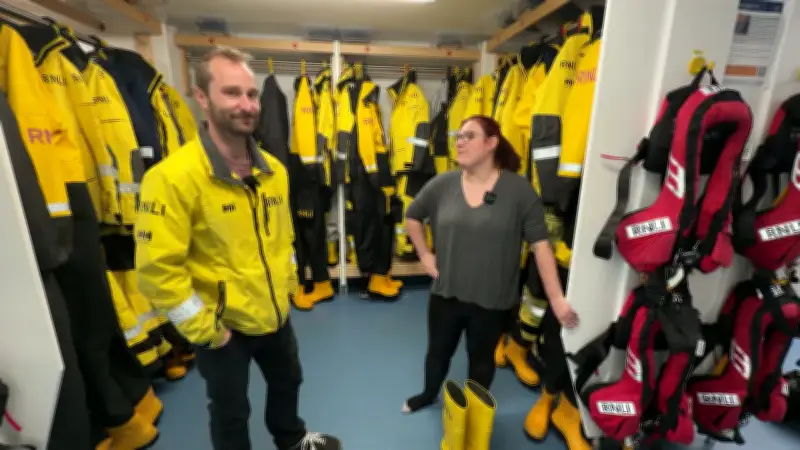
Once alerted, volunteers travel to the station while the coxswain formulates a plan. Time is of the essence, and the crew respond to calls at any hour, 24 hours a day, seven days a week, 365 days a year. Upon arrival, they enter the changing room and suit up, ideally in under one minute.
All suits, wellies, lifejackets, and helmets are checked after every operation and stored in the same place to save time. There are two sets of kit: one for the inshore lifeboat, a dry suit for jobs involving kayakers, paddleboarders, and dogs, and another for the all-weather lifeboat, including foul weather gear and wellies for jobs further out at sea, like a ship in distress.
The team track weather and sea conditions, as well as volunteer availability, to assign jobs. The all-weather lifeboat has a range of 250 nautical miles, while the inshore lifeboat, named Little Suzie after the person who donated the money for the boat, is used for close quarter rescues.
Volunteer Perspectives
Alistair, a volunteer crew member, noted that the all-weather lifeboat goes at 28 knots. He said: “So 28 knots might not sound a lot but in nautical terms it’s like driving a Ferrari.” The boat typically carries a crew of six, including the coxswain, mechanic, helm, navigator, and two other crew members, and can rescue 144 survivors.
Little Suzie can hold a crew of three or four and is used for inshore jobs, with no keel so it can get close to the shore. The helm, James, is described by Alistair as a ‘wizard’ in control. Alistair said: “As a crew member when you do go float you have to have absolute confidence in your coxswain and your helm.”
The RNLI has been saving lives at sea since 1824, saving more than 146,000 lives. Tynemouth’s legacy goes further, with the Tyne Lifeboat Society established in 1790 with the lifeboat Original, the first in the world to be built.
Community and Commitment
James, a volunteer for 10 years and a local of the Fish Quay, said he loves “Giving back to the community. You wander around Shields and people kind of know who you are as you're the guy on the lifeboat.” Alistair added: “We do believe we serve the local community because we are a maritime community here.”
Scott, a primary member of Little Suzie, has volunteered for two years in December. His interest began at a harbour day in Wallsend, and he said: “It’s kind of just been a boyhood dream. It was always cool when you were a child to see the orange boats flying about.” One of his favourite memories was learning the local waterways, saying: “It was a surreal experience to go under the Millennium Bridge, under the Tyne Bridge, seeing the Quayside markets, having people wave to you.”
James noted: “The volunteering can come at any time, day or night, and that will always interrupt plans whether or not that’s dinner plans or work plans, all that kind of stuff gets put on hold to go out and ultimately rescue people.” Alistair said: “It’s always satisfying being able to help somebody that might not have got home had it not been for our efforts.”
After rescues, the crew debrief, and James said: “You come in home and have a debrief with your crew and you’re like ‘what on earth did we just do? That was amazing!’ So yeah, it shows that good crew mentality that we’ve all got and the training that is used when it’s most needed.” The team also spend time together at community barbecues and maintaining the boats, with donations covering fuel costs.
The crew take on new volunteers at different points of the year. Scott said to future volunteers: “It’s one of the greatest things you can do with your time. It’s one of the most rewarding things I’ve ever done because it’s a way to give back to your community but also gives back to complete strangers.” The RNLI are local people who take on responsibilities to protect and save those in trouble in our waters, and donations can be made at the RNLI website.