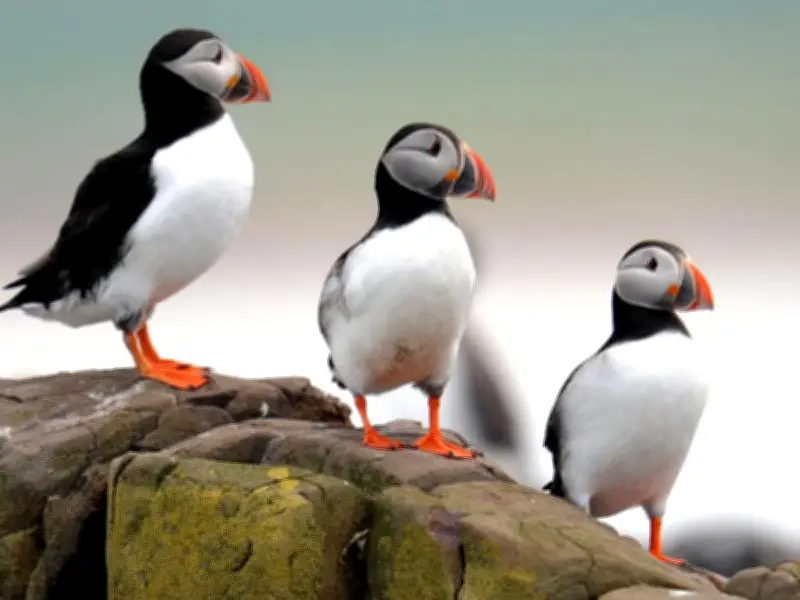
The number of puffins breeding on the Farne Islands fell by 12% this year, from 38,559 breeding pairs last year to 33,939 this year, following an exceptionally difficult winter, the National Trust has said.
The charity's annual seabird survey of the islands off the Northumberland coast found that Atlantic puffins, one of the species most vulnerable to severe winter weather, saw breeding numbers decline. However, breeding success for the puffins that did return to nest reached its highest level in three years.
Severe winter storms and seabird wreck
European shags, Arctic terns, northern fulmars and common guillemots also saw breeding numbers fall in the wake of the hard winter in the North Atlantic, when three severe storms contributed to a major seabird "wreck" in which large numbers of birds washed up dead or dying on beaches.
More than 38,000 seabirds were stranded along the Atlantic coasts of Spain, Portugal and France as a result of the storms, while hundreds of puffins washed ashore in south-west England, in what is thought to be Europe's largest seabird wreck since 2014.
Conservationists warned the scale of the event showed how vulnerable seabirds are to extreme weather, which is increasing as a result of human-caused climate change. With a "super" El Nino climate phenomenon in the Pacific developing this year, the possibility of more unsettled winter conditions could cause more difficulties for already struggling birds.
Mixed picture for island wildlife
The survey showed a mixed picture overall for wildlife on the islands, which host around 220,000 birds each summer. Some species saw increases in numbers, including black-headed gulls, razorbills, and gadwalls.
Long-term monitoring showed declines of more than a fifth (22.8%) in puffin numbers since 2018, with similar declines recorded at neighbouring puffin colonies suggesting the pressures on the birds extend beyond the Farnes.
There was better news for the ground-nesting birds in the form of more chicks surviving to fledging, with an average of 0.89 chicks fledging per occupied burrow, up from 0.78 in 2025 and 0.51 in 2024. While puffin numbers declined overall on the Farnes, they increased slightly on Inner Farne, so rangers are looking carefully at why the birds are doing better on that island, to help protect and manage their breeding habitat across the islands.
Shags and other species
The count by rangers for the National Trust, which has cared for the Farne Islands for more than a century, also showed that European shags had one of the steepest declines among the birds that nest there, falling 42% from 96 to 56 breeding pairs.
Sophia Jackson-Chaytor, senior ranger for the National Trust on the Farne Islands, said: "Puffins and shags are both particularly vulnerable to severe winter weather, but for different reasons. Puffins spend much of the winter far out at sea, where repeated storms and rough conditions can make it harder to find food and increase the energy they need simply to survive."
She added: "Shags stay closer to the coast and their feathers aren't fully waterproof, which helps them dive for food but means they need to regularly return to land to dry out. Prolonged periods of wet and stormy weather can therefore be particularly challenging for them."
The survey found Arctic terns fell 27% from 519 to 377 pairs, northern fulmars were down 21% from 235 to 186 breeding pairs and common guillemot numbers fell 11% from 44,509 to 39,059 individuals.
Recovery of some species
But it was better news for black-headed gulls, whose numbers increased by 55%, from 128 to 198 pairs, as they recovered after being hit by avian flu in 2022. Their increased presence could have benefits for smaller breeding birds on the Farnes, such as Sandwich and common terns, as their colonies provide protection from larger predatory gulls, the National Trust said.
Razorbills also saw an increase in numbers, of 17% from 408 to 478 pairs, while rangers found four gadwall nests, following their first ever recorded breeding on the islands in 2024 and no nests in 2025.
Ben McCarthy, head of nature conservation at the National Trust, said: "The Farne Islands are one of the UK's most important seabird sanctuaries, so the trends we're seeing here matter far beyond Northumberland. This year's census highlights the growing pressures facing seabirds and how those pressures can combine, making populations less resilient to future challenges."
"At the same time, improved puffin breeding success and the recovery of black-headed gulls show that nature can respond positively when conditions improve," he said, adding it showed the importance of long-term conservation efforts to ensure the Farne Islands remained an important sanctuary.