
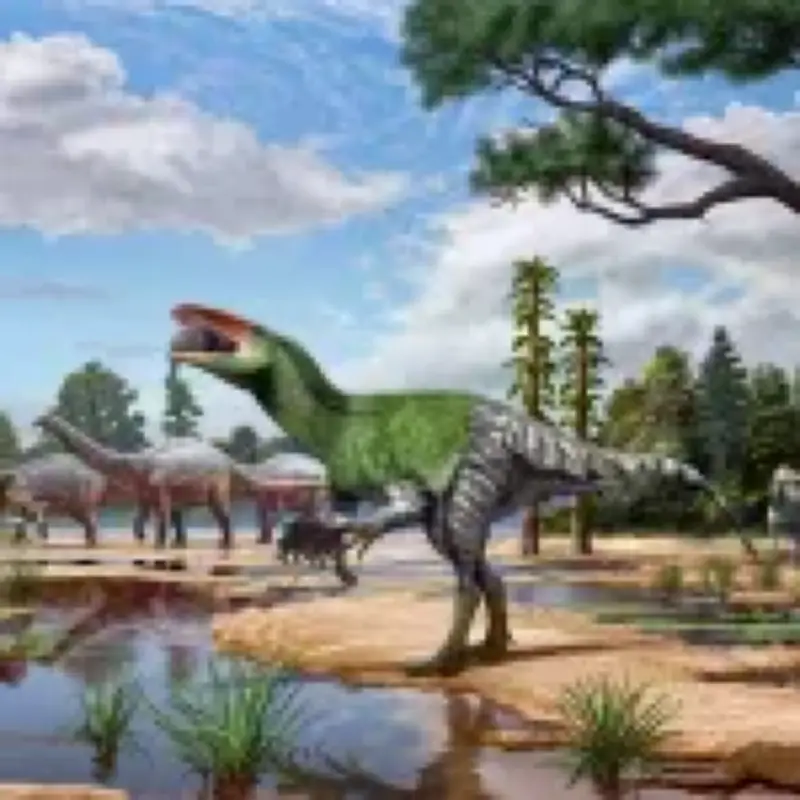
A newly identified dinosaur species that stood just 4ft 11in tall would have been more dangerous to humans than a Tyrannosaurus rex, according to researchers. The species, named Invictibellatrix amberina, was identified from a fossil found on the Isle of Wight more than 100 years ago.
Fossil identified after a century
The discovery was detailed in a paper published in Royal Society Open Science. Invictibellatrix amberina, meaning 'unconquered female warrior', was a megaraptoran: a light-footed, feathery carnivore with long, powerful arms tipped with giant claws. It lived during the Early Cretaceous period, about 120 million years ago, when rainforests existed at the poles.
Despite its classification, Invictibellatrix was not particularly large, standing just a metre and a half tall, roughly the height of a human. Lead author Dr Cassius Morrison, of University College London, said the species would have been three to four metres long, likely had feathers, and had claws measuring about 10cm to 20cm.
Role in the food chain
Dr Morrison explained that Invictibellatrix would have eaten small dinosaurs, lizards and mammals, occupying a similar role in the food chain to the hyena today. Unlike the Tyrannosaurus rex, to which it is closely related, it was not an apex predator.
'But for humans, this dinosaur would have been more dangerous than a T Rex,' Dr Morrison said. 'We would have been perfectly sized prey, about a third of their body weight. They definitely would have chased us. A T Rex would not have bothered, as we would have been too small.'
Discovery in museum collections
Megaraptors' bones were unusually light and air-filled, so they do not fossilise well, and their remains had not previously been found in Europe. Part of an Invictibellatrix skull was found at the foot of a cliff on the south-west coast of the Isle of Wight. The fossil was acquired by the Natural History Museum in London in 1924 and has since been 'sitting inside a drawer', Dr Morrison said.
Professor Paul Barrett, the study's senior author from the Natural History Museum, noted that many dinosaur bones have been dug up on the Isle of Wight. 'Work like this shows the exceptional value of working with historical museum collections where there are still many discoveries to be made,' he added.
New insights from CT scans
Researchers took a CT scan of the fossil to compare it with other meat-eating dinosaurs, including tiny-armed tyrannosaurs and spinosaurs. The team found the skull had an odd, oval hole and an hourglass-shaped crest, features not seen in any other known dinosaur species. Mathematical modelling provided new insight into how megaraptors spread over time.
Fossil scraps suggest they were the great hunters of the early Cretaceous in what is now Asia before moving to Europe. Tens of millions of years later, they died out in northern Europe while megaraptors elsewhere grew larger and developed 35cm-long claws. Researchers are not sure why megaraptors went extinct in some places but not others, though it is thought they may have been unable to compete with their younger offshoots, tyrannosaurs, during the late Cretaceous period.
'Who knows what else is waiting to be discovered,' added Dr Morrison.




