
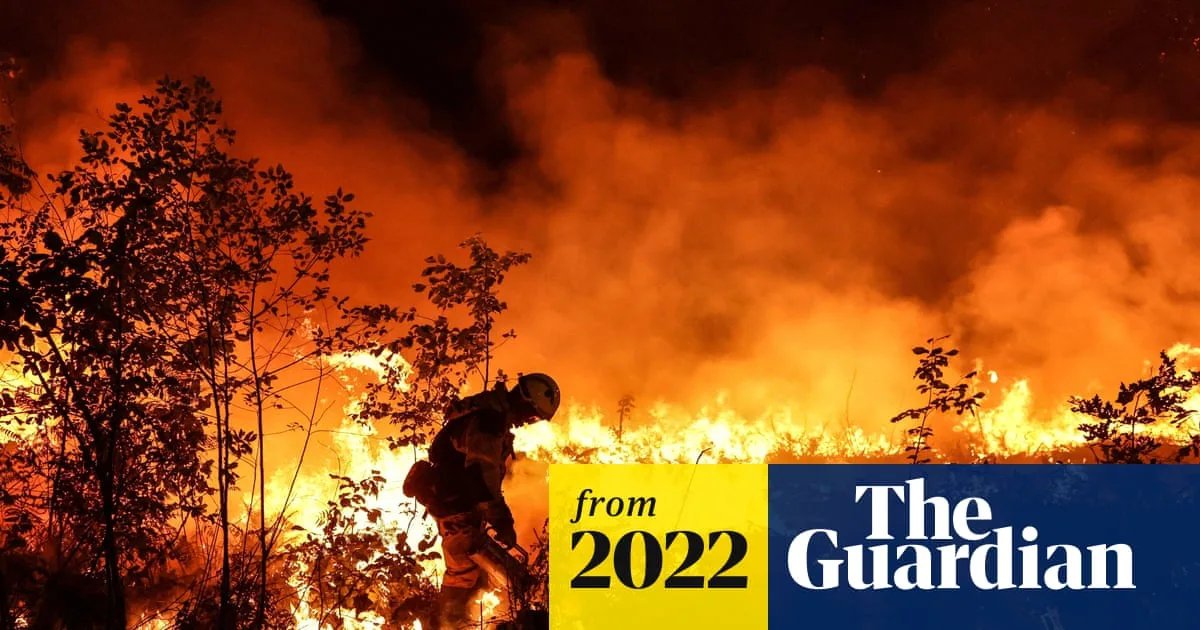
Meteorologists have warned of a 'heat apocalypse' in western France as more than 8,500 people fled their homes to escape a large wildfire sparked by a searing southern European heatwave that has already caused hundreds of deaths. Nearly 25,000 people have been forced to abandon homes, holiday rentals and campsites for emergency shelters in the Gironde département west of Bordeaux.
Temperatures across southern Europe showed some sign of abating on Monday as the heatwave moved north, including towards Britain, which was set for its hottest day on record. 'It never stops,' said David Brunner, one of 1,500 firefighters battling to control the Gironde blaze, which since Tuesday has destroyed 14,000 hectares of pine forest near the Dune du Pilat, Europe’s highest sand dune. 'In 30 years of firefighting I have never seen a fire like this.'
An area 5.5 miles long and 5 miles wide was still burning near the dune on Monday, with temperatures in the area forecast to hit 44C. 'We’re climate change refugees,' Théo Dayan, 26, told Le Monde after fleeing his home near the village of La Teste-de-Buch. Jean-Luc Gleyze, the head of the local fire service, said: 'We’re not reaching out and touching global heating – it’s hitting us full in the face.'
France’s interior ministry announced it would send an extra three firefighting planes, 200 firefighters and more trucks. Fifteen départements have been placed on the highest state of alert for extreme temperatures, including Brittany, where the coastal city of Brest was set to hit 40C on Monday, nearly twice its usual average for July.
The extreme temperatures of the past week have directly claimed at least four lives in Spain and fanned dozens of wildfires that have seared almost 30,000 hectares across the country. Spain’s Carlos III public health institute said 510 deaths were attributable to the heat between Sunday 10 July and Saturday 16 July. During a visit to the south-western region of Extremadura, Spain’s prime minister, Pedro Sánchez, said: 'Climate change kills: it kills people, as we’ve seen; it also kills our ecosystem, our biodiversity.'




