
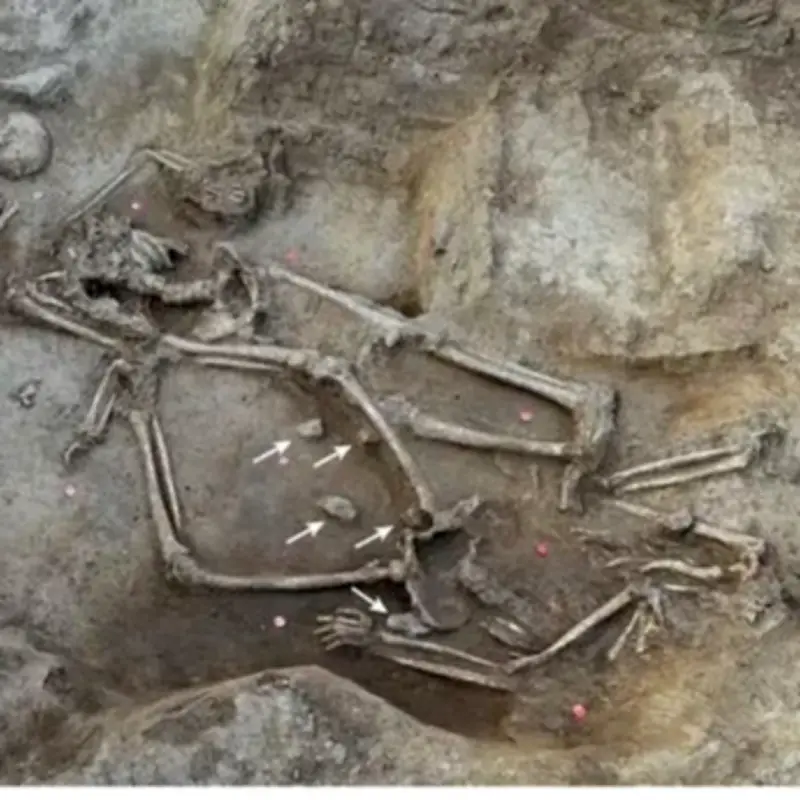
Archaeologists have discovered a 7,000-year-old mass grave filled with headless skeletons, leaving experts baffled by the macabre find. The site, located at the entrance of an ancient settlement in Vráble, western Slovakia, has been described as a 'horror pit' due to the gruesome condition of the remains.
Discovery of the Mass Grave
The excavation, which began in 2022, initially revealed four pairs of headless skeletons alongside a larger grave containing 77 additional bodies. Remarkably, only one skeleton, belonging to a child, was found with its skull still attached. The findings have been published in the Proceedings of the Prehistoric Society.
Ritual Decapitation Theory
Researchers believe the decapitation was not a result of violent conflict but rather a complex burial ritual. Cut marks on the bones indicate that the heads were skillfully removed after death. Katharina Fuchs, a biological anthropologist at Kiel University in Germany, stated: 'First analyses suggest that violent decapitations were not conducted here, but rather skillful removal of the skulls. The deposition of bodies and body parts may have been part of more complex, meaningful and recurring practices.'
Historical Context
The settlement was once home to the Linear Pottery culture, a Stone Age group known for their distinctive ceramics decorated with parallel lines. While headless burials have been found elsewhere in Europe, the Vráble site is unique because the missing skulls have not been located, deepening the mystery.
Scientists remain uncertain about the cause of death for these individuals and whether violence played any role. Ongoing excavations aim to uncover more clues about this enigmatic practice.




