
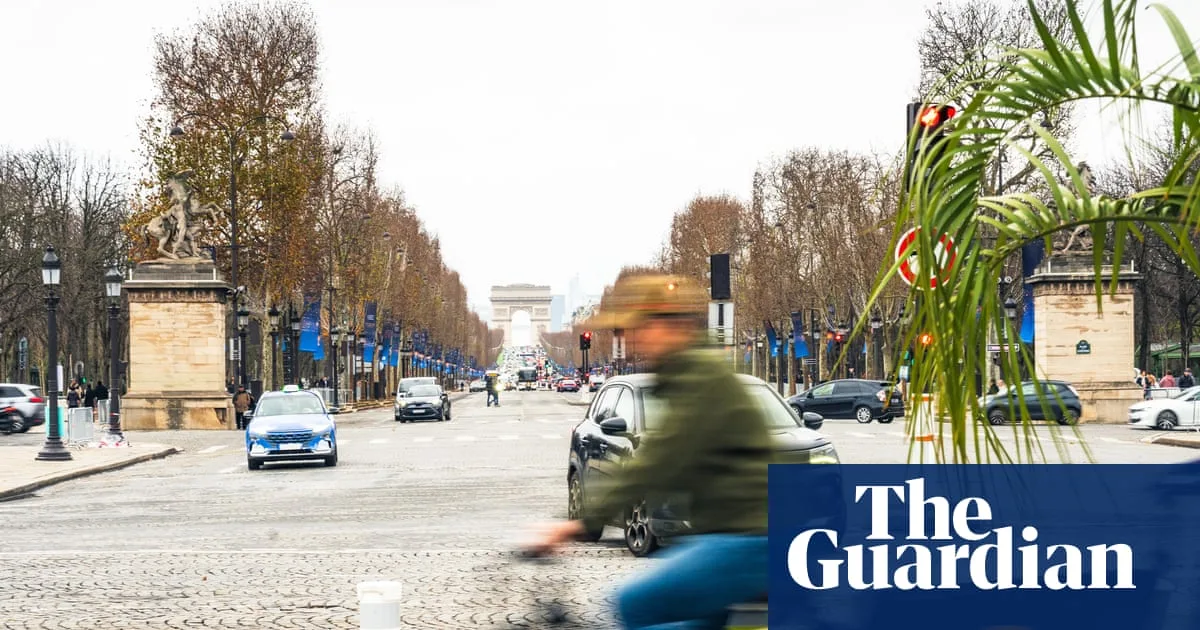
Under Anne Hidalgo, who stepped down as mayor last week after 12 years, Paris has undergone a dramatic transformation, adding bike lanes, cutting traffic and reclaiming public space. The city has planted 155,000 trees, added several hundred kilometres of cycle paths, pedestrianised 300 school streets and banned cars from the banks of the Seine. Parking spots have been turned into green spaces and café terraces.
Corentin Roudaut, an IT developer who moved to Paris a decade ago, was initially too scared to cycle. After a segregated bike lane was built on Boulevard Voltaire near his home, he returned to cycling and now volunteers with the campaign group Paris en Selle. 'It was a process that started slow and really accelerated in the last 10 years,' he said. 'At least in some parts of the city, we have a network that is starting to be safe and pretty much complete.'
However, the changes have faced resistance. Motorists have opposed the removal of car space, and referendums on charging SUV drivers more to park and pedestrianising more school streets saw low turnouts. Rachida Dati, the right-wing mayoral candidate, criticised the 'chaos' in public space but stopped short of proposing to reverse key policies.
Experts say the transition was eased by Paris's tight administrative boundaries, which limit the influence of commuter suburbs, and by groundwork laid by previous mayors. Audrey de Nazelle, an environmental epidemiologist at Imperial College London who grew up in Paris, said courage was needed to push through policies that inconvenienced motorists. 'What's missing in the rest of the world is courage,' she said. 'Mayors could say: “This is my opportunity [to leave a] legacy,” but most will not dare.'
Paris is one of 19 global cities that achieved significant reductions in two toxic air pollutants between 2010 and 2024, though fine-particle pollution fell faster in Brussels and Warsaw, and nitrogen dioxide fell faster in London. Berlin still has a higher share of cyclists than Paris. Giulio Mattioli, a transport researcher at the Technical University of Dortmund, said Paris had caught up with many other cities from a lower starting point: 'The conditions were there already, you just needed to make some bike lanes.'




