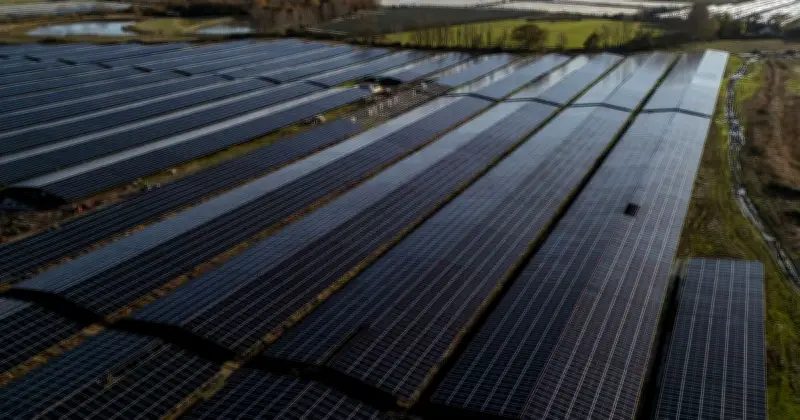
Solar farms in the UK were paid £356,605 in 2025/26 to reduce their electricity output, the highest sum ever recorded, prompting campaigners to call for a freeze on new mega-sites.
The payments, which began only in 2024/25, have risen sharply. In that first year, solar farms received £17,600, meaning the latest figure is 20 times higher.
Payments and the grid
These payments are made when solar panels generate more electricity than the power lines can carry, forcing grid controllers to pay owners to cut output. The cost is passed on to households and businesses through electricity bills, on top of larger sums already paid to wind farms to power down.
Figures from the National Energy System Operator (NESO) show that Cleve Hill Solar Park near Faversham in Kent, the largest operating solar farm in the country, was the biggest earner, receiving £127,000 for its two generating units. Sutton Bridge Solar Farm in Lincolnshire received £49,000, and Larks Green in South Gloucestershire was paid £28,000.
Campaigners call for a halt
The Campaign to Protect Rural England (CPRE) has called for a halt to new mega-sites, arguing that the rush for net zero is destroying prime farmland. Its demand followed the government's decision to reject Botley West in Oxfordshire, which would have been the biggest solar farm in Britain.
CPRE research found that almost six in ten of England's giant solar farms have been built at least partly on prime agricultural land.
Jackie Copley, chief planner at CPRE, said: “Paying solar farms to switch off is a symptom of poor planning and an outdated energy grid. Tackling the climate crisis and cutting people’s bills doesn’t need to mean sacrificing irreplaceable landscapes and farmland. We need much more renewable energy but the government should put rooftop solar first and make sure we have a grid fit for the future.”
Industry response
Dr John Constable, Director of the Renewable Energy Foundation, noted that while the sum is small compared with the £2.3 billion spent on grid constraints last year, it is significant where it is being paid: Kent, Lincolnshire and Gloucestershire, rather than Scotland where such problems have been concentrated. He said, “It seems that the bottlenecks are spreading, and to the south of England. Generation has been connected far faster than the network to carry it has been reinforced, and consumers across Great Britain are paying for the mistake.”
Solar Energy UK said solar farms have handed around £30 million back to consumers so far this year through a government scheme that returns profits to bill payers. The trade body estimates that solar farms and rooftop panels generated 16 terawatt-hours of electricity between March and August, power that would have cost about £1.36 billion at wholesale prices.
Gareth Simkins, of Solar Energy UK, said: “Solar farms save consumers money twice over. Solar power generates power that would otherwise be generated from natural gas, which is extremely expensive. The costs of constraint payments are tiny compared to the vast economic benefits of solar generation. The state of the grid is a great frustration to the sector. In many parts of the UK, connections cannot be made at all as there is insufficient capacity to carry the extra power.”
The sums paid to solar farms remain far smaller than those for idle wind turbines, which reached £7.4 million on a single day in August 2025. On the ten most expensive days of last year, wind farm operators shared £56 million for electricity the grid had no room for. NESO says paying generators to reduce output is sometimes the cheapest way to keep the electricity system balanced and protect the network.