California Photographer Documents Hundreds of Threatened Native Bee Species
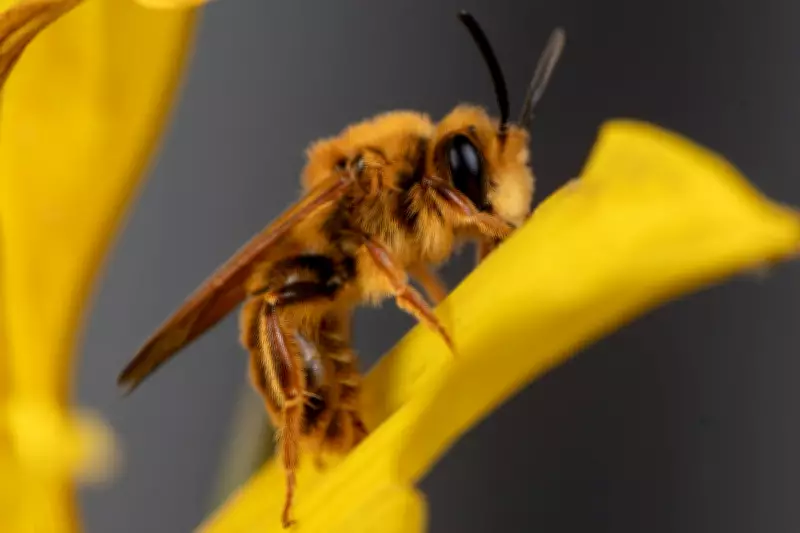
In the arid, cracked desert ground of Southern California, a tiny bee emerges from a hole no larger than the tip of a crayon. Krystle Hickman, a California photographer and conservationist, crouches with her specialized camera, capturing minute details of the bee's antennae and fuzzy behind. "Oh my gosh, you are so cute," Hickman murmurs as the female sweat bee flies away.
A Quest to Document Native Bees Under Threat
Hickman is on a mission to photograph hundreds of species of native bees, which face significant threats from climate change and habitat loss. Some of this habitat loss is exacerbated by the more recognizable and agriculturally valued honey bee, an invasive species in many regions. Of the roughly 4,000 types of bees native to North America, Hickman has photographed over 300. For about 20 of these species, she is the first person to ever photograph them alive.
Through her photography, Hickman aims to raise awareness about the critical importance of native bees to the survival of surrounding flora and fauna. "Saving the bees means saving their entire ecosystems," Hickman emphasized. Her work highlights how these pollinators are integral to environmental health, yet often overlooked in favor of honey bees.

Community Scientist Making Groundbreaking Discoveries
On a Saturday in January, Hickman walked among the early wildflower bloom at Anza Borrego Desert State Park, a few hundred miles east of Los Angeles. Clumps of purple verbena and patches of white primrose were blooming unusually early due to a wet winter. Where there are flowers, there are bees, and Hickman's keen observation skills have made her a standout community scientist.
Despite having no formal science education and dropping out of a business program she disliked, Hickman's passion for bees has led to significant contributions. In October, she published a book documenting California's native bees, partly supported by National Geographic. She has conducted research with the University of California, Irvine, and hopes to publish research notes this year on some of her discoveries.
"We're filling in a lot of gaps," Hickman said of the role community scientists play in contributing knowledge alongside academics. On a typical day, she might spend up to 16 hours waiting beside a plant, observing bees as they wake up and go about their business, often paying her no attention.
A Different Approach to Bee Study
Traditionally, melittologists—scientists who study bees—have used pan trapping to collect and examine dead specimens. To officially log a new species, scientists usually must submit several bees to labs. However, Hickman is vehemently against capturing bees, worrying about harming already threatened species. She believes her photography-based approach has allowed her to document at least four previously undescribed species unofficially.
Her method has also helped her become an expert in bee behavior. During her trip to Anza Borrego, Hickman noted that bees won't emerge from their hideouts until around 10 a.m., when the desert heats up. They generally spend 20 minutes foraging and 10 minutes back in their burrows to offload pollen.
"It's really shockingly easy to make new behavioral discoveries just because no one's looking at insects alive," she explained. Hickman still collaborates closely with other melittologists, often sending photos for identification and discussing research ideas.
Importance of Diverse Perspectives in Science
Christine Wilkinson, assistant curator of community science at the Natural History Museum in Los Angeles, praised Hickman as a perfect example of why incorporating different perspectives is crucial in scientific pursuits. "There are so many different ways of knowing and relating to the world," Wilkinson said. "Getting engaged as a community scientist can also get people interested in and passionate about really making change."

Declining Native Bees and Conservation Efforts
One bee Hickman is particularly determined to find is Bombus franklini, or Franklin's bumblebee, last seen in 2006 and considered critically endangered. Since 2021, she has traveled annually to the Oregon-California border in search of it. "There's quite a few people who think it's extinct, but I'm being really optimistic about it," she said.
Habitat loss and competition from honey bees have made survival increasingly difficult for native bees. Many native bees are specialists, only consuming the nectar or pollen of specific plants. Due to her success in tracking down bees, Hickman now works with various universities and community groups to help find "lost species"—bees that haven't been documented in the wild for at least a decade.
Hickman often finds herself explaining to audiences why native bees matter. They don't produce honey, and the disappearance of a few species might not have an immediately apparent impact on humans. "But things that live here, they deserve to live here. And that should be a good enough reason to protect them," she asserted.
Originally from Nebraska, Hickman moved to Los Angeles to pursue acting but shifted her focus to bees in 2018. Now a full-time bee scientist, she believes anyone can contribute to conservation efforts. "I really think anyone could do this," Hickman said, encouraging others to engage with nature and support biodiversity through observation and awareness.