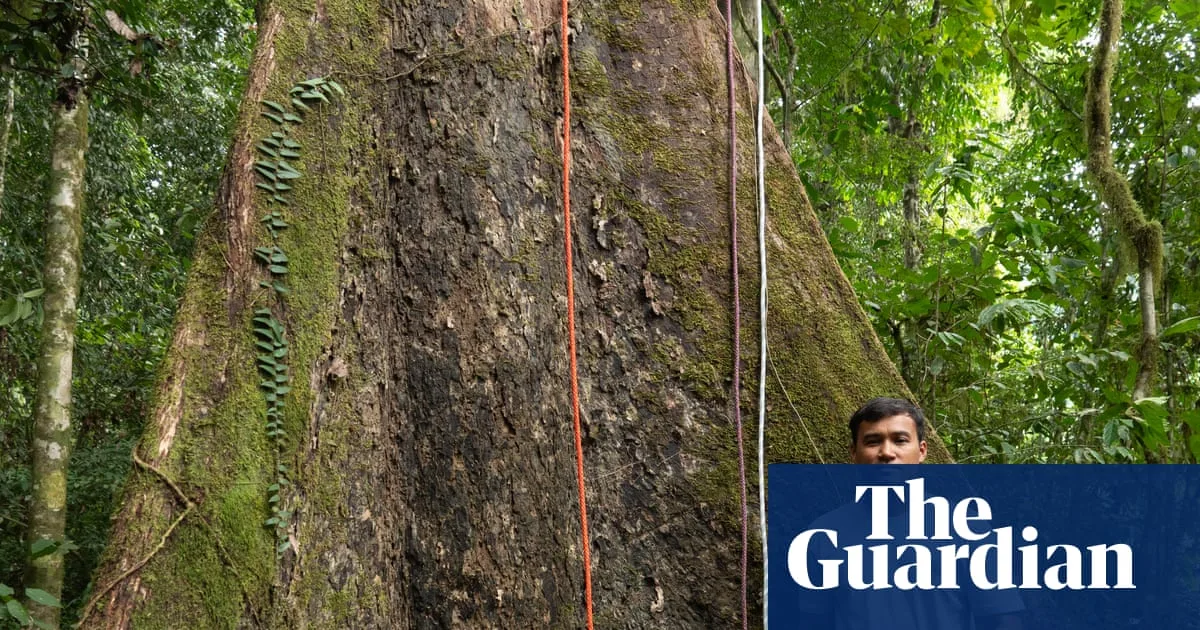
Unding Jami, a Malaysian conservationist from Tawau in Borneo, grew up around logging camps where his father worked. In the early 1990s, as forests were cleared for commercial use, he initially accepted it as normal. However, his perspective changed when he began working as a teenager at the South East Asia Rainforest Research Partnership in the Danum Valley, planting seedlings in deforested areas and learning about forest conservation.
At around 19, Jami saw colleagues climbing trees for scientific research—measuring heights and setting up wildlife cameras. Despite a fear of heights, he was determined to challenge himself and pursue tree climbing, noting that few conservation researchers work in the canopy. He has since dedicated his life to climbing trees.
In 2018, researchers from the University of Nottingham identified a yellow meranti tree in a Borneo rainforest, estimated at 100 metres tall and potentially the world's tallest tropical tree. Jami's team was tasked with verifying this. After a three-to-four-hour trek through dense forest to locate the tree, Jami delayed the climb for three months due to nerves. In January 2019, he led a team of ten, using 400 metres of rope and a fishing line to anchor ropes, and began the ascent with a colleague.
The climb was slow and cautious, checking for wasps, snakes, scorpions, and branch strength. Jami had previously been attacked by bees during a climb, receiving about 100 stings and passing out for 20 minutes. This time, the path was clear. At 70 metres, the ground team looked like tiny ants; soon, the forest floor was invisible. At 95 metres, branches became too thin to climb further, so Jami used a pole to measure the final height, reaching 100.8 metres.
From the top, Jami described the view as like a sea of tree ripples, with clouds over the forest and miles of lush green. The descent was quick, but he wanted to stay overnight. He has since climbed the tree again in about 40 minutes to install research cameras. Jami hopes his work highlights the importance of preserving forests, saying, 'Every tree tells a different story about our history.'