New planning rules introduced last week make it harder for developers to convert pubs into housing or offices, following the closure of 1,800 pubs across the UK over the last decade, including more than 790 this year alone, according to the Campaign for Real Ale (CAMRA). Of those closed this year, 82 have been demolished or converted for a different use.
The closures are attributed to rising operating costs and changing consumer habits, which have made it harder for the hospitality industry to thrive. Shut pubs often remain vacant, as prospective new owners are cautious about taking on a venue that has struggled financially. As a result, buildings are frequently bought by property developers looking to convert them into residential accommodation or offices.
New NPPF protections
The updated National Planning Policy Framework (NPPF), which came into force on August 17, contains more protections for pubs facing conversion. Under the new rules, developers must prove there is no reasonable prospect of keeping a pub as a going concern. Local authorities are also required to consider whether losing a pub would deprive a community of a place for people to gather.

Housing Secretary Angela Rayner said: "Pubs are part of who we are as a nation. They’re where we celebrate, grieve, argue and belong, the beating heart of so many of our communities, and it’s an outrage that weak protections have allowed too many of them to slip away without a fight."
She added: "That’s why we’re drawing a line so that developers have to prove there’s genuinely no way to save a pub before they can even think about knocking it down, because building the homes we desperately need should never come at the cost of the pubs we love."
Local reaction in Liverpool
Cllr Nick Small, Liverpool's Cabinet Member for Growth and Economy, said: "Pubs are at the heart of communities and I welcome Angela Rayner's announcement." He noted that planning applications must be determined in accordance with the development plan and national planning policy framework in force at the time a decision is made, adding that the Council will carefully consider any formal changes and apply new requirements through the planning process in Liverpool.
The new rules are too late to save some pubs, many of which have fallen into dereliction. One example is the Old Roan pub in Aintree, a non-designated heritage asset with a pub on the site for 400 years. The Old Roan opened in 1908 but was demolished after lying derelict for more than ten years, with plans approved to replace it with a housing development.
Restoration and stalled plans
Some disused pubs are being restored, including the Caledonia pub on Caledonia Street in Liverpool city centre, which closed last year. A new proposal would reopen the ground floor as a public house and enlarge a rear extension to create a four-bedroom apartment on the second floor.
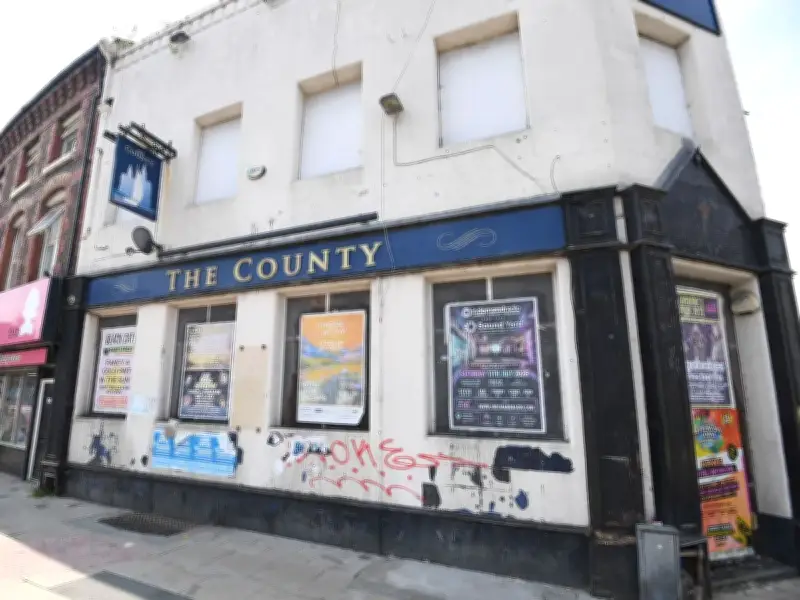
The County pub, near Goodison Park, closed between 2015 and 2016. The freehold was bought for £125,000 in September 2016 by Trivelles Landmark Ltd. A 2022 planning application to convert it into a ground-floor hotel with 11 flats was disposed of by Liverpool City Council under Article 40, and no approved plans exist for the site.
The Prince of Wales Hotel on London Road has been partly boarded up for almost 30 years. The ECHO found eleven planning applications submitted between 1995 and 2007, ten of which were approved with conditions but have now expired. Liverpool City Council owns the freehold, and a spokesperson said the council "would welcome the restoration and reuse of heritage assets wherever viable opportunities can be identified."
The Winslow Hotel on Goodison Road, a focal point for Everton fans, closed after visitor numbers dropped following the team's relocation. A 2024 application to convert the first and second floors into a 20-room hotel was refused in November 2025. The pub was put up for auction last month with indicative plans for retail units and apartments, but despite an offer for £350,000, no sale was agreed.