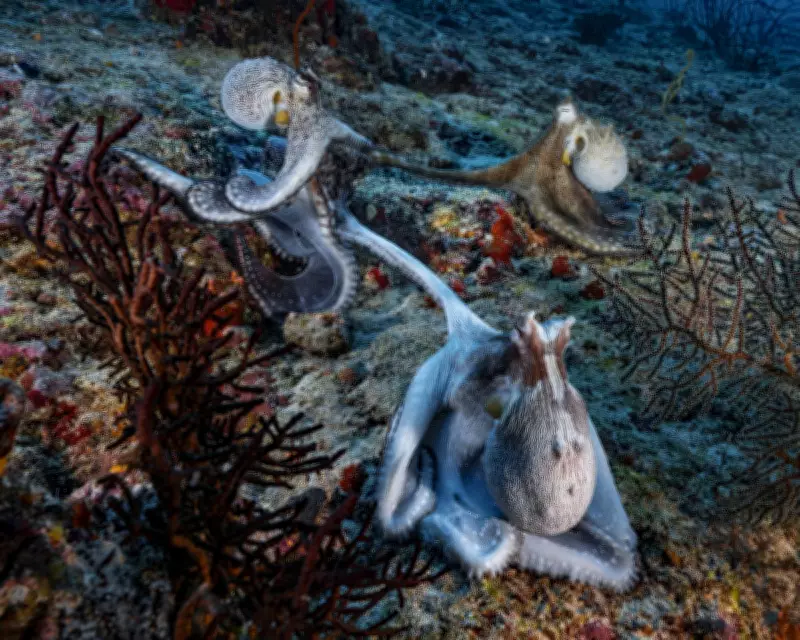
Octopus Mating Mystery: Specialised Arm Acts as Sensory Organ for Reproduction
Sex might appear an intimate act, but new research reveals how octopuses achieve it from a distance, using a unique biological mechanism. Male octopuses employ a specialised arm, known as the hectocotylus, to transfer sperm into the female's reproductive system. However, the precise methods by which this arm locates a mate and delivers sperm accurately have long puzzled scientists.
Breakthrough Discovery in Cephalopod Biology
Recent findings published in the journal Science indicate that the hectocotylus functions as a sensory organ, akin to a tongue, capable of detecting the female hormone progesterone. This allows male octopuses to seek out and fertilise females even when visual contact is impossible, a crucial adaptation for these solitary creatures.
Professor Nicholas Bellono of Harvard University, the senior author of the study, explained the significance of this mechanism. "It makes sense that the arm is both the sensor and the mating organ because in these chance encounters, the arm has to be able to both localise the female, localise the oviduct and very quickly initiate the mating or move on," he stated. This dual role enhances reproductive efficiency in environments where interactions are rare and potentially hostile.

Experimental Insights into Octopus Behaviour
The research team, including first author Pablo Villar, designed experiments to observe mating behaviours in California two-spot octopuses. They separated males and females in a tank using a black, opaque barrier with holes large enough for arms to pass through. Initially, the plan was to allow the octopuses to acclimate before removing the barrier, but an unexpected event occurred.
The male octopus extended its specialised arm through a hole, located the female, inserted it into her mantle—the sac containing vital organs—found the egg-transport tubes, and began mating. This behaviour was replicated with other pairs and even in darkness, confirming that visual cues are unnecessary for copulation. Notably, no mating attempts were observed between male pairs, highlighting the specificity of this sensory response.
Role of Progesterone in Triggering Mating
Investigating further, the team discovered that female octopuses release progesterone from their ovaries and skin. In tests, amputated hectocotyli of males moved when exposed to progesterone but not to similar hormones, indicating a targeted chemical sensitivity. In barrier experiments where females were replaced with tubes containing various substances, males actively explored and attempted to mate with the progesterone-filled tube, demonstrating that this hormone alone can trigger key aspects of mating behaviour.
Additional experiments identified receptors on the tip of the male's specialised arm involved in progesterone sensing, suggesting recent, rapid evolution across cephalopods. Bellono noted, "This raises the intriguing possibility that these chemical cues help encode both sex and species identity." While progesterone sensitivity was consistent across species, responses to other hormones varied, potentially influencing reproductive barriers and crossbreeding.
Implications for Evolutionary Biology
This research provides insights into how sensory systems evolve to maintain or blur reproductive boundaries, possibly leading to new species. Bellono emphasised the importance of observational science, stating, "We didn't really plan to study that this arm was a sensor. It was sort of revealed to us by watching the animals." The findings underscore the complexity of marine life and open new avenues for studying animal behaviour and reproduction in cephalopods.