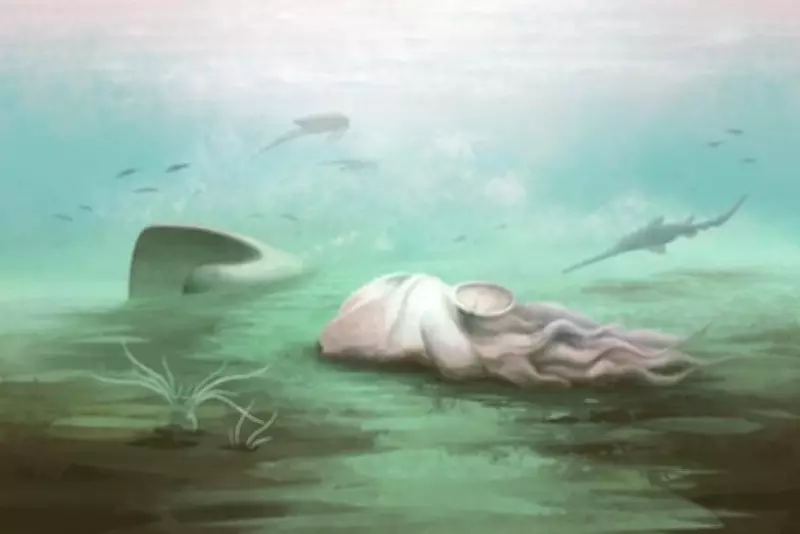
In a groundbreaking paleontological discovery, a fossil previously hailed as the world's oldest octopus has been dramatically reclassified following new scientific analysis. The specimen, known as Pohlsepia mazonensis and dating back an astonishing 300 million years, has now been identified as a relative of the modern nautilus, fundamentally reshaping our understanding of cephalopod evolution.
Advanced Imaging Uncovers Hidden Details
Researchers at the University of Reading employed state-of-the-art synchrotron imaging technology to conduct a meticulous scan of the ancient fossil. This high-resolution technique revealed previously invisible anatomical features, most notably a set of tiny teeth that were part of a radula feeding structure. These minute details had eluded earlier examinations due to their size and the fossil's preservation state.
Anatomical Evidence Points to Nautiloid Origins
The critical finding from the scans was the configuration of these teeth. In octopuses, the radula typically features fewer teeth per row, but the fossil displayed a pattern inconsistent with this anatomy. Instead, the dental arrangement aligned more closely with that of nautiloids, a group that includes the modern nautilus. This discrepancy provided the key evidence necessitating the re-evaluation of the fossil's classification.

Scientists hypothesize that the specimen underwent partial decomposition before the fossilization process, which may have initially obscured its true characteristics. This decomposition likely contributed to the earlier misidentification, as the fossil's appearance superficially resembled that of an octopus.
Implications for Evolutionary Timeline
The reclassification carries profound implications for the evolutionary history of octopuses. If Pohlsepia mazonensis is not an octopus, then the earliest confirmed octopus fossils likely date to the Jurassic period, which began approximately 201 million years ago. This suggests that octopuses emerged significantly later in Earth's history than previously thought, potentially by tens of millions of years.
This adjustment to the timeline necessitates a revision of scientific models regarding cephalopod diversification and adaptation. Understanding when octopuses first appeared helps researchers trace the development of their unique traits, such as their intelligence, camouflage abilities, and complex nervous systems.
Broader Context in Paleontology
This case underscores the importance of advanced technological tools in paleontology. Synchrotron imaging, which uses intense X-rays to create detailed internal views, is revolutionizing the field by allowing scientists to examine fossils non-destructively and with unprecedented clarity. Such technologies are crucial for verifying identifications and uncovering new insights from ancient remains.
Moreover, the discovery highlights the dynamic nature of scientific knowledge. As techniques improve and new evidence emerges, long-held assumptions can be challenged and corrected, leading to a more accurate understanding of prehistoric life. This iterative process is fundamental to the progress of paleontology and evolutionary biology.
In summary, the re-identification of Pohlsepia mazonensis from an ancient octopus to a nautiloid relative marks a significant correction in the fossil record. It not only clarifies the origins of octopuses but also demonstrates the power of modern imaging in uncovering the truths of deep time.