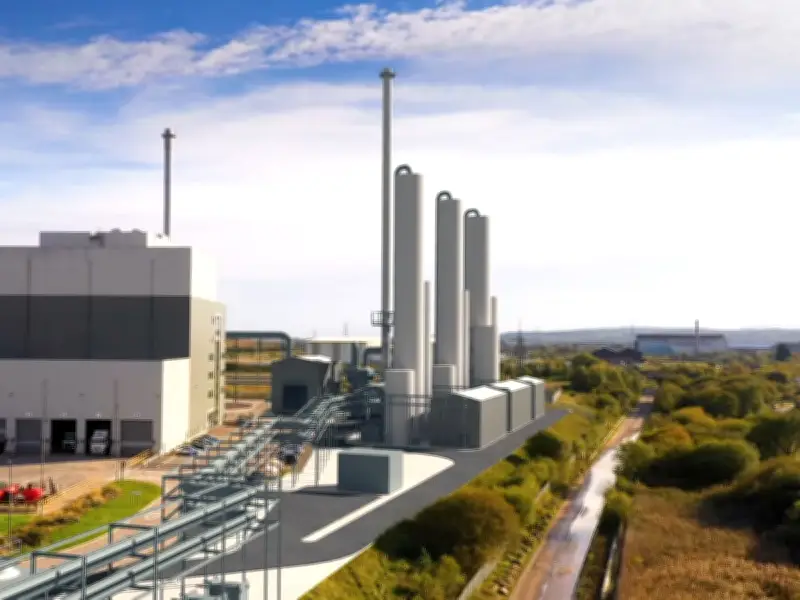
Flintshire County Council's planning committee has approved a £200m carbon capture facility at the Parc Adfer energy-from-waste plant, which will capture 95% of carbon emissions from the site.
The plant, operated by Enfinium, treats 232,000 tonnes of non-recyclable waste from Flintshire, Denbighshire, Gwynedd, Conwy and the Isle of Anglesey, converting it into 21 megawatts of electricity exported to the National Grid to power the equivalent of 45,000 homes.
The new carbon capture facility will capture 95% of all carbon emissions from the site and feed them into the Hynet pipeline for permanent storage. Approval was delayed last month because neighbouring authorities in England had not been consulted.
Energy Export Impact
Communities in Cheshire West have now had an opportunity to have their say, and the planning committee approved the plans last Wednesday. However, during the discussion, it was revealed that the energy consumption of the carbon capture plant would mean only 7.9 megawatts of electricity could be exported back into the National Grid – enough to power just 6,320 homes. The rest of the energy generated by Parc Adfer would be required to operate the carbon capture facility, which will use the equivalent of 38,000 homes' worth of electricity to run each year.
Councillors acknowledged that while the energy export impact was disappointing, the fact the plant was making a significant contribution to carbon reduction and was powering itself meant it was a positive for the county.
Councillor Reactions
Councillor Chris Bithell told the planning committee: "I think it's a bit sad really that some of the electricity that's going to the grid has been taken up by this new process. Carbon capture such as this is not the ideal solution. The ideal solution is to get into carbon emissions full-stop. But that's going to take considerable time to achieve and there'll always be some form of carbon emissions anyway. This is a novel way of dealing with the situation as a kind of a medium-term proposal to deal with this issue. It is a method of reducing carbon emissions into the atmosphere and improving the general environment, the atmospheric effect and, of course, the impact on public health and wellbeing."
Councillor Andrew Parkhurst asked whether the published carbon capture figure of 95% was accurate or an estimate. He said: "Looking at statements from the European Union and the Institute for Energy Economics and Financial Analysis (IEEFA), the real-world carbon capture rate for similar plants essentially seems to be near 50%. Is 95% an aspiration or is it a realistic prospect based on solid evidence?"
Technical Assurance
Tom Dearing, chartered environmental assessor for global real estate firm Savills, which has consulted on the plans, explained that the target had been set based on testing work done by Enfinium and would be monitored through permit by Natural Resources Wales. "The 95% carbon capture rate is one Enfinium is confident in achieving," he said. "We can say that because Enfinium has engaged over the past three or four years with several technology providers and indeed tested a pilot plant to assure themselves it does work at the level predicted. The environmental permitting process imposes a requirement to implement best available techniques for this type of technology – and the minimum performance target that's set through that is 95%. So evidence will be provided to NRW through the permitting process as well."
The application was approved by majority vote with one abstention.