
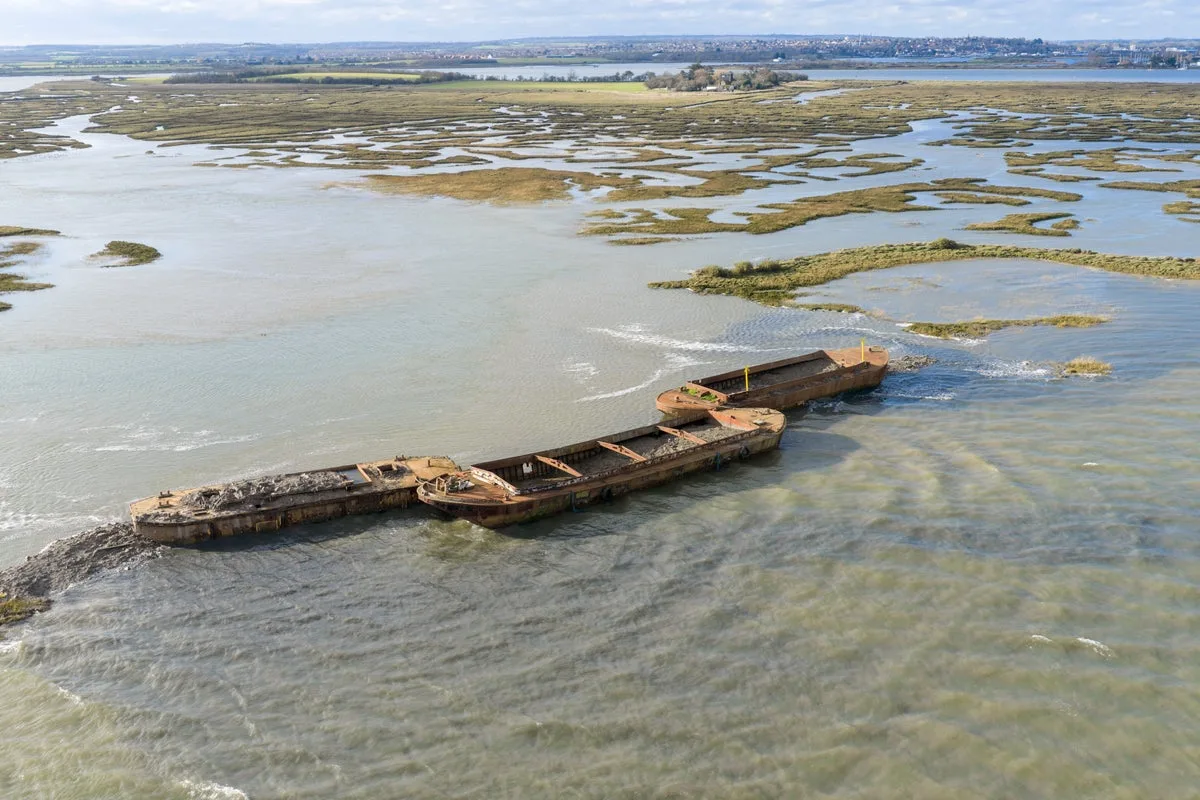
The National Trust has sunk three decommissioned barges in the Blackwater Estuary, Essex, to create a new island habitat for birds. The project, described as the ultimate act of marine recycling, will see up to 8,000 cubic metres of sediment used to fill and surround the vessels, requiring around 170 dredge barge trips from Maldon harbour.
The sunken craft are former Thames lighters dating from the 1950s, which once transported building materials, coal, and food from the Port of London. The flat-bottomed barges measure between 20 and 32 metres long. Holes have been cut in their hulls to sink them and use them as a stable structure that will become a habitat for birds including dunlin, curlew, lapwing, ringed plover, little terns, and avocets.
Katy Gilchrist, coastal project manager for the National Trust, said: “This is the ultimate act of marine recycling — transforming retired industrial vessels into a sanctuary for wildlife. We’re basically turning history into habitat and, as far as we know, no one has attempted anything quite like this before.” She added that the lighters had been decommissioned for some time, requiring specialist contractors to make them clean and seaworthy before being towed into place and set on a platform of sediment.
Once the work is complete, the island will add 0.55 hectares (1.4 acres) of new habitat – almost the size of a football pitch – within the Blackwater Estuary, just off the eastern shore of the National Trust’s existing Northey Island. Matt Wilson, countryside manager for the National Trust, said the island “will provide a refuge for birds above the highest tides and away from disturbance on shore”. He hopes to see oystercatchers, Brent geese, redshank, and curlew using the sanctuary.
Wilson also noted that the island will help reduce erosion of the existing saltmarsh at Northey Island, which acts as a natural flood defence and is one of the biggest natural carbon stores in the marine landscape. “By sheltering the marsh from wave energy, the new island will also help us slow erosion and protect this precious habitat,” he said.




