
Archaeologists in Egypt have announced a series of significant discoveries, including a marble head of Aphrodite, the ancient Greek goddess of love and beauty, alongside Pharaonic funerary furniture and the remains of a Roman basilica. The findings are part of a broader governmental initiative to invigorate the nation's tourism industry and inject much-needed capital into its economy, following the recent inauguration of the Grand Egyptian Museum near the Giza Pyramids.
The marble head of Aphrodite and the basilica remains were unearthed in an ancient necropolis within the Beni Suef province, approximately 80 miles south of Cairo. This site, known as Ehnasiya or by its Roman name Heracleópolis Magna, was historically one of ancient Egypt's most prominent cities. Mohammed Abdel-Badei, head of the antiquities department at the Supreme Council of Antiquities, detailed the discovery of massive stone blocks, weighing up to 45 tons, that once supported the basilica's columns, with three still standing in their original positions. The Aphrodite head, measuring about 9½ by nearly 10 inches, showcases intricate facial features and curly hair, reflecting classical Greek and Roman artistic traditions.
Further excavations at Ehnasiya revealed inscriptions linked to Senusret III, a notable ruler of Egypt’s Middle Kingdom from the 12th Dynasty (1837-1819 B.C.), including his throne and birth names. Fragments of wall statues and terracotta molds, believed to have been used for coin crafting during the Roman period, were also found. These artifacts suggest Ehnasiya served as a vibrant economic and commercial hub when Egypt was part of the Roman Empire between 30 B.C. and A.D. 395.
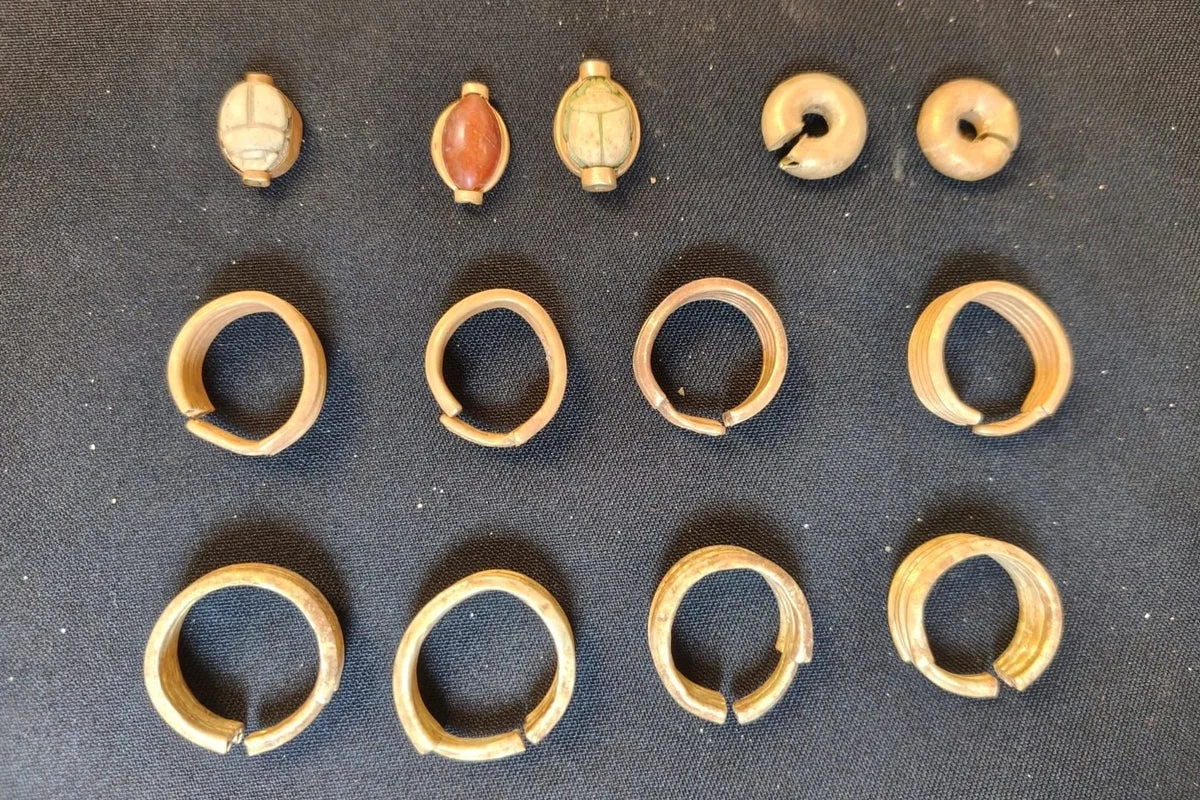
Meanwhile, in Cairo's Matariya neighborhood, once part of the ancient city of Heliopolis, archaeologists uncovered a nearly complete set of funerary furniture. This included a mudbrick burial with gilded remains in a coffin, thought to belong to a military figure, along with a cache of cosmetic tools such as a copper mirror and alabaster kohl containers. A collection of five pairs of yellow-colored metal earrings, varying in size and believed to be gold, was also among the finds.
These latest archaeological revelations are strategically aimed at bolstering Egypt's vital tourism sector, which relies heavily on antiquities sightseeing. The industry has faced considerable challenges, enduring political turmoil and violence following the 2011 uprising, and more recently, recovering from the coronavirus pandemic and the economic fallout of the Russia-Ukraine war. Despite these hurdles, official figures indicate a record 19 million tourists visited Egypt last year, marking a 21% increase from the prior year. The first four months of 2026 saw 6.1 million tourists, compared with 5.7 million during the same period in 2025, according to the prime minister’s office.




