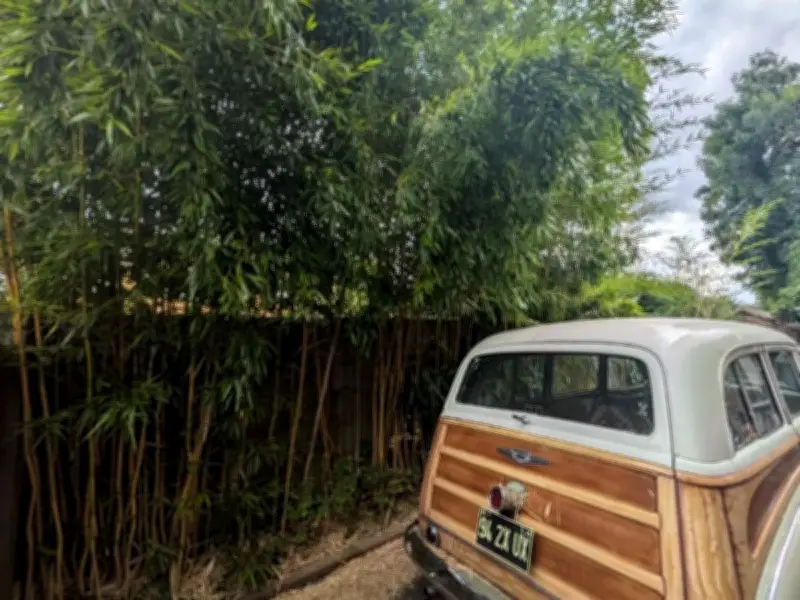
Homeowners are being urged to check their gardens for signs of spreading bamboo after a woman in Surrey found it had encroached into her neighbour's garage. Bamboo can grow rapidly and, if left unchecked, can break through floors and walls and cause serious damage to plumbing.
This was nearly the reality for 66-year-old Jill, from Woking. Jill had hired a landscaper 15 years ago and had the plant installed in her garden. Her landscaper assured her the plant was contained and would not spread. However, years later, her neighbour noticed an unusual plant growing on their side of the fence. These turned out to be bamboo shoots, from the very same bamboo Jill had planted in her garden all those years before.
Bamboo spreads into neighbour's property
Initially, neither party was particularly worried — but then bamboo shoots began emerging in the neighbour's lawn, pushing through the boundary fence and into the garage wall and roof. The bamboo dislodged the guttering and started growing inside the building itself.
During removal work carried out in both gardens by Environet, the team found that a root barrier had been fitted around the original bamboo plant, which had deteriorated over time, making it completely useless.
Jill said: "I was aware that bamboo could be invasive, but our gardener reassured us at the time and we didn't give it another thought for 13 years. Even when our neighbour first mentioned it coming through on their side, we didn't fully understand the extent of the problem."
She added: "It was a real shock to discover bamboo growing inside their garage, but once we saw what was happening and the speed the problem was developing, we knew we needed to get it dealt with quickly. Thankfully, we're on good terms with our neighbours, and they've been very understanding!"
Bamboo's invasive nature and costs
Bamboo can prove tricky to get rid of, as it spreads via lengthy underground roots that can travel unnoticed beneath lawns, paving, flower beds and fences. It's frequently planted along boundaries for screening and privacy, but this means it can easily creep between properties. Even chopping bamboo back won't eliminate it, as it keeps spreading until it's physically dug out of the ground.
Fresh data from invasive plant specialist Environet reveals that boundary encroachment accounted for 33% of its bamboo enquiries so far this year, up from 30% in 2025. By comparison, just 12% of Japanese knotweed enquiries involved encroachment during the same period. This indicates bamboo is nearly three times more likely than Japanese knotweed to invade neighbouring properties.
Environet data puts the average cost of professional bamboo removal with a guarantee at £6,200. If left untreated, bamboo can rapidly become costly to tackle. Removing it early, before it spreads and harms gardens, sheds, patios or paths, can help keep costs manageable.
Despite these dangers, a surprising number of people remain in the dark about bamboo's invasive nature. YouGov research commissioned by Environet in 2025 found that only 35% of British adults knew bamboo could physically damage property, and just 23% knew it could lead to legal claims if allowed to spread.
Environet director Emily Grant said: "Bamboo is unusual because there can be such a long lag between planting it and it becoming a problem. A homeowner might see very little change for years, so naturally, they assume it's staying put, but this can change quite suddenly."
She added: "With no apparent warning, it can start spreading rapidly and sending new shoots out way beyond the original planting area. By the time they emerge in a neighbour's garden or close to a building, the underground spread may already be extensive. Jill's experience shows how easily homeowners can be caught out."
How to safeguard your home from bamboo
Check regularly for warning signs, such as shoots appearing in new locations or displaced paving stones. If you're worried, have an early conversation with your neighbour. Ask whether they know what variety of bamboo it is and whether it's showing any signs of spreading.
If bamboo crosses the boundary, act swiftly. Notify your neighbour straight away in writing and request that they arrange a bamboo survey to establish the best course of action. Tackling the problem early will keep costs down in the long run.
As a final option, or if your neighbour won't get rid of the bamboo, put in a bamboo-proof root barrier to safeguard your garden. It needs to be extra strong, 0.5 metres deep, and have no gaps or weak spots. If it's already spread into your space, you might be able to claim back the expense from your neighbour.