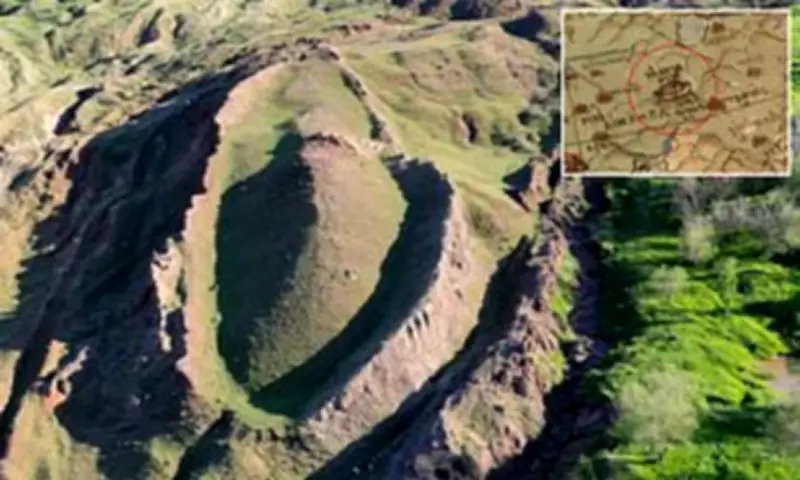
A remarkable 16th-century world map, created by Italian nobleman and cartographer Urbano Monte in 1587, may have pinpointed the legendary resting place of Noah's Ark nearly 440 years before modern researchers began their search. The massive Planisphere, which stretches nearly 10 feet wide when fully assembled, is adorned with intricate illustrations of continents, mythical creatures, and uncharted territories. Hidden within this cartographic masterpiece is a small depiction of Noah's Ark resting on the mountains of Ararat in what is now modern-day Turkey—the very region where many believe the biblical vessel still lies concealed.
The Map's Discovery and Significance
Monte crafted the map during the height of the Age of Exploration, a period when European cartographers were rapidly updating their knowledge of the world following voyages to the Americas and Asia. Unlike most maps of the 16th century, Monte's Planisphere adopts a north polar perspective, placing the Arctic at the center of the world. The enormous map consists of 60 separate hand-drawn sheets that can be assembled into a single circular image nearly 10 feet across. It is filled with elaborate illustrations of ships, sea monsters, mythical creatures, and detailed notes describing distant lands and cultures. Historians believe Monte was inspired to create the map after a Japanese delegation visited Milan in 1585, exposing Europeans to new global perspectives. The original manuscript is now housed at Stanford University's David Rumsey Map Center, where it has been digitally restored and made available online.
Connection to the Durupınar Site
The depiction of Noah's Ark on the mountains of Ararat has drawn significant attention because it predates modern archaeological investigations into the biblical story by centuries. The Bible states in Genesis 8:4 that the Ark came to rest on the 'mountains of Ararat' after the Great Flood. Some online viewers have noted that Monte's illustration appears to align closely with the mysterious Durupınar site, a boat-shaped geological formation located just 18 miles south of Mount Ararat, Turkey's tallest peak. Independent researcher Jimmy Corsetti wrote online: 'The same location as the Durupinar site, virtually the exact same length. Coincidence?'

The Durupınar Formation emerged less than a century ago, according to local reports. Heavy rains and earthquakes in May 1948 washed away surrounding mud, revealing the formation, which was later discovered by a Kurdish shepherd. Researchers have investigated the site since the 1970s, hoping to determine whether it is a natural geological structure or the remains of the biblical Ark. Biblical measurements describe the Ark as 300 cubits long, 50 cubits wide, and 30 cubits high—approximately 515 feet long, 86 feet wide, and 52 feet tall. The dimensions of the Durupınar Formation appear to match these measurements, adding to the intrigue.
Modern Investigations and Discoveries
Archaeologist and amateur researcher Ron Wyatt first visited the Durupınar site in 1977, claiming the boat-shaped formation was the remains of Noah's Ark. Decades later, in 2019, the Noah's Ark Scans team began exploring the mysterious mound with modern technology to peer deep below the surface. The team recently announced the discovery of hidden tunnels and chambers that align with biblical descriptions of the Ark. Andrew Jones, an independent researcher with Noah's Ark Scans, used ground-penetrating radar to uncover a network of 'corridors' converging on a hollow central chamber he dubbed the atrium. Jones linked the discovery to the Bible's description of the Ark, which states the boat contained three internal levels built to shelter Noah, his family, and pairs of animals.

Further studies using infrared thermography (IRT), a heat-sensing technology that can uncover hidden structures underground, have also suggested the presence of a ship-shaped hull buried deep in the soil. In 2024, researchers identified angular structures as deep as 20 feet beneath the surface, features that could represent rooms below a deck-like platform. While many scientists argue that the formation is a naturally occurring geological feature, the team at Noah's Ark Scans firmly believes it points to something far more extraordinary. The ongoing debate continues to captivate both believers and skeptics, as modern technology sheds new light on one of history's most enduring mysteries.