Yellowstone Supervolcano's Magma Source Found to Be Surprisingly Shallow
A groundbreaking new study has fundamentally altered our understanding of the Yellowstone supervolcano, one of Earth's largest active volcanic systems. Contrary to long-held scientific belief, the magma fueling this geological giant originates from a much shallower source than previously imagined.
Rethinking the Volcanic Engine
For decades, scientists operated under the assumption that supervolcanoes like Yellowstone were powered by vast chambers of liquid magma deep within the Earth's crust. These chambers were thought to fill via narrow columns of superheated rock, known as magma plumes, rising from the planet's deep interior.
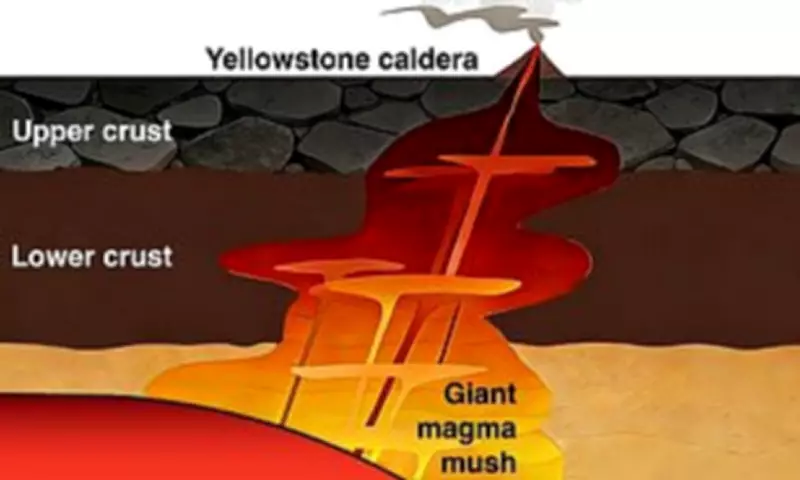
However, research led by Chinese scientists now demonstrates that Yellowstone's volcanic engine operates at a significantly shallower depth. Rather than drawing from deep sources, the volcano taps into a layer of partially molten rock just below the Earth's crust, described by researchers as a 'magma mush' system.

The Mechanics of the Magma Mush
The study, published in the prestigious journal Science, proposes that Yellowstone sits atop a large, spread-out zone of this magma mush. As tectonic forces stretch and tear the Earth's rigid outer shell, molten rock seeps upward from the upper edges of the semi-molten mantle layer known as the asthenosphere.
This process creates a channel that allows magma to rise and accumulate. The interaction between the rising molten rock and the solid material above it forms a highly viscous magma mush that fills the volcano's chambers.
'This discovery is crucial for evaluating hazards at the Yellowstone volcanic system and other similar volcanic systems around the world,' noted Dr. Jamie Farrell, associate professor of geology and geophysics at the University of Utah, in a review of the findings.
Implications for Eruption Potential
The critical consequence of this new model is that Yellowstone can fill its potentially explosive magma chambers through tectonic activity alone, without requiring a deep magma plume. This understanding arrives amid growing concerns about the supervolcano's activity levels.
Yellowstone, which lies beneath the 30-by-45-mile crater of the Yellowstone Caldera, has produced two supereruptions over the past 2.1 million years. Such events are among Earth's most catastrophic geological hazards, capable of launching over 1,000 cubic kilometers of material and causing widespread environmental impacts, including climate disruption.
Increased Seismic Activity Detected
Recent monitoring has revealed troubling signs of increased activity. A separate study using artificial intelligence detected more than 86,000 'hidden earthquakes' between 2008 and 2022—ten times more tremors than scientists had previously identified.
Worryingly, over half of these earthquakes occurred in swarms—small groups of interconnected tremors that often precede volcanic activity. Researchers found these chaotic swarms moving along rough, young fault lines deep below the caldera.
While experts suggest these tremors are likely caused by hot, mineral-rich water forcing through rock cracks and may indicate steam-driven geyser eruptions rather than a catastrophic magma event, the sheer volume of seismic activity is cause for heightened vigilance.
The Staggering Scale of a Potential Eruption
The potential consequences of a Yellowstone supereruption are almost unimaginable in scale. Studies suggest such an event could cover up to two-thirds of the United States with ash, rendering entire states uninhabitable due to toxic air.
The aftermath would likely involve:

- The grounding of thousands of flights across North America
- The forced evacuation of millions of residents from affected regions
- Severe, long-term disruption to agriculture, infrastructure, and climate patterns
- Potential global climatic effects lasting years
Could an Eruption Be Prevented?
NASA has previously explored theoretical methods to mitigate the Yellowstone threat, including a proposal to drill up to six miles into the supervolcano to pump in water at high pressure, thereby cooling the magma. This ambitious plan, estimated to cost $3.46 billion, could potentially use the extracted heat to generate geothermal power.
However, the approach carries enormous risks, including the possibility of inadvertently triggering the very eruption it seeks to prevent. Even if successful, the cooling process would proceed at an excruciatingly slow pace—approximately one meter per year—meaning it would require tens of thousands of years to complete, with no guarantee of success for centuries or millennia.
While the US Geological Survey currently estimates there may be about 100,000 years before Yellowstone is likely to erupt, the new understanding of its shallower magma source and the detection of increased seismic activity underscore the importance of continued monitoring and research into one of Earth's most formidable geological features.