
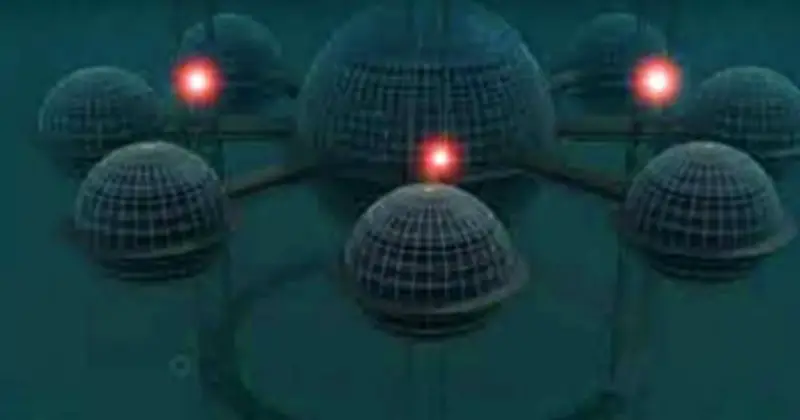
As Britain swelters under a record-breaking June heatwave, with temperatures forecast to hit 39°C and red extreme heat warnings in place across southern and central England, resilience architect Philip Pauley argues that humanity's best bet for surviving extinction-level threats lies in vast, self-sustaining underground habitats. These bunkers could withstand asteroid strikes, nuclear war, and climate collapse.
Closed-Loop Systems for Survival
Mr Pauley, whose work spans high-level concept design, futurism, and operational resilience, has long championed closed-loop systems. His earlier concepts, such as the Sub-Biosphere 2 underwater habitat, explored self-sufficient living in extreme environments. Now, his focus has shifted to terrestrial underground worlds—digital twins that could soon become physical bunkers sustaining human life for years without resupply.
Current Heatwave Underscores Urgency
The current heatwave, part of a pattern of intensifying extreme weather linked to climate change, underscores his urgency. With hosepipe bans, school disruptions, and health alerts in force, Mr Pauley sees Earth itself beginning to resemble the hostile conditions we imagine on Mars. He warns: “Climate change is the biggest threat humanity has ever faced, the biggest threat to our civilisation. What makes it uniquely dangerous is that it is not a single event but a slow, compounding crisis that erodes the foundations everything else depends on: food, water, stable societies.”
Existing Precedents for Underground Living
In an era of rising global risks—geopolitical tensions, potential pandemics, and cosmic threats—Mr Pauley's underground habitats represent “critical national infrastructure” rather than fringe survivalism. Existing precedents include military bunkers, Antarctic research stations, and submarine crews enduring months in sealed systems. The leap, he says, is scaling these for longer durations and larger populations while achieving true self-sufficiency.
Timeline for Demonstration Habitats
When asked about the transition from digital designs to reality, Mr Pauley states: “Closer than most people realise. There are already real-world examples of sealed, underground environments sustaining human life… The technology exists. What we are now working on is scaling that capability: extending the duration, increasing the number of people a habitat can support, and making the systems genuinely self-sustaining rather than dependent on resupply.” He envisions demonstration habitats within a decade, given sufficient investment. Digital twins allow comprehensive stress-testing: “The digital twin phase allows us to stress-test every variable before a single brick is laid.”
Engineering and Psychological Challenges
Engineering challenges around water recycling, oxygen generation, and vertical farming are solvable, Mr Pauley insists. The tougher nut is human psychology. He explains: “Keeping people psychologically whole over years of confinement, cut off from natural light, open space and the rhythms of the outside world, is a far more complex problem.” His solution involves immersive AI and extended reality experiences designed not just for entertainment but to foster “a sense of place, connection and purpose.” He adds: “If your habitat keeps people breathing but breaks them mentally, it has failed. The two are inseparable.”
Earth-First Approach to Space Colonisation
Mr Pauley directly addresses the Mars debate, arguing that perfecting closed-loop living on Earth is essential before any off-world leap. He poses rhetorically: “If we successfully master self-sustaining, closed-loop living here on Earth, does that change the timeline or urgency for colonising Mars? Yes, and I believe it accelerates the likelihood of any Mars mission actually succeeding… We don't go to Mars to experiment. We go to Mars to survive. Getting that right on Earth first is not a detour, it's the only sensible route in my view and I would love to hear Elon Musk's view on it.”
Technology Transfer to Surface Applications
This pragmatic stance positions underground bunkers as a bridge, not a retreat. Technologies developed for disaster resilience—extreme recycling and vertical farming—can deploy on the surface immediately to tackle current crises. Mr Pauley says: “Think of it like Formula 1. The extreme engineering demands… have given us advances… that ended up in ordinary road cars. The same principle applies here.” Vertical farming systems proven underground could transform urban food security above ground. He notes: “Survival engineering is sustainability engineering, they are the same discipline.”
Inspiring the Next Generation
Beyond survival, Mr Pauley sees profound opportunity. He is passionate about engaging young people in engineering, framing resilience architecture as a frontier of hope. He says: “Resilience architecture is not about telling young people the world is ending, it's about showing them that there is an entirely new industry to build, and they are the ones who will build it.” Closed-loop habitats, AR-guided systems, and circular manufacturing represent “a vast new frontier” that energises rather than frightens the next generation. He continues: “The young people I speak to are not frightened by these ideas. They are energised by them. They want to solve hard problems, and these are among the hardest and most meaningful problems our civilisation faces.”
Societal Consensus as the Main Barrier
According to Mr Pauley, the primary barrier is not technological but societal. He notes: “The biggest hurdle is not the technology, it is the consensus. The engineering solutions either exist or are within reach. What is missing is the public will and support… The biggest hurdle right now is persuading people that this is not science fiction. It is critical national infrastructure.” As the heatwave grips the UK and climate impacts mount, Mr Pauley's message is clear: rather than pinning all hopes on a multi-planetary future, we must first secure our home planet's resilience—underground if necessary. Building these giant bunkers isn't defeatism; it's the ultimate act of ingenuity and optimism in the face of existential threats. With political will and investment, the underground worlds he designs could move from concept to cornerstone of human survival.




