
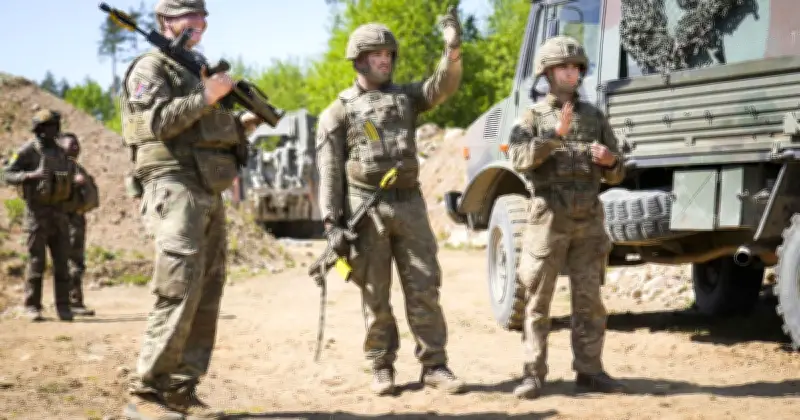
NATO allies, including the United Kingdom, are intensifying defensive preparations in the Baltic Sea region amid rising concerns over Russian aggression and the potential for a broader conflict. Military officers and officials have warned of growing threats, prompting the alliance to bolster its presence along Europe's eastern flank.
US Seabees Construct Key Infrastructure in Latvia
As part of the Baltops exercise, US Navy Seabees have been constructing boat ramps on Latvia's western coast to enable rapid reinforcement and counter-offensive operations against a possible Russian invasion, according to military officers. Captain Allen Willey, the Seabees' commanding officer, inspected a ramp built at an 11-degree incline designed for offloading troops, vessels, and military vehicles. The veteran construction battalion, operating under the motto “Can Do” since 1942, is positioned to play a critical role in logistics and resupply for NATO's eastern flank.
Baltic Sea: Europe's Strategic Sea
The Baltic Sea is viewed by military experts as Europe's key “strategic sea,” bordered by eight NATO members and Russia. Swedish officials have warned that Russia is preparing plans to occupy Gotland Island to test NATO's resolve, while analysts have highlighted potential hybrid threats to Denmark's Bornholm. Western officials have expressed concerns that Moscow could target a Baltic state within the next few years, posing a major test of NATO's Article 5 collective defence commitment.
Preparations and Exercises
During Baltops, Seabees also assembled wooden Arctic huts intended for temporary billets, storage, or command posts, while US Marine demolition teams practised clearing obstacles using C4 explosives. Lieutenant Commander Cody Robertson told The Telegraph that the drills enhance preparedness: “This exercise will make us better prepared, if defence is required.” He emphasised the increased importance following Finland and Sweden's accession to NATO.
Satellite Imagery Shows Russian Build-Up
Satellite imagery reported by Danish broadcaster DR has shown Russia clearing forested areas for new barracks, combat divisions, and vehicles near the borders with Estonia and Sweden. Experts have also pointed to a pattern of suspected Russian sabotage targeting undersea cables in the region.
Latvian Perspectives on Deterrence
Latvia's former intelligence chief Janis Kazocins said that the Baltic states are especially exposed: “As tiny countries with limited resources, we need to be absolutely sure that our deterrence is strong enough to make sure Russia does not view us as a suitable target.” Latvia has increased its defence spending to 4.9% of GDP in response to the threats, drawing on its history of Soviet occupation.
In Riga, administrative worker Daiga Klavina said that the exercises support readiness: “The more we know, the better we are prepared.” A Russian-speaking resident named Renars criticised the situation, saying: “It’s all bull----. The politicians are trying to involve us in a war.” Latvia’s Foreign Minister Baiba Braze said the drills affirm strong alliance support: “The United States has been, and remains, an indispensable ally for Latvia and European security.”
Strategic Importance of the Baltic Sea
The Baltic Sea accounts for 15% of global cargo traffic and provides Russia with vital naval access to the Baltic Fleet and the heavily armed Kaliningrad exclave. Senior military figures have cited General Dwight D. Eisenhower’s assessment that logistics frequently determine the outcome of battles and wars. As the Seabees concluded the exercise with a controlled C4 detonation, officers described the activity as evidence of sustained commitment. UK-backed NATO measures for a potential “Battle of the Baltics” are advancing amid heightened tensions.




