
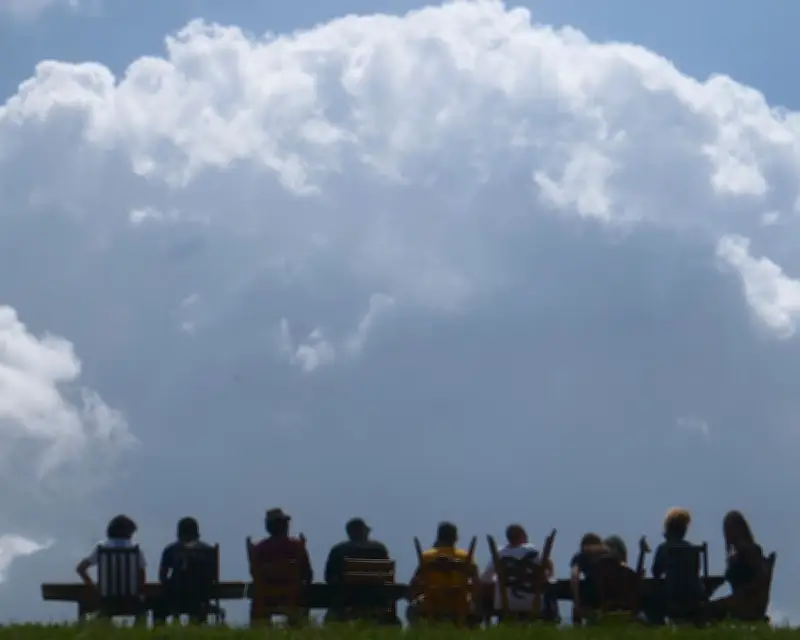
In his new documentary The Welcome Table, director Josh Fox brings together people from across the world whose lives have been dramatically altered by the climate crisis. The film, airing on HBO on 23 June, is part stark warning and part opportunity to enter into the experience of those living on the front lines of global warming.
Fox, the Emmy-winning director of Gasland, travels from Paradise, California—site of wildfires that killed 85 people—to torrential rains in São Sebastião, Brazil, drought in Kenya's Turkana Basin, and other disaster-stricken regions. The film culminates with participants gathering at a large table in New Orleans, eating and singing together.
Collective Joy as Antidote to Division
“The sound of the thousand voices singing together is something I want to bring all over the world,” Fox told me. “I didn’t anticipate it, but I learned how powerful that can be. I think we underestimate how powerful collective joy can be.” He believes a welcome table is the perfect antidote to a wall—like the one on the US southern border—and argues that with climate change unfolding, we must prepare to welcome new neighbors.
“Welcoming is a practice,” he said. “It’s hard, it’s not an easy thing to do. Encountering people from other cultures is a difficult project. The film offers that template, and I think that’s the most powerful aspect of it.”
Dire Warnings and Climate Migration
The film warns that one third of all humanity could lose their homes due to climate change. A 2020 article in PNAS suggested that 1 in 3 people may need to move to cooler regions due to extreme heat, while the World Bank in 2021 estimated 216 million climate migrants by 2050. Even if less severe, Fox stresses that combined with rising hatred against LGBTQ+ people, wars, and poverty, migration will continue to grow.
“Climate change is a form of economic and political oppression that is created by a billionaire class that refuses to stop,” Fox told me.
LGBTQ+ Community on the Front Lines
In Brazil, Fox meets Léo Farah, a firefighter-turned-humanitarian who co-founded Humus to mitigate climate disasters. While documenting a landslide, Fox encounters a group of LGBTQ+ Brazilians in a favela. He connects with Gabriel, a gay man who fled his home after coming out and now helps disaster victims. This “queer dream team of disaster mutual aid workers” navigates the favela offering hope.
“I went to cover the landslide, and I didn’t anticipate that it was going to be this amazing story of looking at the climate catastrophe through the lens of the LGBTQ+ community,” Fox said. “It became a story about how these people were facing a triple catastrophe of climate change, bigotry, and poverty.”
Indigenous Voices in Kenya
In Kenya's Turkana Basin, the cradle of humankind, Fox meets Arot and Lodoyo, indigenous community members struggling with a years-long drought. Arot, standing before animal figurines representing lost wildlife, says: “I want to show the rich leaders of countries who are responsible for this crisis the abundance we used to have.” Fox notes that “these are two people who are incredibly outspoken and incredibly passionate about speaking their truth.”
Fox emphasizes that freedom to travel should not be restricted to the wealthy. He quotes the UN Universal Declaration of Human Rights: “everyone has the right of movement and residence within the borders of each state.” Yet none of the Kenyan participants were granted visas to join the New Orleans feast. Only Purity Gakuo, a Kenyan climate advocate, was allowed entry.
New Orleans as a Symbol of Resistance
Fox chose New Orleans for its spirit of collective joy. “It’s a place where there’s collective joy in the streets all the time,” he said. “To celebrate the hard things in life is such a very New Orleans thing to do, and at this moment it’s something that we directly need. The opposition’s whole point is to make us depressed, fragmented, defeated – we have to draw on the power and the strength that we have.”




