Colorado's Record Low Snowpack Signals Deepening Water Crisis for US West
Hydrologists working high in the Rocky Mountains have confirmed a dire situation: Colorado has experienced its driest winter of snow moisture on record since statewide measurements began in 1941. This record low snowpack, which peaked a month early and contained just half the average moisture, spells trouble for water supplies across the drought-stricken US West.
Grim Measurements in the Rockies
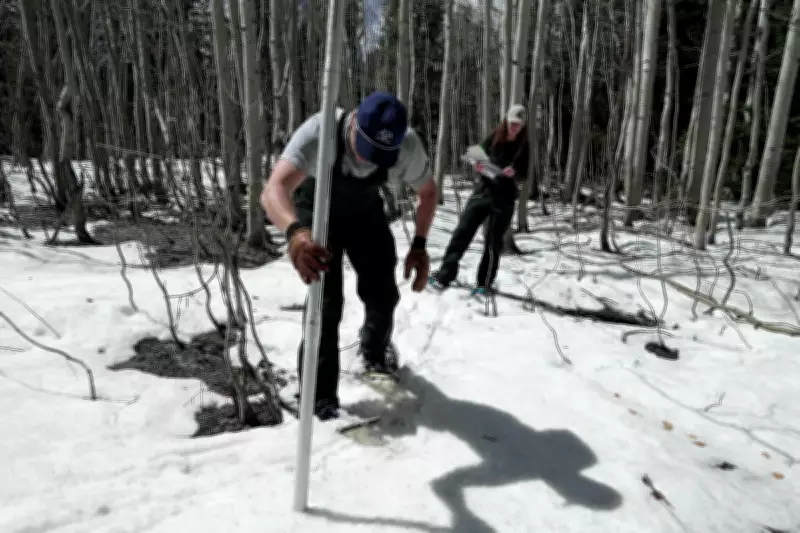
Maureen Gutsch, a hydrologist with the U.S. Department of Agriculture's Natural Resources Conservation Service, trudged through mud and slush to document the bleak conditions. Despite sunny, 56-degree weather, she described the findings as "slightly depressing." The snow is vanishing from all but the highest elevations, a clear indicator that water shortages could worsen the ongoing significant drought unless an unexpected deluge occurs.
Field assessments concluded late Tuesday revealed the dismal state of the snowpack, prompting concerns from cities to ranches. With a warm winter giving way to early springtime record heat, the region faces mounting challenges.

Agricultural Impacts and Ranchers' Struggles
Ranchers in Colorado's scenic mountain valleys near the Continental Divide are among the first to feel the drought's effects. Philip Anderson, a retired teacher and lifelong rancher in North Park valley, noted, "I've never seen it so warm so early and no snow all winter long." At an elevation of 8,100 feet, his pastures typically retain a foot of snow until spring, aiding grass growth and refilling stock ponds.
This year, however, cows are grazing grass prematurely, and several ponds are dry. Anderson's water ditch from the nearby Illinois River is also dry, as neighbors with senior water rights have tapped it first. He recalled having to haul water in 2002, a year he sold off his herd, and fears a repeat.
Jo Stanko, who ranches on the Yampa River, faces similar woes. Low flows allow cattle to wade across the Colorado River tributary, requiring roundups, and she has been watering her meadow earlier than ever in 50 years. Stanko plans to cut hay before June and may buy hay soon, noting, "Hay's always a good investment, you know, because it might be really expensive."
Water Rights and Interstate Disputes
The old Western saying, "whiskey's for drinking and water's for fighting over," rings true as scarcity intensifies amid a decades-long drought driven partly by human-caused climate change. Upper Basin states—Colorado, New Mexico, Utah, and Wyoming—remain at an impasse with Lower Basin states—Arizona, California, and Nevada—in negotiations for new water management rules during shortages.
Time is running short, with current rules expiring in September. Becky Mitchell, Colorado's River negotiator, emphasized that Upper Basin states already use far less water than entitled, honoring senior rights dating to the 1880s. "When there is less, we use less. This is not voluntary and no one gets paid as a result," she said.
After missing multiple federal deadlines, both sides are hiring more lawyers in anticipation of potential court battles.
Urban Water Restrictions and Conservation Efforts
Following the driest and warmest winter on record, cities are implementing cuts. Salt Lake City announced a 10% daily reduction in water use, voluntary for residents but mandatory for large nonresidential users. Denver Water approved limits on lawn watering, aiming for a 20% cut, with officials urging even less usage.
Nathan Elder, water supply manager for Denver Water, stated, "We're 7 to 8 feet of snow short of where we need to be. It would take a tremendous amount of snow to recover at this point, so it's time to turn our attention to preserving what we have." Denver relies on mountain snow from both sides of the Continental Divide, with tunnels diverting half its water from western snow-fed streams.
Wildfire Risks and Weather Patterns
Hot, dry conditions elevate wildfire threats. Denver set a new March high temperature record of 87 degrees, breaking the previous record of 85 degrees set just a week earlier. In California, Sierra Nevada snowpack measured only 18% of the average for this time of year.

Forecasters expect fire risk in the Rockies to rise as above-average temperatures and below-normal precipitation persist into summer. While cooler, damper weather offers a temporary reprieve, Anderson stressed the need for sustained rainfall—half an inch every other day for several days—to alleviate the drought.
He called for cooperation among water-rights holders, saying, "It's pretty serious. If we just talk and communicate together and cooperate, we might be able to make it through this. But we'll see."
Contributions from Amy Taxin in Santa Ana, California, are acknowledged. The Associated Press' climate and environmental coverage receives financial support from multiple private foundations, with AP solely responsible for all content.