
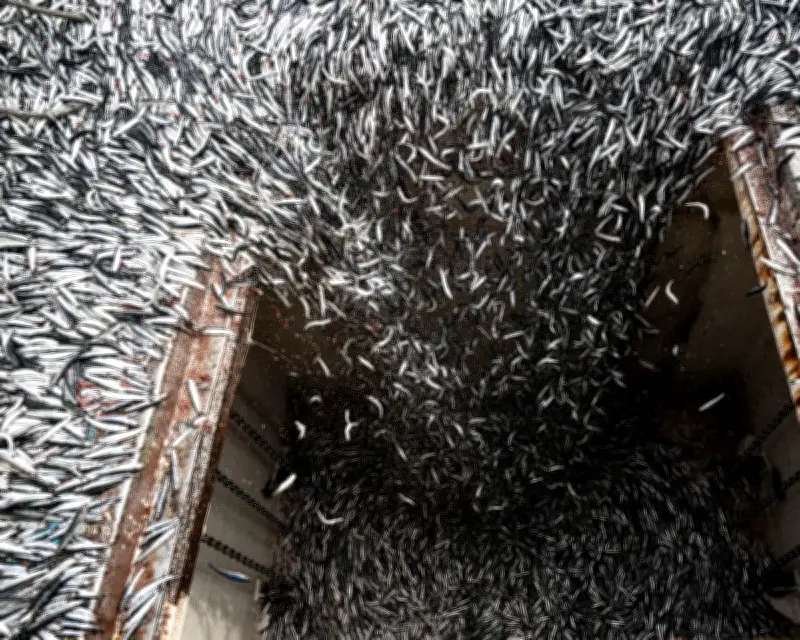
On 10 June 2026, the government of Peru stopped all anchoveta fishing boats from going out to sea, suspending the fishing season. At first the order was temporary, but in mid-August, the suspension turned into a total closure. The decision was a brutal blow to the Peruvian economy.
Peruvian anchovies – the scientific name is Engraulis ringens – are not the salty, punch-packing little fillets in a puttanesca sauce or caesar salad dressing. That is a different species – Engraulis encrasicolus – which is smaller, tastier and found mostly in the eastern Atlantic and the Mediterranean. Only a small part of Peru's anchoveta catch is eaten in fish form. The rest – more than 90% – is immediately processed as fishmeal and fish oil, packed in sacks and barrels, and shipped to fish, shellfish and seaweed farms, factory farms and nutritional supplement producers around the world.
A fish that feeds the world
The vast majority of the anchoveta industry is concentrated off the coast of north-central Peru, and it is hard to overstate how economically significant this fish is. By weight, Peruvian anchoveta have made up about a 10th of the entire global commercial fishing catch since 1970, more than any other fish. Some years, the anchoveta catch is worth close to $3bn and directly employs almost 50,000 people, close to a quarter of a million if you include indirect jobs. The Peruvian central bank is forecasting a 30.7% contraction for the fishing sector and about 78,000 job losses in 2026, and another 44,000 in 2027.
The ripples will be felt far beyond Peru's borders. The country is by a long way the world's most important exporter of fishmeal – a crucial input to aquaculture and livestock agriculture virtually everywhere – and prices are skyrocketing as a result. This anchoveta closure will have a direct impact on jobs, food supplies and supermarket prices the world over. Peru's then minister of production, César Quispe Luján, defended the decision as the only one possible: “The government has the responsibility to manage marine resources based on scientific criteria, timeliness and a long-term vision. When there is a need to strengthen conservation measures, it is necessary to act with prudence and responsibility to ensure the sustainability of the fishery.”
El Niño and the Humboldt current
When the June suspension was announced, the fishing boats had already been back in port for weeks. At the start of the season, in early April, Peru's ministry of production had set a total allowable catch of 1.9m tonnes. But in May, it closed the fishery for 15 days, with only 24% of the quota harvested. When the closure was extended to a full shutdown, there were even hints there would be no second fishing season this autumn. The main concern of the Instituto del Mar del Perú, which recommended the closure, was the risks already posed by this year's El Niño, and a fear of what is to come.
We are heading into what global climate models forecast as the most severe El Niño since the 1880s, the earliest for which we have accurate records. The super El Niño that is developing “may end up the strongest by a truly mind-blowing margin,” said climatologist Zeke Hausfather in July. Peru's anchoveta population was already down before the suspension of fishing. We cannot know how the anchoveta would have fared in the absence of El Niño, but we know that its presence makes things considerably more volatile. The warmer waters produced by El Niño threaten the plankton on which anchoveta feed, which in turn threatens the anchoveta population.
Most years, the Humboldt current, which flows north along the west coast of Chile and Peru, produces the most fertile fishing grounds on Earth. The current generates massive upwellings of deep colder waters that bring nutrients up from the depths, creating some of the most biologically productive zones in the ocean. This extraordinary biological abundance astounded the first Europeans who witnessed it. Islands piled tens of metres deep with the guano of innumerable birds feeding on sea life; the ocean boiling with million-tonne anchovy and sardine shoals; tuna, bonito and mackerel virtually leaping from the water. By comparison, today's Humboldt current system is much impoverished – industrialised extraction has taken its toll – but even so, it remains exceptionally productive. Intensive commercial fishing continues, and the most intensive of all is for Peruvian anchoveta, 6in (15cm) flashes of big-eyed, blue-backed silver.
Overfishing and volatility
In an average year, Peru produces 20% of the world's fishmeal. But that word “average” obscures the extraordinary volatility of the anchoveta catch in the decades since the fishery was fully commercialised after the second world war. In 1970, Peru landed more than 12m tonnes of anchoveta. In 1973, the catch fell by 88%. The shock of this stock collapse was so existential for Peru that the military dictatorship introduced the first regulatory regime for the anchoveta fishery. In 1984, the catch plummeted again, to less than 100,000 tonnes, a fraction of what it had been 15 years earlier. The catch recovered in 2000 to about 9.6m tonnes, but has declined since then. Recent annual catches have been in the 2m-4m tonne range.
Overfishing has played a crucial role in this ecological and economic rollercoaster ride. But the crazy seesaw of the anchoveta fishery is not merely a tale of rapacious industrial extraction, but of how overfishing combines with the bouts of accelerated oceanic warming driven by El Niño, which always hit Peruvian coastal waters especially hard. El Niño (“the little boy”) is the name that fishermen four centuries ago gave periods of unusually warm water off the coast of western South America. It is so named because the episodes usually reach their peak towards Christmas.
During El Niño events, the trade winds weaken and atmospheric pressure builds up over the coasts of Asia. As a result, the higher-temperature water spreads eastwards. With milder El Niño events, it reaches into the central Pacific, south of Hawaii, but in stronger phases it piles up off equatorial South America. Warmer water, much less hospitable to anchoveta, is driven south along the coast into the Humboldt current system, sometimes as far as Lima, Peru, 12 degrees south of the equator. There it sits at the surface, pushing the colder water into the depths and severely limiting the upwelling flows that bring nutrients to the upper layers of the ocean.
For the anchoveta and everything above it in the food web, the result is a disaster. The warm surface waters have the devastating double effect of shrinking the area of the ocean in which the anchoveta find suitable habitat, and robbing them of their main food source, the plankton that depend on the nutrients carried by upwelling. Anchoveta populations shrink, sometimes dramatically; birds starve, predators higher up the food chain that rely on anchoveta scatter or die; and there are a lot fewer fish for the fishing fleet to catch.
Regulation and the future
Every massive crash in the anchoveta fishery is the consequence of a severe El Niño event hitting already intensely exploited stocks. The climate crisis increases ocean temperatures and acidification, all of which is bad for most marine life, anchoveta included, and further exacerbates the situation by intensifying El Niño. In its latest report on the state of the world's marine fisheries in 2025, the UN Food and Agriculture Organization deemed more than a third to be overfished, meaning harvests exceed the rate of reproduction. Though the report classifies most of the anchoveta stocks in Peru as “maximally sustainably fished”, it is worth remembering that calling a fishery sustainable does not take account of the fact that populations are at historically low levels – and, since the onset of industrial fishing, are more vulnerable than ever before.
In contrast to Newfoundland, Peru's fisheries managers decided to protect the anchoveta population, despite pressure from an industry that has a lot of sway with the government and is increasingly concentrated in the hands of massive corporations, foreign and domestic. (In November 2024, the Canadian conglomerate Cooke Incorporated paid $1bn for Copeinca, the largest anchoveta firm in Peru. Cooke now controls a sixth of Peru's anchoveta fishery, and a fifth of its meal and oil processing.) Corporate power like that doesn't take massive revenue losses lying down. When the government delayed the start of the fishing season in 2023, the CEO of an anchoveta conglomerate moaned that regulators were “lost in a sea of ignorance”, creating an existential crisis for an industry that was “fighting to survive”. At that point, the ministry budged a little, and temporarily reopened the fishery. This year, it held firm: “Sustainability takes precedence over any short-term decision,” Juan Carlos Requejo, the minister of production, said in mid-August.
The stakes are enormous. Peru's fisheries sector contracted by almost 75% in June and July, and fishmeal production is plummeting just as prices have skyrocketed to almost $3,500 a tonne, more than twice what they were at the same time last year. The same is true of all the fisheries for high-value species that prey on anchoveta: the bonito, jack mackerel and the rest of the bigger torpedo-shaped beauties that bring in premium prices.
The privatisation of the Peruvian anchoveta fishery began in 1992 and culminated in the introduction of a vessel quota system under the guidance of the World Bank in 2009. The creation of private property rights in the fishery has had complex repercussions, not least the increasing marginalisation and impoverishment of tens of thousands of smaller-scale fishers and their communities. Almost all the anchoveta catch is controlled by a collection of wealthy boat owners and big firms with close ties to the state.
Monitoring is continuous, sophisticated and data-driven. The idea is to operate a sensitive, real-time regulatory regime based on the assumption that there is no longer any such thing as “normal” – and there isn't. Every day of the anchoveta season, Peru's ministry of production pays close attention to scientists' advice and is ready to step in, not just to end the season altogether but to make tweaks on the fly, for example ordering temporary closures of local fishing zones.
In August, the ministry declared a national fisheries and aquaculture emergency, which included launching a marine survey, Operation Eureka LXXVIII, to undertake an intensive stock assessment coordinated with the largest vessel owners. The outcome has not yet been officially announced, but in early October, Diario de Chimbote, the newspaper of Peru's main fishing port (one of the largest in the world), reported that 2026's second season will be cancelled entirely: the water is too warm, forcing the anchoveta in deeper and closer to shore, and the risks to juveniles are too great. Though this decision has not been confirmed, if it goes ahead, the closure is expected to cost Peru's economy about $1.4bn. As Jessica Luna, president of Peru's National Fisheries Society, an industry organisation, put it, the sector is “in the ICU”.
Prior to these most recent calamities, many industry observers have noted that by some measures, Peru's management of fish populations is a remarkable success story, all the more impressive in light of the way that multinational capital often gets what it wants in similar situations. In the past 20 years, the see-sawing catch numbers that plagued the industry for so long has declined considerably. But so too have average harvests, and the trend is decidedly downward. In the midst of what has been called a “Godzilla” El Niño, it is worth reconsidering what counts as success in a world in which crisis has become normal. Is the goal just a slightly slower road to the same destination?
So far, despite everything, the anchoveta keep coming back, albeit in drastically diminished numbers compared with a few decades ago. It does sometimes seem as though they can survive whatever we throw at them, and their persistence can easily be mistaken for indestructibility. But there are limits to the robustness of any species or natural system. The fact that we don't know where those limits are doesn't mean they aren't there, and as we push the anchoveta, and so much of the planet, we inevitably press upon fragilities we never knew were there, sometimes because until very recently they probably weren't. Many of our leaders would have us believe that we can continue as before, but we have never been here before, and we need to proceed with modesty and care. Often, you only recognise a threshold once you have crossed it.




