Scientists Uncover Origins of Antarctica's Mysterious 'Gravity Hole'
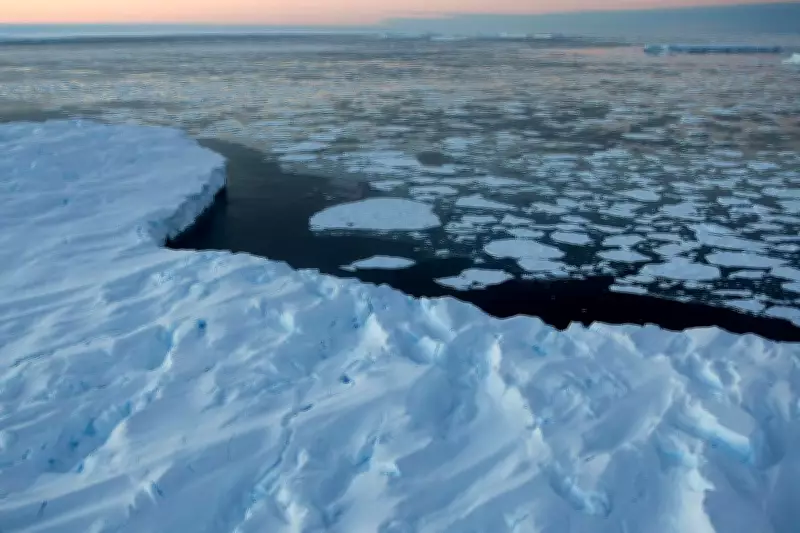
Researchers have finally deciphered the origins of a "gravity hole" beneath Antarctica, a region where Earth's gravitational pull is at its weakest. While gravity is often perceived as uniform globally, its strength actually varies significantly across different areas. This weaker gravity in Antarctica has profound effects on the oceans, causing water to flow toward zones with stronger gravitational forces, thereby lowering the continent's sea level compared to what it would otherwise be.
How Mantle Movements Shape Gravity
Gravity diminishes in regions where hot rock from the Earth's mantle ascends toward the surface. Over millions of years, these slow, deep-seated rock movements have culminated in the formation of the so-called "gravity hole" in Antarctica. The study, published in the Scientific Reports journal, investigated how alterations in Antarctica's gravity may have triggered significant climatic shifts in the region. It lays a foundation for future research into how evolving gravity patterns could have fostered the expansion of the continent's vast ice sheets.
Professor Alessandro Forte of the University of Florida, a co-author of the study, emphasized the importance of this discovery: "If we can better understand how Earth's interior shapes gravity and sea levels, we gain insight into factors that may matter for the growth and stability of large ice sheets."

Mapping Earth's Interior with Earthquake Data
To assess the development of the Antarctic gravity hole over millions of years, researchers created a gravitational map of the planet. They integrated earthquake recordings with physics-based modeling, a method that professor Forte likened to a planetary CT scan: "Imagine doing a CT scan of the whole Earth, but we don't have X-rays like we do in a medical office. We have earthquakes. Earthquake waves provide the 'light' that illuminates the interior of the planet." The resulting map aligned with gravitational data captured by satellites, validating the accuracy of their models.
Rewinding Geological History
Using computer models, scientists traced the flow of rocks within Earth's interior back as far as 70 million years ago, during the age of dinosaurs. They found that the gravity hole was weaker around 70 million years ago but began strengthening approximately 50 to 30 million years ago. These timelines coincide with major transformations in Antarctica's climate system, including the emergence of extensive glaciers across the continent, hinting at a potential causal relationship.
The study, titled 'Cenozoic evolution of Earth's strongest geoid low illuminates mantle dynamics beneath Antarctica', underscores the intricate connections between Earth's internal processes and surface phenomena. By unraveling these dynamics, researchers aim to enhance predictions about future climate changes and ice sheet behavior in polar regions.