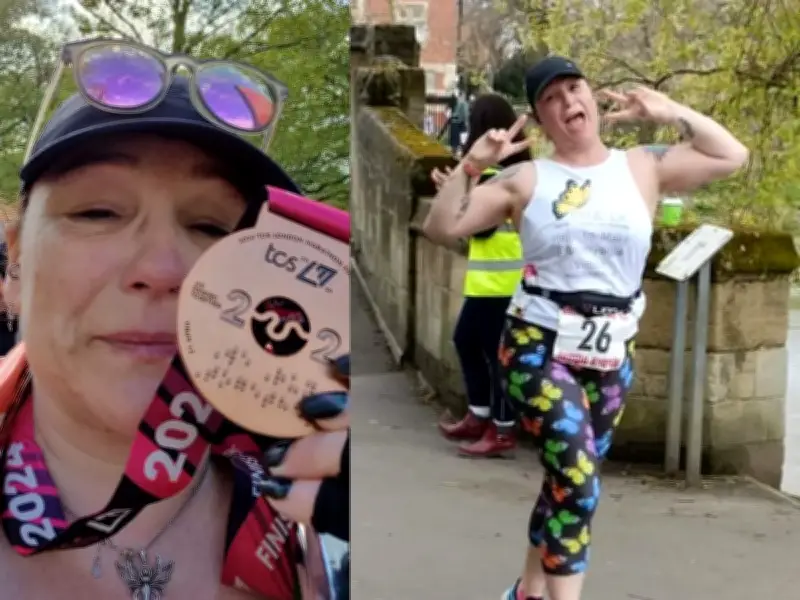
Charlotte Crane, 51, was diagnosed with fibromyalgia in 2018 after six years of struggling with full-body pain, headaches, neuralgia and brain fog. Despite her diagnosis, she was a keen runner who regularly took part in weekly Parkruns, races and even the London Marathon to raise money for Fibromyalgia UK. The 51-year-old found that exercise helped relieve her symptoms.
Diagnosis and adaptation
“Up until the diagnosis, it was mostly just frustration,” she said. “All over body pain, headaches, neuralgia, and fibro fog is one of the worst things, you feel your mind just disappearing. But I adapted.”
“The diagnosis made it a little easier because then I could kind of adjust myself. I knew what it was, I knew how I needed to look after myself, and I knew how I needed to advocate for myself at the doctor’s to get the right medications.”

Surgery and rapid decline
By the end of 2024 she began to find walking more difficult and underwent surgery in September 2025, which Charlotte hoped would relieve her pain and bring back her mobility. Tragically, the surgery had the opposite effect and the mother of three experienced a ‘rapid decline’ and now needs to use a wheelchair full-time, with doctors still unsure what is causing it.
Lottie was booked in for radiofrequency ablation on both sides of her sacroiliac joint, which connects the spine to the pelvis. The procedure uses heat from radiowaves to destroy nerve endings causing chronic pain, and Lottie had hoped it would solve her problems, but said that “unfortunately, it hasn’t”.
“It’s never a guarantee that it’s going to work, and the pain just became more and more and more,” she said. “I’ve ended up at the point where I can’t stand for long periods of time, can’t walk.”
Fundraising for a racing wheelchair
After almost a year of feeling “so low”, spending weeks at a time without leaving the house and being unable to take part in the sport she loves, Lottie, from Northampton, is fundraising to fix up a second-hand racing wheelchair so that she can get back to being able to exercise.
“I think people don’t realise that a lot of the time people with disabilities want to be active, they want to be able to get out there, and it’s just not physically possible or financially possible,” Lottie told PA Real Life. The estimate is it costs £10,000 more a year to be a disabled person than it would be to be able-bodied.
“(My) racing chair would have been £1,200 new, and then there’s everything that goes on top of that, all your accessories… You can’t just join a regular gym because there’s very few gyms that are actually wheelchair accessible.”
Lottie was lucky enough to find a second-hand Flying Start racing wheelchair, which she lovingly named Ophelia, but it needs some pricey work to be ready for her to use. Her fundraising will go towards fixing up the bike, which also needs an anti-tip bar adding, work done to the brakes, and a new set of wheels which can cost up to £500 for a set. She also needs to procure a helmet – “and you can’t go cheap with that because you can come out of those at quite a big speed,” she said – as well as a set of 3D gloves, as the chair is operated by the user ‘punching’ the wheels with their knuckles rather than pushing with their hands, and a pair of gloves costs upwards of £270.
“Once the chair is ready, I’m going to find a race for next year, and that’s what I’m going to train for,” Lottie said. “It is just such a huge boost to my mental health, knowing I am getting out of the house and I’m doing something. I’ve got something to work towards again.”