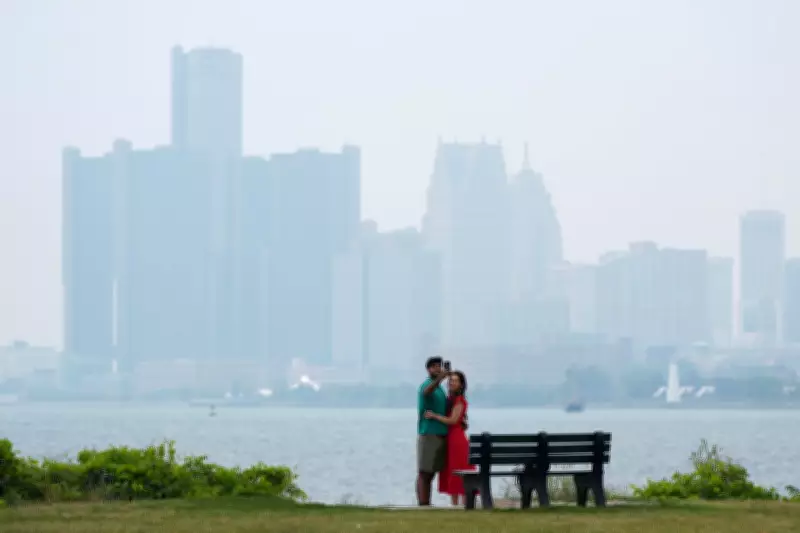
Michigan is implementing significant updates to its air quality alert communication system this year, responding to the severe impacts of Canadian wildfire smoke that blanketed Detroit in 2023 and 2025. The state aims to enhance public safety by issuing alerts more proactively as wildfire season approaches.
Streamlined Alert Thresholds
The Michigan Department of Environment, Great Lakes, and Energy (EGLE) is revising its protocol to issue air quality alerts whenever fine particulate matter or ozone levels reach the "unhealthy for sensitive groups" range on the federal Air Quality Index (AQI), also known as the orange category. Previously, alerts were reserved for the "unhealthy" red range, with advisories for orange levels.
Jim Haywood, a senior meteorologist with EGLE, explained that this change reflects the evolving challenges posed by severe smoke events. "Forecasting models are improving, but predicting smoke movement beyond 24 to 48 hours remains difficult," Haywood said. He highlighted the unpredictability of long-distance smoke, which may affect ground-level air quality or stay aloft.

Monitoring and Forecasting Tools
Residents are encouraged to use resources like the Environmental Protection Agency's AirNow webpage for 48-hour air quality forecasts and the EnviroFlash system for local alerts. Additionally, private networks such as JustAir and PurpleAir offer more localized monitoring data. For broader insights, FireSmoke Canada provides a multiday forecast map covering ground-level smoke across much of the U.S. and Canada.
Wildfire Outlook and Climate Factors
Brian Wiens of Canada Wildfire noted that while fewer fires are expected in Canada this year compared to last, the potential emergence of an El Niño pattern could heighten fire risks in western Canada by late summer. Drought conditions persist in provinces like Saskatchewan and Ontario, though recent storms have alleviated some areas.
In the United States, the National Interagency Fire Center forecasts significant fire potential in the South and Southwest during April and May, with increased risks in the West through June and July. Scott Stearns, a fire warning coordination meteorologist at the National Weather Service, attributed this to above-average temperatures and below-normal precipitation in the West, exacerbated by climate change trends over the past two decades.
"Drought and low precipitation could lead to a more active fire season through July," Stearns said, adding that a possible above-average monsoon in the Southwest might complicate predictions by promoting vegetation growth that later becomes fuel.
Health Risks and Protective Measures
Laina Stebbins, a spokesperson for the Michigan Department of Health and Human Services (MDHHS), emphasized the dangers of wildfire smoke, particularly for vulnerable groups like children, pregnant individuals, and older adults. "Exposure to higher pollution levels is linked to increased emergency visits, hospitalizations, and deaths," Stebbins stated.
Wildfire smoke contains PM2.5 particles, which are minuscule enough to penetrate lung cells and enter the bloodstream, contributing to cardiopulmonary illnesses and mental health issues. MDHHS recommends using air purifiers with MERV-13 filters, running air conditioning with closed fresh air intakes, and creating "clean rooms" for those without access to such equipment.
For outdoor exposure during heavy pollution, N95 or P100 respirators are advised, with KN95 and KF94 as alternatives. More detailed guidance is available in resources like Planet Detroit's wildfire smoke guide.
This report, originally published by Planet Detroit and distributed in partnership with The Associated Press, underscores Michigan's proactive steps to safeguard public health amid growing environmental challenges.